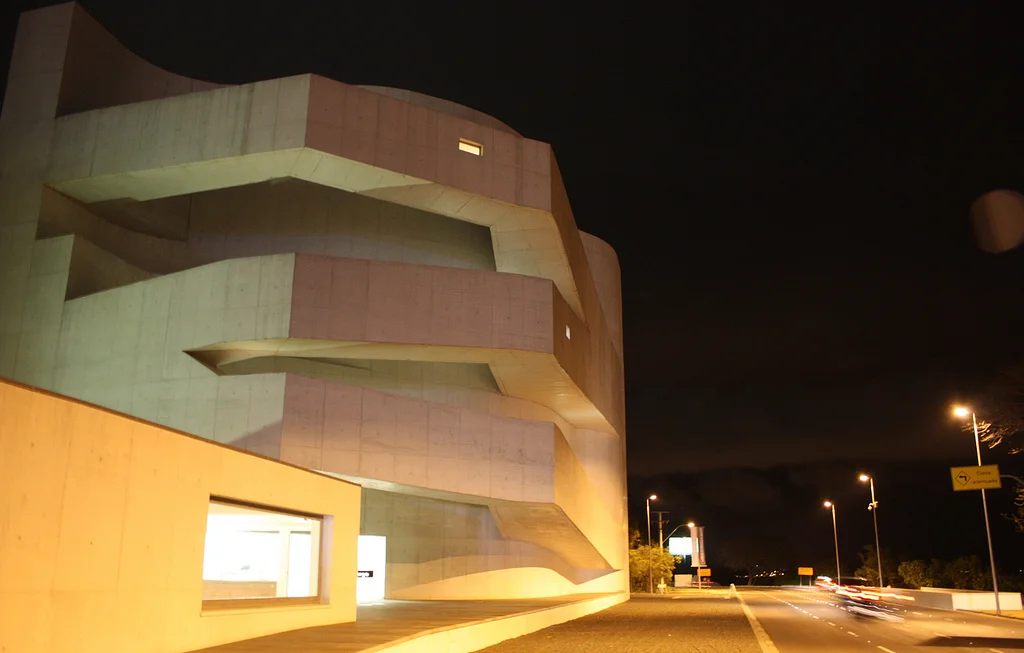

Iberê Camargo Foundation
From the road along the Guaíba, it looks almost like a cliff face that learned to fold. The Iberê Camargo Foundation in Porto Alegre is a sculpture you can walk inside, a tall block of luminous white concrete with curving arms that reach out from its sides and dive back in. It was the first building in Brazil ever made of white concrete, and it was designed by one of the most honored architects alive. The man it honors, though, was a painter who spent his life wrestling with darkness.
A Master's First Work in Brazil
The building is the work of Álvaro Siza, the Portuguese architect who won the Pritzker Prize, architecture's highest honor, and this museum was his very first project realized in Brazil. He set it on a difficult site - a narrow plot against a steep, vegetation-choked slope that had once been a stone quarry, right on the bank of Guaíba Lake. The design earned Siza a Golden Lion at the 2002 Venice Architecture Biennale years before it was even finished. When it opened in May 2008, Porto Alegre gained not just a gallery but a landmark, a piece of world-class architecture standing where workers had once cut rock from the hillside.
Ramps in the Light
Inside, Siza turned the simple act of moving between floors into the heart of the experience. A system of ramps, sloping gently at eight or nine percent, winds up through the building's tall central atrium and then breaks free of the walls entirely, looping outside as enclosed white galleries that curl around the main volume. As visitors climb, small openings and skylights puncture the concrete, releasing sudden glimpses of the lake and the sky before closing again. The effect is a slow, deliberate procession - light, then enclosure, then light again - that prepares the eye before it ever reaches a painting. The five-story building holds flexible exhibition halls, workshops, and an auditorium seating three hundred.
The Painter in the Name
All of it exists for Iberê Camargo, the Brazilian painter who lived from 1914 to 1994 and ranks among the country's most important modern artists. His later work was famously dark and physical, built up in thick, churning layers, his lone cyclists and distorted figures pressing toward an almost tragic view of human life. One motif followed him from childhood: the spool, the *carretel*, which he first knew as a toy improvised from the thread reels left over from his mother's sewing. In his hands those humble objects became recurring symbols, drifting from still life toward abstraction over the 1950s. The foundation was created in 1995, just one year after his death, to preserve and promote that body of work. Before this building rose, it operated humbly out of the artist's own former home elsewhere in the city. The institution's honorary president is his widow, Maria Coussirat Camargo, a direct human link between the man and the monument built in his memory.
More Than a Mausoleum
The foundation was never meant to be only a shrine to a single painter. From the start it set out to stir living debate about contemporary art, mounting exhibitions but also running courses, seminars, and gatherings that bring artists and audiences together. The white concrete galleries that loop toward the Guaíba have become a stage for new work as much as a vault for old, a place where the questions Camargo spent his life asking stay open. There is a quiet symmetry in the setting, too: this luminous building rose on the scar of an old stone quarry, a place once given over to cutting rock from the hillside and now devoted entirely to art. Standing on the lakeshore at dusk, with the pale mass glowing against the darkening water, it is easy to feel the rhyme between the architecture and the painting: both reach toward the light, and both keep circling back.
From the Air
The Iberê Camargo Foundation stands at 30.08°S, 51.25°W on the eastern bank of the Guaíba in Porto Alegre, the capital of Rio Grande do Sul. From the air it is best picked out by its waterfront setting along Avenida Padre Cacique, a bright block of white concrete against the broad silver expanse of the lake, with the dense city rising behind it. The Guaíba itself is the dominant landmark, a vast body of water that frames the whole southern edge of the city. The site lies only a few kilometers southwest of Porto Alegre's Salgado Filho International Airport (ICAO SBPA), the region's main gateway. The humid subtropical climate brings clearest visibility on dry, stable days; late afternoon light off the Guaíba is when the building glows most dramatically.
Nearby Stories
- São Leopoldo 14 km away
- Santa Cruz do Sul 74 km away
- Lagoa dos Patos 85 km away
- Aparados da Serra National Park 92 km away
- Torres, Rio Grande do Sul 125 km away
- 2009 Brasil de Pelotas Bus Disaster 146 km away
- Pelotas 192 km away
- Battle of the River Plate 427 km away