.jpg)
Canela, Rio Grande do Sul
The name means cinnamon. It comes from a tree, but it suits a town that runs on warm things in a cold place: mulled wine, hot chocolate, woodsmoke, and crowds bundled against the chill. Canela sits high in the Serra Gaúcha of Rio Grande do Sul, at 837 meters, far enough south and high enough up that snow occasionally falls here, a rarity almost anywhere in Brazil. People come for exactly that incongruity, a tropical country wearing a winter coat, and for the waterfall and the stone church that anchor one of the most visited corners of southern Brazil.
A Cathedral That Isn't One
Rising from the center of town is the building everyone calls the Catedral de Pedra, the Cathedral of Stone, even though it is technically not a cathedral at all. Its real name is the Church of Our Lady of Lourdes, and it is built in the English Gothic style, in pale stone that gives the whole structure a transplanted European gravity. Its tower climbs 65 meters, and inside it hangs a carillon of twelve bronze bells cast by the Giacomo Crespi foundry in Italy. At night during the Christmas season the church becomes the stage for light shows, the spire glowing above a town that has made the holidays into its signature. It is the photograph everyone takes home, the silhouette that means Canela.
The Falls in the Snail Park
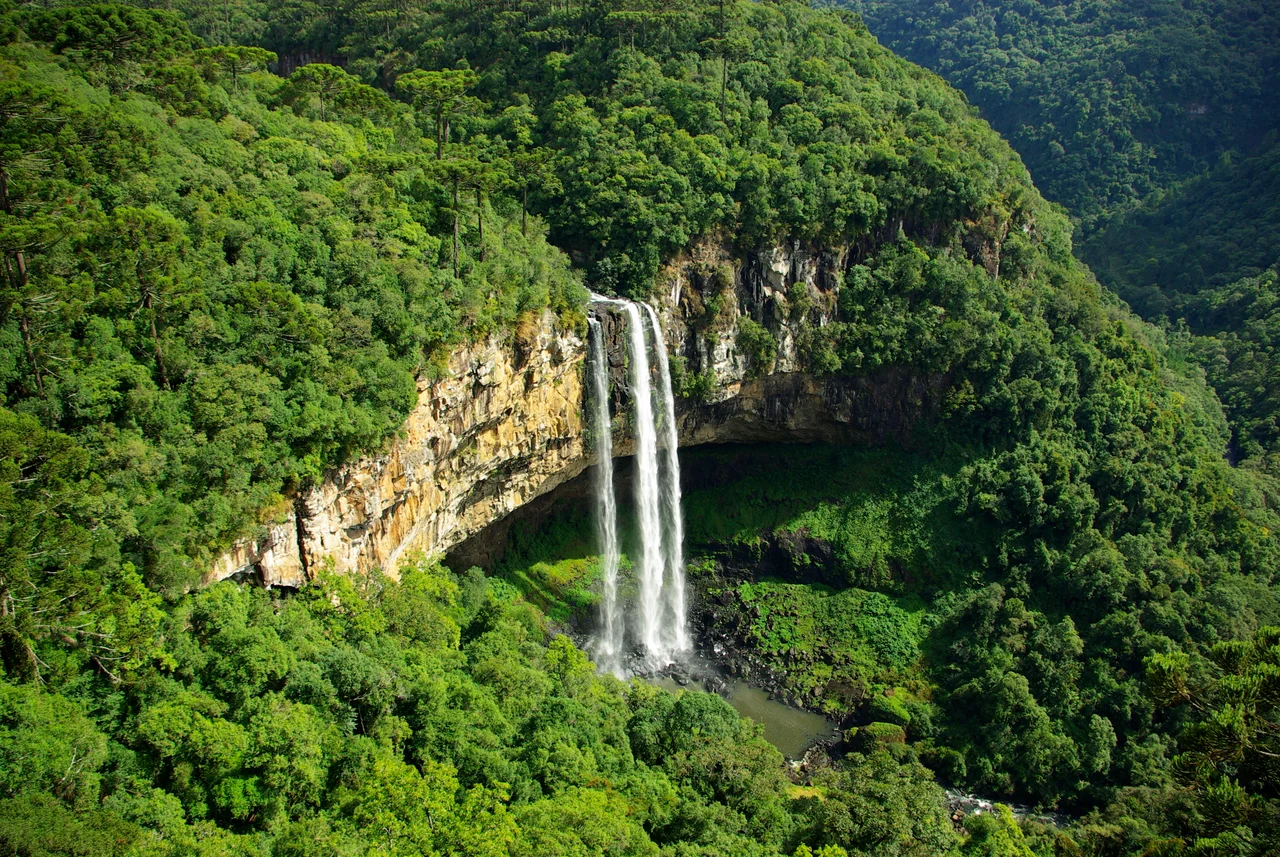
A few kilometers from town, the land simply drops away. At Parque do Caracol, the Caracol River pours over the edge of a basalt cliff and falls 130 meters in a single white plume into the forested canyon below. Caracol means snail, a nod to the spiraling shape of the gorge, and the falls are the reason the park exists. Visitors descend long staircases toward the base or take in the plunge from belvederes carved into the cliff edge, the spray drifting up through the Serra Geral's subtropical forest. It is the kind of landscape that makes the surrounding ecotourism obvious in hindsight: the hills around Canela are laced with trails for hiking, rock climbing, horseback riding, and rafting.
Winter, Lights, and a Staged Disaster
Canela leans into the cold the way other towns lean into the sun. Like its neighbor Gramado, just a few kilometers away, it draws its heaviest crowds in winter, when snow is at least possible, and at Christmas, when the town council strings it with lights and decorations and the whole place becomes a festival. It sits on the Rota Romântica, the Romantic Route that links the highland heritage towns. And then there is the curiosity: outside the Mundo a Vapor theme park, Steam World, the town has built a full-scale recreation of the 1895 Montparnasse derailment, the famous Paris accident where a steam locomotive burst through a station wall and hung nose-down over the street. In Canela, that improbable image is frozen in place as a roadside attraction.
A Young Town in Old Hills
For all its European stonework, Canela is young. Its first real settlement formed only in 1903, when Colonel João Ferreira Corrêa da Silva put down roots here, and the municipality itself was not created until the final days of 1944, taking effect on the first day of 1945. By 2018 it counted some 44,489 inhabitants spread across about 253 square kilometers of highland. It grew up fast and built deliberately for visitors, shaping itself around the waterfall and the church and the promise of cold weather. The cinnamon name is older than any of it, a small inheritance from the forest that was here first, kept by a town that turned a Brazilian highland into a place where it snows. Even its transportation tells the story of arrival: Canela has its own airport, shared with Gramado just down the road, and the steady stream of visitors it was built to receive is the engine the whole town runs on.
From the Air
Canela sits at 29.37°S, 50.82°W in the Serra Gaúcha highlands at an elevation of 837 meters (2,746 ft), immediately east of its twin town Gramado. From the air the two towns read as a near-continuous cluster of development on a high plateau, ringed by forested ridges and the deep canyon country of the Serra Geral, where the Caracol River's 130-meter falls cut through basalt just northeast of town. The 65-meter Gothic spire of the Cathedral of Stone is a useful visual landmark over the town center. Canela Airport (SSCN), shared with Gramado, lies about 3 km from downtown but has no scheduled service; the nearest airport with airline flights is Hugo Cantergiani Regional Airport (SBCX) at Caxias do Sul, roughly 40 km southwest, with Porto Alegre's Salgado Filho International (SBPA) about 115 km south. The high terrain attracts fog and low cloud, particularly on cool mornings, so expect reduced low-level visibility.
Nearby Stories
- Old Sanctuary of Our Lady of Caravaggio 1.9 km away
- Cambará do Sul 19 km away
- Garibaldi, Rio Grande do Sul 29 km away
- Aparados da Serra National Park 33 km away
- São Leopoldo 34 km away
- National Monument to the Immigrant 35 km away
- Santa Cruz do Sul 106 km away
- Battle of the River Plate 492 km away