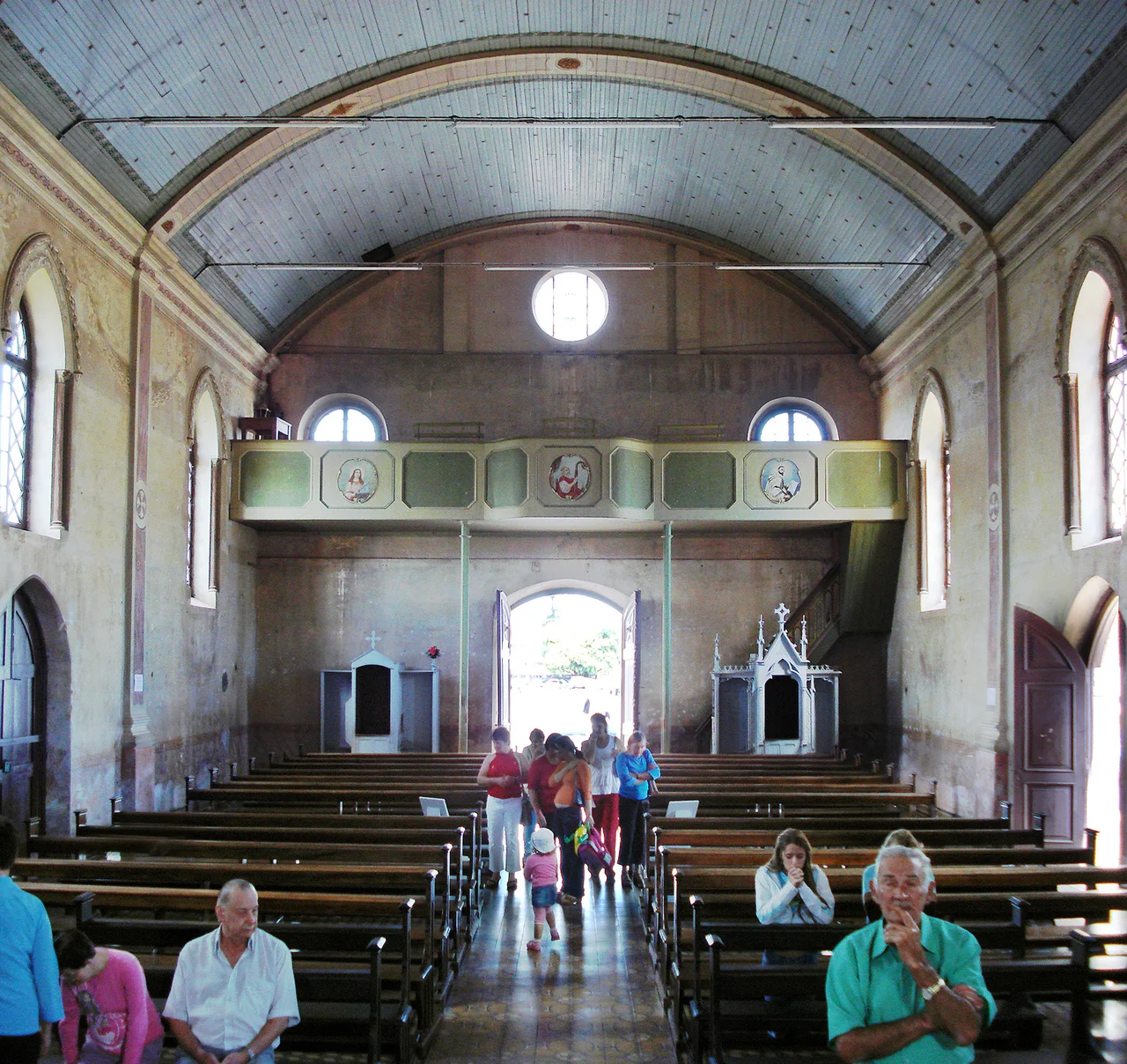

Old Sanctuary of Our Lady of Caravaggio
In 1876, a man named Natal Faoro packed a small religious engraving among his belongings and carried it across the Atlantic to the forested hills of southern Brazil. It was an image of the Virgin, a devotion he and his neighbors had brought from northern Italy, and at first there was nowhere to put it. The immigrants of Linha Palmeiro had no church. They prayed in their own homes. So two of them, Antônio Francischetti and Pasqual Pasa, built a chapel barely twelve square meters in size, and from that small wooden room grew a sanctuary that now draws pilgrims by the hundreds of thousands.
An Apparition Carried Across an Ocean
The devotion has deep roots in Italy. On 26 May 1432, in the countryside outside Caravaggio in Lombardy, a peasant woman named Giannetta de' Vacchi reported that the Virgin Mary had appeared to her while she cut hay. The vision became one of northern Italy's enduring Marian devotions, and when families from the Veneto and neighboring regions emigrated to the Serra Gaúcha in the late 1870s, they brought it with them. What had been a local Italian story became, on a different continent, the spiritual anchor of an immigrant community. In 1885 the settlers acquired a statue of the Virgin of Caravaggio from Pietro Stangherlin, an Italian sculptor living in nearby Caxias do Sul, and carried it to the chapel in procession. The pilgrimages began that day and never stopped.
Bricks From Improvised Kilns
A twelve-square-meter room could not hold a growing faith, and donations soon stretched it to seat a hundred. Then the community decided to build in masonry, and here the story turns practical and human. They had no brickworks, so they improvised pottery kilns and fired the bricks themselves, while keeping carved stone aside for the adjoining bell tower. The church was inaugurated in 1890, the date still inscribed on its facade. A clock built by Augusto Rombaldi was set into the bell tower in 1900. Every stage was the work of farmers who built their sanctuary the same way they built their farms: by hand, from what the land around them could provide.
A Chapel of Plain Lines and Quiet Art
The old chapel wears its modesty well. Its architecture mixes neoclassical and neo-Gothic touches, a triangle-over-square facade crowned by a pediment, a cross at the apex, slender fluted pilasters flanking a single door. Inside, two murals by the painter Cremonese depict healings attributed to the Virgin of Caravaggio, and ogival windows of colored glass throw light across a wooden half-dome ceiling. The old sacristy now holds something more telling than any artwork: ex-votos. These are the offerings left by people who came to ask for help and returned to give thanks, crosses and tokens and small testimonies of crisis survived. The room is full of them. Each one is a private story the chapel kept.
When the Faithful Outgrew the Walls
Devotion has a way of overwhelming the buildings meant to contain it. On 26 May 1921 the parish was raised to a diocesan shrine, with permanent clergy to organize the swelling pilgrimages, and in 1959 Our Lady of Caravaggio was declared patroness of the Diocese of Caxias do Sul. By 1963 the old church simply could not hold the crowds, and it passed its role as parish church to a far larger building beside it, one that seats around two thousand. The annual romaria, the pilgrimage, has become one of the most traditional in all of Brazil, drawing crowds into the hundreds of thousands. The little chapel, once the whole of the sanctuary, became its sacred heart.
What the Stone Remembers
In 2006 the state of Rio Grande do Sul listed the old sanctuary as a heritage site, recognizing what the bricks and murals and ex-votos preserve: the memory of an immigrant community that arrived with little and built belonging out of shared faith. A restoration led by Marinês Gallon ran from 2005 to 2012, and the temple now holds an audio system that recounts the 1432 apparition in Italy and the history of the shrine. Some 140 families and seven smaller chapels still gather around it. The engraving Natal Faoro carried across the ocean is long since outshone by everything it set in motion, but the chapel he and his neighbors built still stands inside the larger one, the original answered prayer.
From the Air
The Sanctuary of Our Lady of Caravaggio sits at 29.17°S, 51.35°W on the outskirts of Farroupilha, in the Serra Gaúcha highlands east of Bento Gonçalves and west of Caxias do Sul, at roughly 700 meters elevation. From the air the complex stands out as a pair of large church structures on a prominent rise, the older stone chapel tucked beside the newer sanctuary, with a hilltop mirante (overlook) nearby. A viewing altitude of 3,000–5,000 ft AGL frames the site against the surrounding vineyard hills. Hugo Cantergiani Regional Airport (SBCX) at Caxias do Sul lies only about 15 km northeast; Porto Alegre's Salgado Filho International (SBPA) is roughly 110 km south. Highland fog is common on winter mornings, so plan for haze at low level early in the day.
Nearby Stories
- Festival de Gramado 10 km away
- Caracol State Park 27 km away
- Nova Petrópolis 38 km away
- Santa Cruz do Sul 56 km away
- Passo Fundo 73 km away
- Serra do Rio do Rastro 147 km away
- Paleontological Sites of Santa Maria 184 km away
- São Joaquim National Park 207 km away