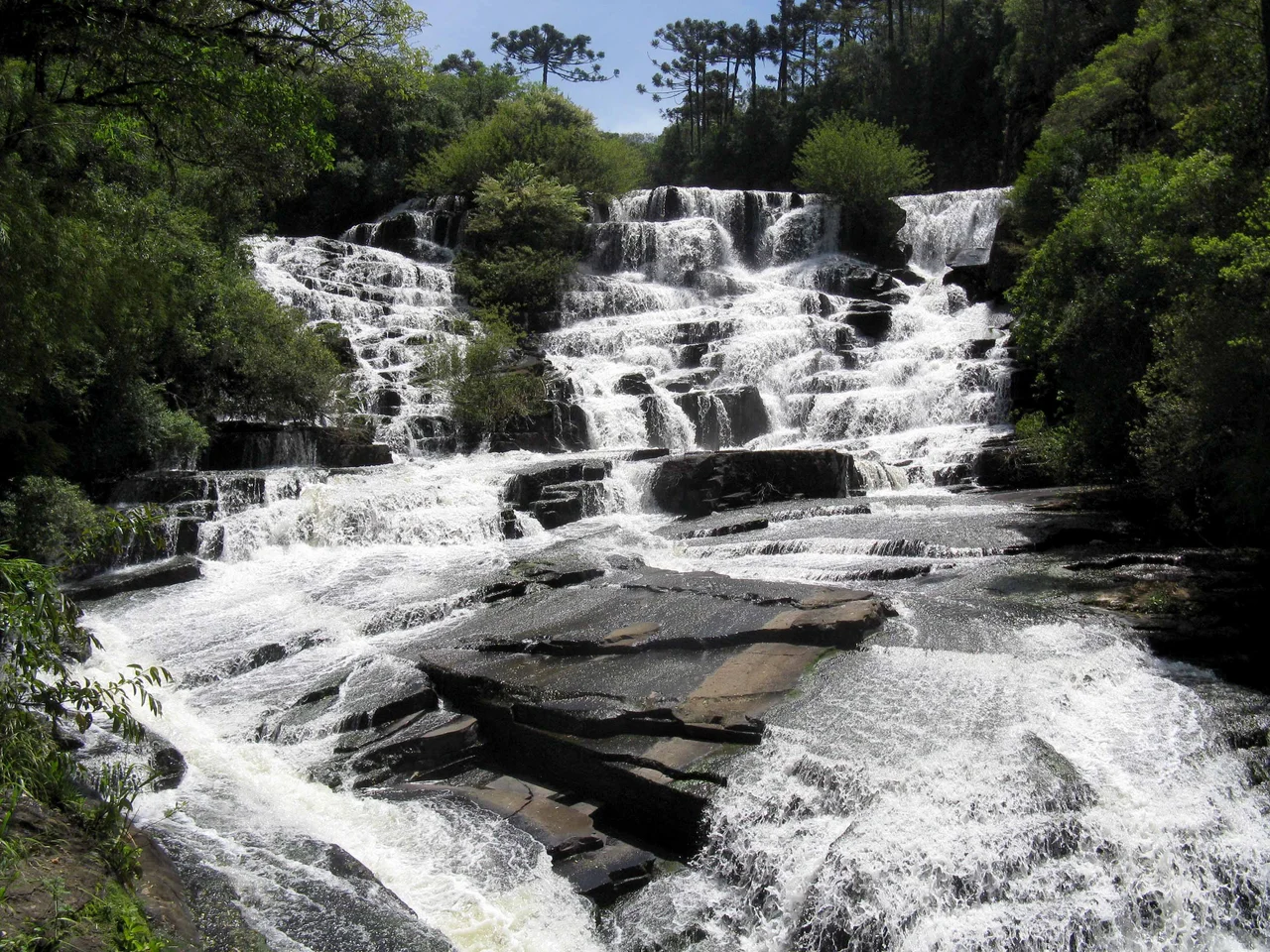

Caracol State Park
The Arroio Caracol runs quietly through the araucaria forest until, without much warning, the ground simply ends. The stream pours over the edge of a basalt escarpment and drops 131 meters in a single unbroken plunge, scattering into mist before it reaches the valley floor. This is the Cascata do Caracol, and the small state park built around it has become one of the most visited places in all of southern Brazil - a waterfall so striking that millions come each year just to stand and watch it fall.
The Cinnamon Tree and the Wassen Family
Long before tourists, the Kaingang people lived in this part of the Serra Gaúcha, gathering fruit and seeds and hunting through the forest. The first European explorers left their own mark in a name: they called the region Canela, the Portuguese word for cinnamon, after a caneleira tree under which they made camp. In 1863 the Wassen family arrived from Germany and began farming and raising livestock on the highland. The climate was pleasant, the canyons and waterfalls beautiful, and by 1900 - before the town of Canela itself existed - vacation homes had begun to appear. An old house the Wassens built of araucaria pine still stands within the park.
Wounds in the Forest
Prosperity nearly destroyed the place. When the railway reached the region in 1924, a logging industry tore into the vast araucaria forests that had stood for centuries. A pulp mill rose beside a tributary of the Arroio Caracol, fouling the water that crosses the park. The forests fell, the streams soured, and the tourists who had come for natural beauty drifted away. Animals were driven out too, among them the maned wolf, hunted on the false belief that it preyed on cattle. The state finally intervened, declaring the land of public utility in 1954 and establishing the Caracol State Park in 1973. The araucaria are returning now, slowly, some old survivors near the escarpment still bearing trunks a meter and a half across.
927 Steps to the Bottom
There are gentler ways to meet the falls, and one demanding one. Two belvederes offer views from the rim, and a glassed-in platform reached by elevator juts 27 meters over the drop for those who want the void beneath their feet. A cable car with closed cabins, imported from Switzerland, swings out for a panoramic sweep of the whole cascade. But the most honest encounter is on foot: a metal stairway of 927 steps descends to the base of the waterfall, where the air turns to spray and the full weight of 131 meters of falling water makes itself felt. The trail is unforgiving for anyone in poor condition, so a small train runs from the Sonho Vivo Station for those who would rather ride than climb. For everyone else, the descent and the long haul back up are their own reward, earned one step at a time.
A Forest Coming Back
The park is small - only about 25 hectares are state-owned - but it punches well above its size, drawing on the order of two and a half million visitors a year. After the Iguaçu National Park, it ranks among the most popular tourist destinations in southern Brazil, and the recovering forest must somehow absorb those crowds. Thirty species of mammals and around 130 species of birds have been recorded here, and thousands of seedlings have been planted to speed the regeneration of the araucaria canopy. Above the escarpment the vegetation is montane rainforest and araucaria forest; below it, submontane deciduous forest gives way to patches of grassland. Snow falls in July and August in this temperate highland, a rarity that draws Brazilians the way the waterfall does. Since 1991 the Loboguará Project has run environmental education from within the park, named for the maned wolf that hunting once erased from these hills. The forest that logging nearly took is, step by step, taking itself back.
From the Air
Caracol State Park lies in the municipality of Canela, Rio Grande do Sul, at roughly 29.31 degrees south, 50.85 degrees west, at an average elevation near 760 meters in the Serra Gaúcha. The nearest commercial airport is Hugo Cantergiani Regional Airport in Caxias do Sul (ICAO SBCX), with the larger Salgado Filho International Airport in Porto Alegre (ICAO SBPA) about 100 km to the south. From the air, look for the dark thread of the Arroio Caracol cutting through forested highland and dropping over a sharp basalt escarpment - the white plume of the 131-meter falls is the clearest landmark. The araucaria forest gives the plateau a distinctive flat-topped, umbrella-shaped canopy. Plan for frequent rain and mist; the falls run strongest after wet weather.
Nearby Stories
- Old Sanctuary of Our Lady of Caravaggio 11 km away
- Aparados da Serra National Park 19 km away
- São Leopoldo 42 km away
- Serra Gaúcha 44 km away
- Criciúma 95 km away
- Santa Cruz do Sul 108 km away
- Passo Fundo 134 km away
- Battle of the River Plate 511 km away