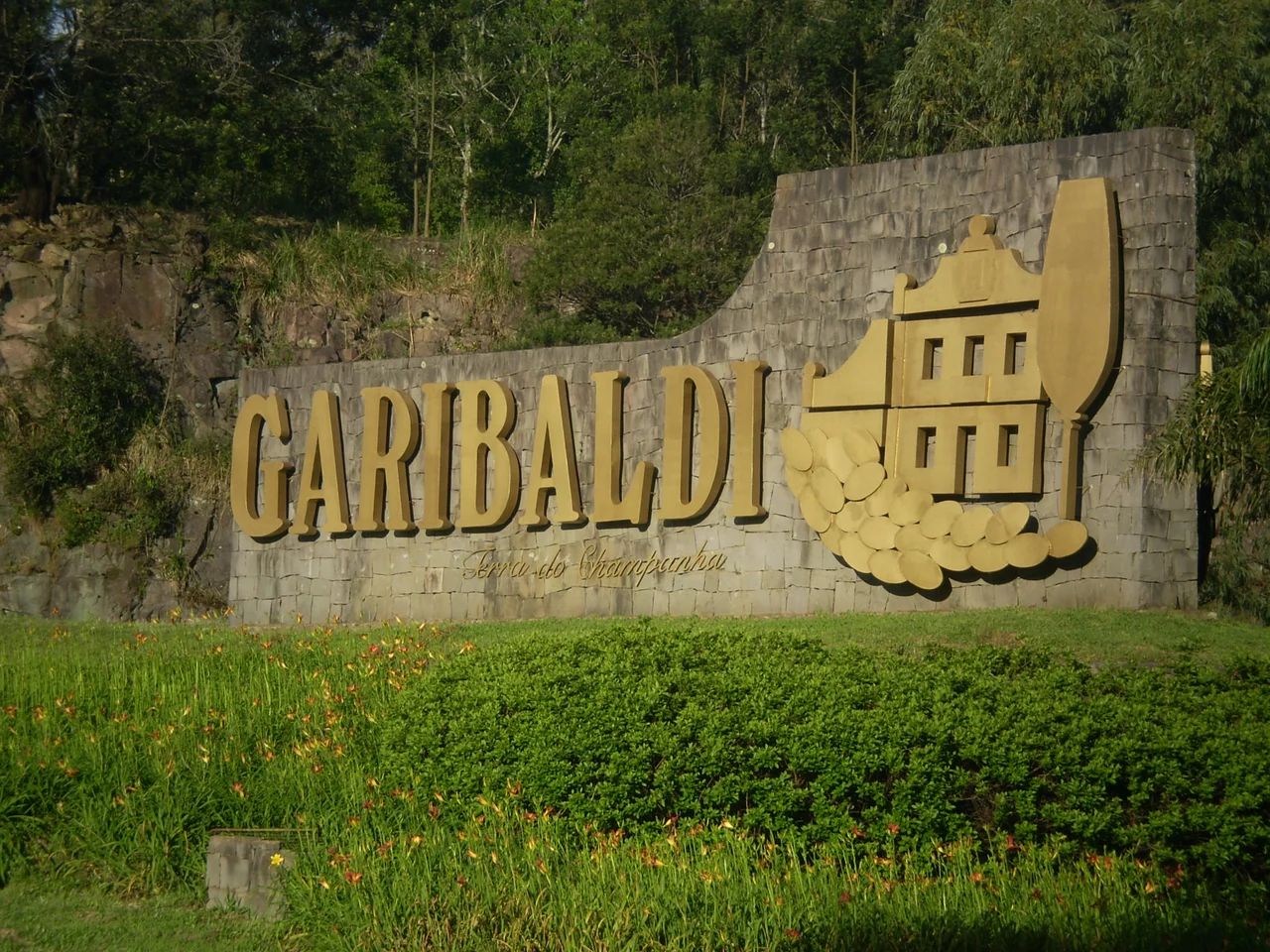

Garibaldi, Rio Grande do Sul
The bottles come out of the cellars with a sound this town knows well - the soft pop of a cork, the rush of bubbles. Garibaldi is the capital of sparkling wine in Brazil, and it earned the name the hard way, one harvest at a time, on steep green hills first planted by Italian immigrants who arrived with vine cuttings in their luggage. The town itself carries the name of a revolutionary: Giuseppe Garibaldi, the Italian who, decades before this colony existed, had ridden into these very southern lands to fight - and whose Brazilian wife, Anita, fought beside him.
A Colony for a Prince, a Name for a Rebel
The settlement began in 1870 as the Colônia Conde d'Eu, named for the French nobleman who had married Princess Isabel, heir to the Brazilian throne. The land was rugged and unwanted, and the government, unwilling to invest in roads, simply hoped European settlers could tame it themselves. The first arrivals, in July 1870, were Prussians. They lived by subsistence farming on terrible roads, joined over the next years by Swiss, French, Austrian, and Polish families. When the colony was finally raised to a municipality on October 31, 1900, it shed the prince's name for a fighter's. It became Garibaldi - honoring the man who, in the 1830s, had joined the Farrapos rebels of the Ragamuffin War in their fight for a southern republic, and his wife Anita, born in Brazil, who rode into battle at his side.
The Italians Who Brought the Vine
By far the largest wave of settlers came from Italy, most of them from the Veneto in the country's north, and this colony was the first nucleus of Italian settlement in the highlands of Rio Grande do Sul. A community of just 720 in 1875 was growing fast, and from 1890 the immigrants raised the stone houses and shops that still form the town's Historical Center today. With them came an inheritance more valuable than any deed: the grapevine. The hills here, too rugged for easy farming, turned out to be very good for grapes. Vineyards climbed the slopes, and wine wove itself into the fabric of the regional economy - the daily craft of families who had been making it for generations in the old country.
Where Brazil Learned to Make Bubbles
Still wine was only the beginning. In 1913 a Garibaldi immigrant named Manuel Peterlongo produced the first Brazilian sparkling wine, and two years later founded the winery that bears his name - the start of an entire national industry. The bubbles took hold. Garibaldi grew into the leading producer of sparkling wine in Brazil, its name now a byword for the drink itself. The town built a tourist route around it, the Rota dos Espumantes, where visitors move from winery to winery tasting the country's most celebrated sparkling wines and watching, cellar by cellar, how the bottles are made. A drink the world associates with France found a second home on these Brazilian hills.
An Italian Heart Beating in the South
Garibaldi feels, in many ways, like a piece of northern Italy transplanted to the Southern Hemisphere. Almost everyone in town descends from those immigrant families, and the culture they carried over the ocean still flavors daily life - the food, the festivals, the dialects, the devotion to the vine. The town's bond with Italy is formal as well as cultural: Garibaldi is twinned with Conegliano, a wine town in the Veneto, the very region most of its founders left behind. The connection runs both ways across more than a century and an ocean. The vineyards on the slopes, the stone houses in the old center, the bottles cooling in the cellars - all of it tells the same story of people who left one wine country and, with patience and bare hands, built another.
From the Air
Garibaldi sits at 29.26°S, 51.53°W, in the Serra Gaúcha highlands of northeastern Rio Grande do Sul, at an elevation around 613 meters. It lies within Brazil's premier wine region, the Vale dos Vinhedos area, near the larger town of Bento Gonçalves. The nearest major airport is Salgado Filho International (ICAO: SBPA) in Porto Alegre, roughly 110 km to the south. From the air the landscape is unmistakable wine country: steep green hills laced with the orderly rows of vineyards, dotted with red-roofed houses and small wineries tucked into the valleys. A viewing altitude of 3,000 to 5,000 feet brings out the corrugated terrain and the patchwork of vineyard plots draped across the slopes. The subtropical highland climate runs from summer highs near 33°C to winter lows that can dip below freezing; clear days reveal the full sweep of the Serra Gaúcha's folded ridges.
Nearby Stories
- Caracol State Park 13 km away
- Serra Gaúcha 25 km away
- São Leopoldo 43 km away
- Santa Cruz do Sul 43 km away
- Passo Fundo 90 km away
- Serra do Rio do Rastro 155 km away
- Paleontological Sites of Santa Maria 177 km away
- Lagoa do Peixe National Park 191 km away