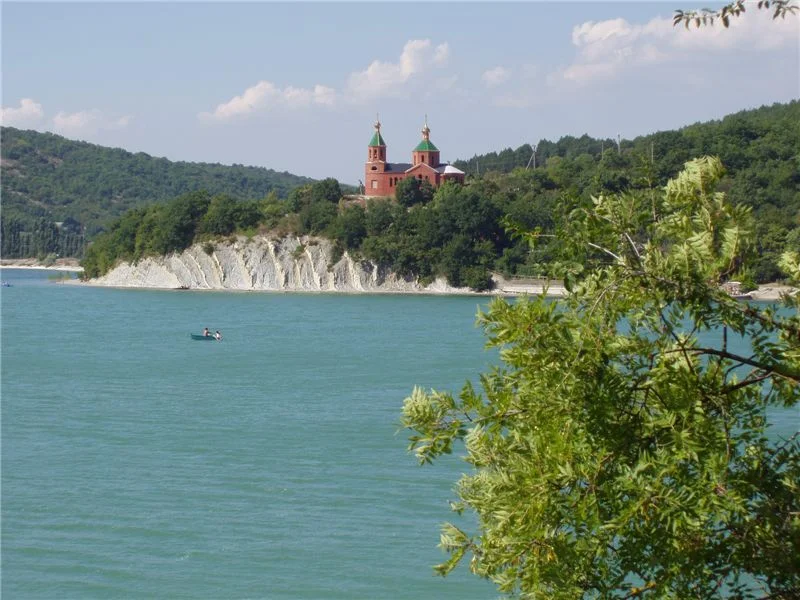

Lake Abrau
The name is a shrug and a mystery at once. Abrau comes from an Abkhaz word for 'sinkhole,' and staring at this long dark ribbon of water in the Caucasus foothills, you can see why the old namers reached for the idea of the earth suddenly opening. Cupped 84 meters above the sea among the folds of the Forecaucasus, just 14 kilometers from the Black Sea port of Novorossiysk, Lake Abrau lies still and outlet-less, holding its water with no visible way in or out. It is the largest lake in all of Krasnodar Krai, and yet how it came to be here is a question its own name only half answers.
Water Without an Exit
Lake Abrau is a karst lake - the kind that forms where soluble rock dissolves and the land collapses or drains in unexpected ways - and it behaves like one. It stretches roughly 2,600 meters long by 600 meters wide, a slender sheet of freshwater pressed between wooded slopes. Most striking is what it lacks: an outlet. No river carries its water onward to the nearby sea. What flows in stays in, balanced only by evaporation and seepage. That closed nature makes the lake feel self-contained and secretive, a body of water keeping its own counsel while the Black Sea churns just over the ridge. The exact story of its formation remains debated, one more thing the lake declines to fully explain.
A Lake Growing Shallower
Abrau is also, quietly, a lake in flux. In the early twentieth century observers measured its deepest point at about 35 meters. Today that maximum has shrunk to roughly 20 - a substantial loss of depth within a century, the kind of change that hints at shifting sediment, water balance, and the slow arithmetic of a lake with no outflow to flush it. For a body of water that looks so permanent from the shore, mirror-flat beneath the hills, it is a reminder that lakes are events as much as places: they arrive, they fill, they silt, they fade. Abrau is somewhere in the middle of that long story, still broad and beautiful, but not quite the lake it was a hundred years ago.
The Vineyards on the Rim
The basin that holds Lake Abrau is no ordinary wilderness. It is a major wine-growing region, its slopes threaded with vineyards, and along the lakeshore sits the village of Abrau-Dyurso with its cellars and wineries. There is a pleasing logic to it: the same karst hills and warm, southern-leaning climate that gave rise to a mysterious closed lake also cradle grapes remarkably well. Visitors come as much for the wine as the water - to taste sparkling vintages with the lake spread out below them, the vines climbing toward the ridgeline. Few lakes double as the centerpiece of a wine country. Abrau manages both, natural curiosity and cultivated landscape sharing the same quiet bowl in the hills.
Stillness in the Hills
To stand at Abrau's edge is to feel the particular calm of a lake that goes nowhere. There is no rush of an outflowing river, no busy shoreline traffic - just the dark water, the wooded Forecaucasus slopes, and the light shifting across the surface. The Black Sea and its ports lie close enough to reach in minutes, but here the mood is inland and hushed, a pocket of stillness held in the mountains. Whatever forces of dissolving rock and collapsing ground first made this hollow, they left behind something that reads less like geology than like a held breath: a lake named for the earth giving way, resting quietly above a sea it never joins.
From the Air
Lake Abrau lies at 44.70°N, 37.59°E, at about 84 m elevation in the Forecaucasus foothills roughly 14 km west of Novorossiysk. From altitude the lake reads as a distinct dark elongated oval - about 2.6 km long - set among pale hills, with the Black Sea and Abrau Peninsula just to the southwest. Nearest airports are Anapa (Vityazevo) Airport (ICAO URKA) and Gelendzhik (URKG).
Nearby Stories
- Soviet Destroyer Smyshlyony 13 km away
- Taman 29 km away
- Taman Peninsula 29 km away
- Soviet Hospital Ship Armenia 211 km away
- Battle of the Tanais River 251 km away
- Livadia Palace 262 km away
- Beriev 282 km away
- Abkhazia 292 km away