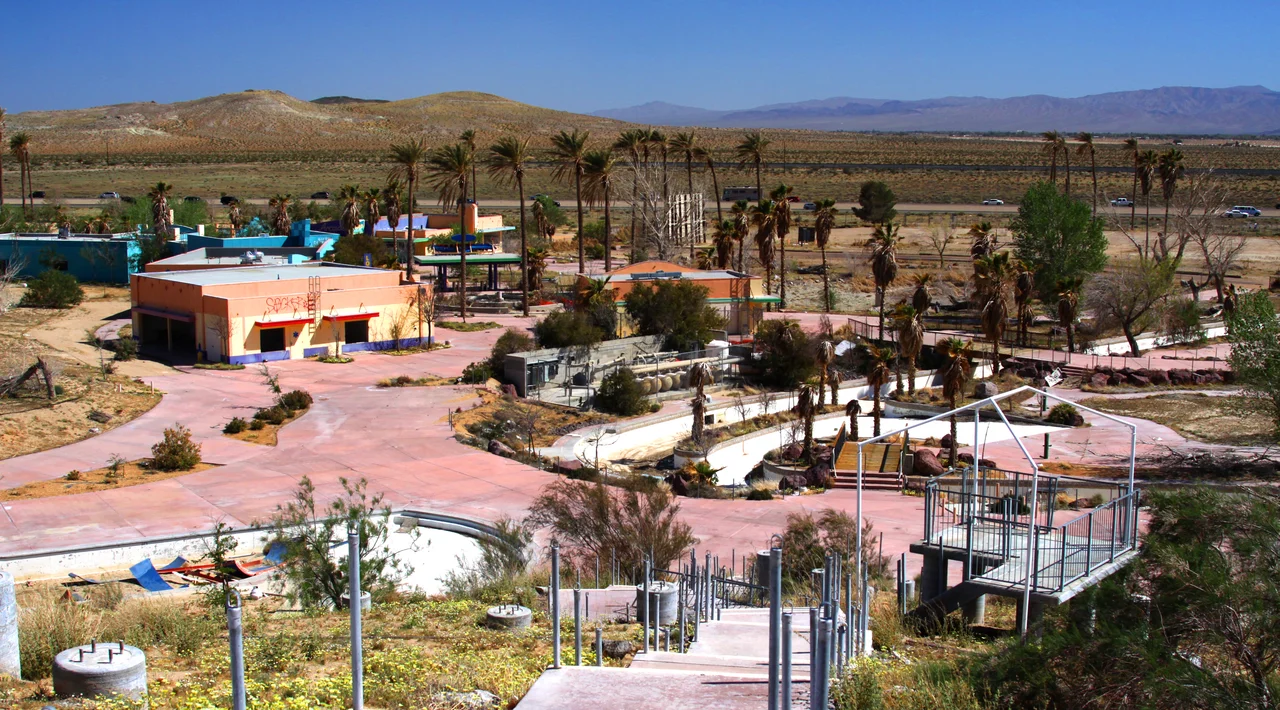

Lake Dolores Waterpark
Bob Byers didn't build Lake Dolores for the public. He built it for his family — digging the lake himself, constructing slides and facilities on a stretch of Mojave Desert off what would become Interstate 15, on land he owned east of Newberry Springs. The park was named for his wife, Dolores. When he finally opened it to the public in May 1962, something unexpected happened: people drove through the desert specifically to get wet in it. The Mojave, which had always been a place people drove through as fast as possible, had become a destination.
A Family Project Scaled Up
Byers had been building the lake and its attractions through the 1950s and early 1960s — a private project that grew into something more substantial than any backyard pool. The man-made lake covered 273 acres, an implausible body of water in a landscape that receives only a few inches of rain a year. He added waterslides, facilities, and the infrastructure needed to welcome visitors. In its peak years, the park employed up to 70 people from the surrounding area.
By the standards of desert tourism, Lake Dolores was a genuine phenomenon. Families drove out from the Inland Empire and the Los Angeles basin to spend a day in water in the middle of nowhere, which was exactly what Byers had improbably made possible. The park operated for decades, becoming a fixture in a region that had very few of them.
Rock-A-Hoola and the Second Act
The waterpark closed and reopened under the name Rock-A-Hoola on July 4, 1998 — a rebranding that tried to capture something louder and more nostalgic than the original name suggested. It was a reasonable bet. Waterparks were thriving elsewhere in California, and the site's isolation, once a liability, had become part of its character.
The second act didn't last. Rock-A-Hoola went bankrupt in 2000, and this time the closure was permanent. The rides stopped. The water drained. The desert, which had been kept at bay by maintenance crews and paying customers, began reasserting itself. What had been a working waterpark became something else entirely — a photogenic ruin where waterslides bleached in the sun and the empty lake bed cracked in the heat.
The Artists Who Came After
Abandoned places have a particular gravity for artists, and Lake Dolores proved irresistible. The Scottish electronic duo Boards of Canada used the site for their 2013 Tomorrow's Harvest debut — the decaying waterpark's visual vocabulary of faded optimism and desert entropy fit the album's mood exactly. Olivia Rodrigo filmed there in 2020. A BTS music video brought the site to a global audience in 2022.
Harrison Ford used the adjacent Amboy Airfield — one of California's earliest airports — when he visited the area. Brad Pitt filmed scenes from Kalifornia nearby in 1993. The pattern suggests something: this stretch of desert, which the closure of Route 66 and then the opening of I-40 had effectively bypassed, had found a second life as a backdrop for stories about isolation, nostalgia, and the strange beauty of things left behind.
What Remains
The waterslides still stand, their concrete and fiberglass weathered into soft grays and off-whites. The lake bed is dry. The facilities that once served thousands of visitors on summer weekends are empty. The park sits just off Interstate 15 — visible from the highway, accessible by those who seek it out, ignored by almost everyone else who passes.
It is a peculiar monument to ambition: one man built a lake in the desert for his family, opened it to the world, and created something that outlasted its usefulness by becoming beautiful in its abandonment. Bob Byers named it for his wife. The musicians who come here half a century later probably don't think about that. But the lake is still called Dolores.
From the Air
Located at 34.948°N, 116.687°W off Interstate 15 east of Newberry Springs in San Bernardino County. The dry lake bed and abandoned waterslides are visible from low altitude as a distinctive feature against the desert floor. Nearest airport: Barstow-Daggett Airport (DAG), approximately 25 miles west.
Nearby Stories
- Mojave Trails National Monument 20 km away
- Granite Mountains (Eastern San Bernardino County) 25 km away
- Giant Rock 36 km away
- The Trona Pinnacles: California's Most Alien Landscape 58 km away
- San Bernardino Train Disaster 60 km away
- Edwards Air Force Base 74 km away
- The 49ers of Death Valley: The Shortcut That Became a Deathtrap 124 km away
- MGM Grand Fire 131 km away