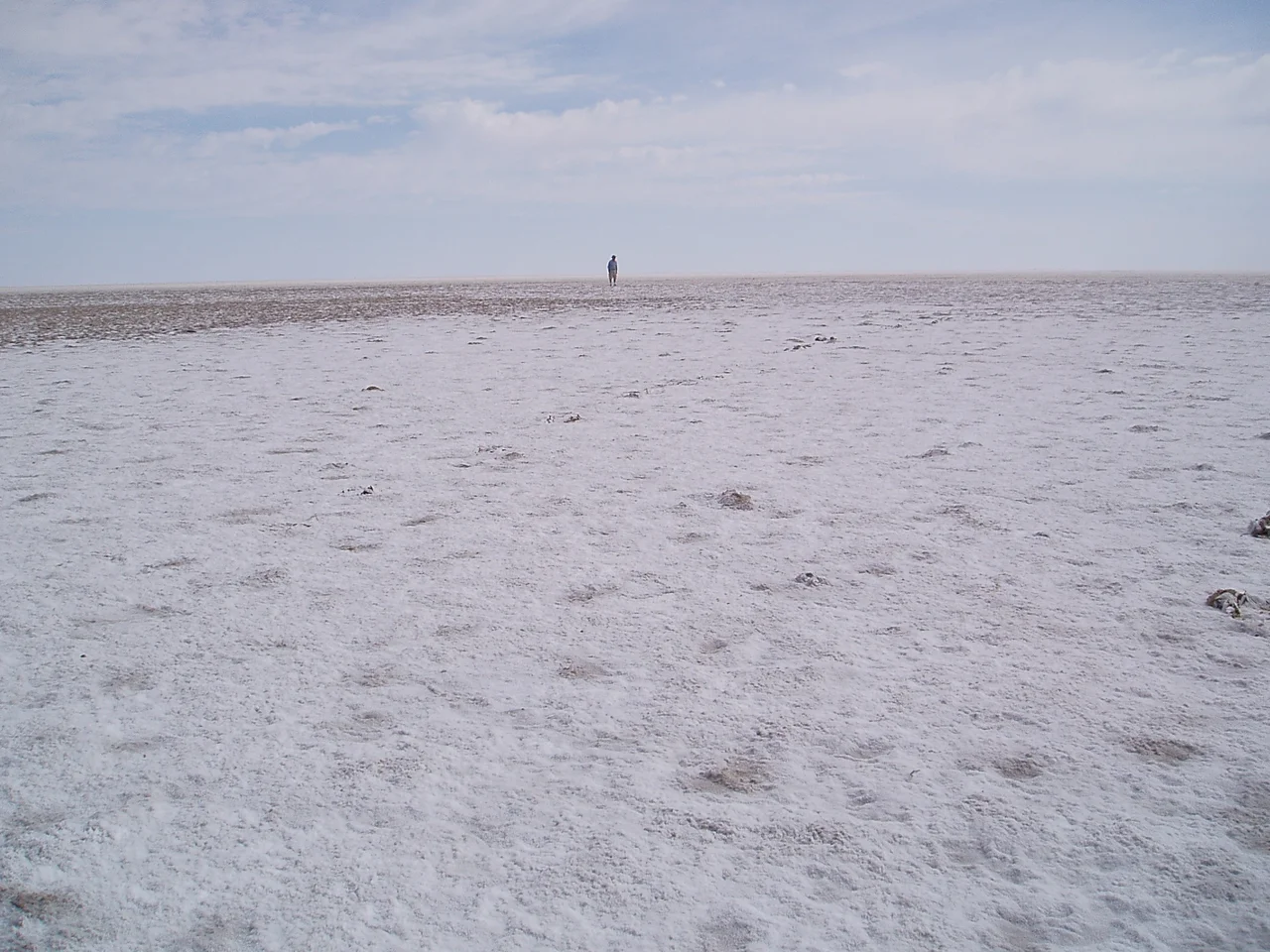

Lake Eyre
For most of any human life, Kati Thanda-Lake Eyre is not a lake at all. It is a blinding white salt pan stretching to every horizon, the lowest place in Australia at around fifteen metres below sea level, so flat and so bright that pilots crossing it can lose the line where ground meets sky. The Arabana people, on whose country it lies, have known its moods for far longer than any map, and their name, Kati Thanda, carries that long acquaintance. Then, perhaps three times in a century, everything changes. Water that fell as monsoon rain hundreds of kilometres away in Queensland finds its way down desert channels over weeks and months, and the dead salt flat becomes the largest lake on the continent - up to 9,500 square kilometres of shallow water where, days before, there was only crust.
The Patience of the Basin
Lake Eyre is the drain at the bottom of an enormous endorheic basin - a sealed-off region where rivers flow inward and never reach the sea. Rain that falls across a sixth of the Australian continent gathers, in theory, toward this single low point. In practice, almost all of it never arrives, soaking into the sand or evaporating under a sun fierce enough to lift more than two and a half metres of water a year. A modest flood reaches the lake roughly every three years; a deep four-metre fill perhaps once a decade; a complete filling only a handful of times in a hundred. The greatest recorded flood, in 1974, rose six metres. To witness the lake brim-full is to see something most Australians never will - a once-in-a-generation event written across a landscape built for drought.
When the Birds Find Out
The strangest thing about a Lake Eyre flood is who shows up. As the water spreads, life detonates: dormant brine shrimp hatch, fish carried down the rivers breed in astonishing numbers, and then come the birds - pelicans, banded stilts, avocets, gulls and terns - in flocks of staggering size. During the 1989-90 flood, an estimated 200,000 pelicans, around 80 percent of Australia's entire population, descended on the lake to feed and nest. The 2025 flood drew tens of thousands more. What no one can fully explain is how they know. These birds appear from the coasts and from as far as Papua New Guinea, somehow sensing that a desert hundreds or thousands of kilometres away has filled, and arriving to exploit a banquet that will be gone within a season. It is one of the great unsolved riddles of animal behaviour.
Pink Water and the Sailing Sky
As a filled lake begins its slow death by evaporation, it stages a final spectacle. When the water saturates with salt, the alga Dunaliella salina blooms and floods the surface with beta-carotene, turning vast stretches of the lake a startling shade of pink. The salinity climbs from seawater to a brine thick enough to crystallise. And at midday, when the wind drops, the lake performs its eeriest trick: the surface goes glassy and mirrors the sky so perfectly that horizon and water dissolve entirely. The commodore of the Lake Eyre Yacht Club - yes, a salt lake that is dry most years has a yacht club, headquartered in Marree - once described sailing across it as the sensation of sailing through the sky itself, suspended in blue with nothing above or below to tell you which way was up.
The Day the Salt Flat Held a Record
On 17 July 1964, the salt flat held something other than water: it held the fastest car on Earth. Donald Campbell brought his turbine-powered Bluebird-Proteus CN7 to the dead-flat expanse of Lake Eyre, gambling that its endless smooth surface could carry a machine to 500 miles per hour. The desert, as ever, had other plans - rain had softened the very flat he needed, and conditions fought him. In the end he set a world land speed record of 403.10 mph, making 1964 the year Campbell took both the land and water speed records, a feat no one has matched. He was, characteristically, disappointed; the car had been built for more. Yet the choice of Kati Thanda was no accident. Nowhere else offered a surface so vast and so level - the same merciless flatness that makes the lake deadly to the unprepared made it, for one dry season, the perfect track.
From the Air
Kati Thanda-Lake Eyre is centred near 28.67°S, 137.17°E in South Australia's Far North, about 700 km north of Adelaide and immediately south of the Simpson Desert. It is the ultimate visual landmark of the region: a vast white salt pan visible for tens of kilometres, or - during a fill - sheets of water that may glow pink with algae. The lake is split into Lake Eyre North (144 km long) and Lake Eyre South, joined by the Goyder Channel. William Creek (ICAO YWMC), on the western edge, is the principal scenic-flight base for overflights and sits on the Oodnadatta Track; Marree (YMRE) lies to the south-east; Coober Pedy (YCBP) to the west offers a sealed runway. Beware: the salt surface and a flooded lake's mirror-calm both destroy the visible horizon - rely on instruments. Heat shimmer and glare are intense. Recommended viewing altitude 1,500-4,000 ft AGL; the lake is within and adjacent to Kati Thanda-Lake Eyre National Park, so respect any overflight or landing restrictions.
Nearby Stories
- Strangways Springs 25 km away
- Anna Creek Station 34 km away
- Cooper Creek 40 km away
- William Creek 59 km away
- Marree Man 61 km away
- Kalamurina Sanctuary 65 km away
- Marree 74 km away
- Indigenous Australian Culture 132 km away