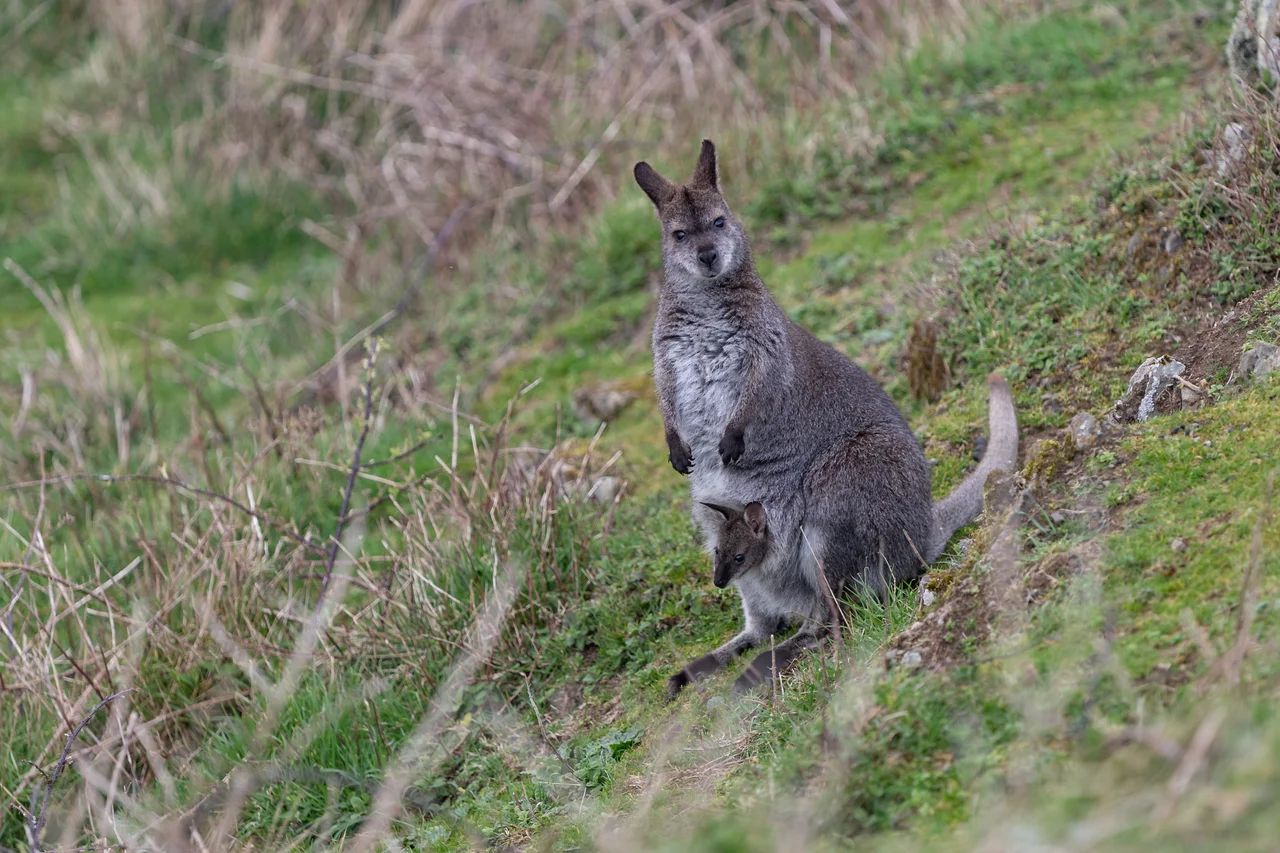

Lambay Island
Wallabies live on Lambay. Red-necked wallabies, native to eastern Australia, hopping through the heather of a small island five kilometres off the coast of Dublin. Rupert Baring released the first pair in the 1950s as a private experiment; Dublin Zoo donated surplus stock in the 1980s. By 2017 the population was around a hundred. They graze the cliff-top grassland alongside fallow deer, sheep, and cattle, while 50,000 common guillemots nest on the seabird cliffs above them and grey seals haul out at Seal Hole. The Baring family has owned this private island since 1904 - bought for 5,250 pounds by an American-born banker who needed somewhere to escape with the wife of one of his business partners.
Lamb Island
The name is Norse: Lamb-ey, lamb island. Old Norse-speaking settlers along this coast in the 9th and 10th centuries used the place as a spring nursery for their ewes, where lambs could be born in a predator-free environment. The Irish name is Reachrainn, and the nearest coastal village - Portrane on the mainland - takes its name as Port Reachrann, the port of Reachrainn. The island covers about 2.5 square kilometres of volcanic rock and loam, rising to 126 metres at Knockbane, its highest hill. Steep cliffs ring three sides; the gentler western shore holds the only harbour and almost all the buildings. The bedrock is largely andesite of a distinctive local type called Lambay porphyry, a hard fine-grained stone that Neolithic toolmakers quarried for axe-heads. Archaeologists working from 1993 to 2001 identified a stone axe factory near the centre of the island, dating to roughly 4000 BC.
Saints, Vikings, and Cromwell
St Columba is said to have founded a monastic settlement here around 530 AD - then passed it to his pupil Colman McRoi, whose feast day is still 16 June. The monastery survived two centuries until the Vikings raided it in 795, in what was the first recorded Norse attack on Ireland. The buildings were burned. The community vanished from the records. In 1181 King John granted Lambay to the Archbishops of Dublin, who collected its rents and taxes on its famously productive rabbit population. In the 1550s the English Reformation Archbishop George Browne handed the island to John Challoner, the first Secretary of State for Ireland, with instructions to settle it "with a colony of honest men." Challoner mined for silver and copper, bred falcons on the cliffs, and built a small blockhouse fort. After the Battle of Aughrim in 1691, more than a thousand Irish soldiers were interned on Lambay; some died there of wounds and starvation.
The Banker and the Tobacco Heiress
In 1904 the Honourable Cecil Baring - of the Baring banking dynasty, later 3rd Baron Revelstoke - bought Lambay for 5,250 pounds. He had been working in the United States when he fell in love with Maude Louise Lorillard, the wife of one of his fellow directors. She was the daughter of Pierre Lorillard IV, the tobacco millionaire who in 1881 became the first American to win the Epsom Derby. Maude divorced her husband and married Baring. They needed somewhere to disappear together, and a privately owned island off the Dublin coast suited admirably. Cecil hired Edwin Lutyens - perhaps the greatest English architect of his generation - to remake the old 16th-century blockhouse into a romantic family castle. Lutyens added a quadrangle of kitchens and bedrooms under sweeping grey Dutch pantile roofs, built a circular curtain wall as a windbreak around the garden, and designed the ceremonial approach from the harbour with curving Baroque terraces. The story of Cecil and Maude's early Lambay life inspired Julian Slade's 1957 musical Free as Air.
Tayleur's Wreck
On 21 January 1854, just two days into her maiden voyage from Liverpool to Australia, the iron-hulled RMS Tayleur struck the southeast rocks of Lambay in a gale and broke up. Chartered by the White Star Line and one of the largest merchant ships of her day, the Tayleur carried 660 passengers and crew bound for the Australian goldfields. About 380 people drowned. Many crew were Chinese sailors who reportedly could not understand commands shouted in English. The wreck lies under about 18 metres of water roughly 40 metres off Lambay's southeastern coast - one of around fifty wrecks identified in the waters around the island. Pre-disaster Tayleur was sometimes called the doomed sister of the more famous Titanic, also a White Star vessel; the comparison turned out to be more apt than anyone could have known.
An Island Today
Alex Baring - Cecil's great-grandson - and his wife Brooke and their children are the only permanent residents in 2020. The island holds 26 National Monuments, two Special Area of Conservation designations, and one of Ireland's largest seabird colonies: 50,000 common guillemots, 5,000 black-legged kittiwakes, 3,500 razorbills, plus puffins, Manx shearwaters, fulmars, and greylag geese. A 1905-06 survey discovered ninety species not seen elsewhere in Ireland and five new to science, including an earthworm called Henlea hibernica and a mite called Trachyuropoda hibernica. Ireland's only self-sustaining colony of black rats lives on Lambay, kept in check by the more numerous brown rats. The Lambay Island Whiskey brand, a joint venture between the estate and the Camus Cognac family, launched in 2018; planning permission for a micro-distillery on the island was approved in principle in 2019. The island is not open to casual visitors. A small number of bird-watching and architecture tours are facilitated each year, weather permitting.
From the Air
Lambay Island lies at 53.49 N, 6.02 W, about 5 km off the coast of north County Dublin between Portrane and Rush. From the air it is unmistakable - the largest island off Ireland's east coast, with prominent cliffs on its northern, eastern, and southern shores and a single small harbour on the gentler western side. The dark conical hill of Knockbane (126 m) rises near the centre. Dublin Airport (EIDW) sits about 18 km southwest; Belfast (EGAA) is roughly 130 km north. The mainland features of Portrane, Donabate, and the long Malahide estuary lie immediately west. Maintain safe altitude - the cliffs draw strong updrafts and the seabird colonies should not be disturbed by low overflight.
Nearby Stories
- Carrickmines Castle 1.8 km away
- Trim Castle 8 km away
- Irish Military Intelligence Service 12 km away
- Cabra Castle 15 km away
- Athclare Castle 16 km away
- German submarine U-1051 21 km away
- Irish Sea Bridge 51 km away
- Ardglass 52 km away