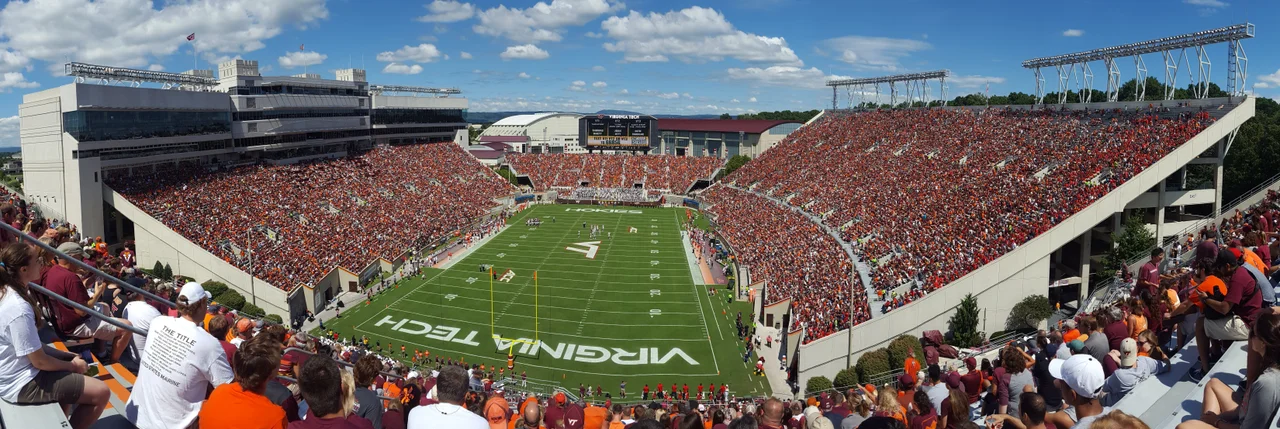

Lane Stadium
When Metallica played Lane Stadium on May 7, 2025, the Virginia Tech Seismological Observatory registered the crowd. Specifically, it registered Enter Sandman. The band's signature track has been the Virginia Tech football team's entrance music since 2000, and when 65,000 fans jump in unison to its opening chords, the ground itself shakes - hard enough to register as a small earthquake. That night was the first time Metallica had ever performed the song at the stadium that adopted it. The seismologists were ready.
The Stadium That Cassell Built
Lane Stadium opened in 1965, replacing the 17,000-seat Miles Stadium that had outgrown its purpose. The new build was the idea of Stuart K. Cassell, a Tech administrator whose name now sits on the basketball arena next door. Construction began on April 1, 1964. The stadium opened with a 9-7 win against William and Mary on October 2, 1965, and Worsham Field has been the home of Virginia Tech football ever since. For 32 years, from 1982 until 2014, Lane Stadium held the highest elevation of any FBS football stadium in the eastern United States - 2,057 feet above sea level. The current capacity sits around 65,000, ranked second in the ACC.
The Enter Sandman Tradition
Beginning in 2000, when the Hokies emerge from the tunnel behind the north end zone, Metallica's Enter Sandman starts playing. The Marching Virginians lead the stadium in jumping in place - the move has become known as the Blacksburg Bounce. As players run onto the field, each one reaches up and touches a slab of Hokie Stone mounted at the tunnel mouth, then sprints between two phalanxes of cadets, the Highty-Tighties (the regimental band founded in 1892), and the Marching Virginians. On the final home game of each year, senior cadets take the place of freshmen in the phalanx, marking the corps's Senior Day. ESPN.com ranked Lane Stadium the #2 scariest place to play in 2007. Rivals.com had ranked it #1 for home-field advantage two years earlier.
April 16, 2007
Lane Stadium cannot be told only in football. On April 16, 2007, a Virginia Tech student named Seung-Hui Cho killed 32 students and faculty in two locations on the Blacksburg campus before taking his own life - the deadliest mass shooting at an American college, then or since. Among the dead was Liviu Librescu, a 76-year-old Romanian-born professor of engineering science and mechanics. Librescu had survived the Holocaust as a child. When the gunman reached the door of Norris Hall room 204, Librescu held it closed with his body, shouting for his students to escape through the second-story windows. Almost all of them did - around twenty made it out. Librescu was shot through the door and killed. He died on Yom HaShoah, Israel's Holocaust Remembrance Day. The 32 dead are memorialized in 32 Hokie Stones arranged in a semicircle on the Drillfield. Their names are read aloud every April 16.
Beamer, Skipper, and Frank Beamer's Statue
Frank Beamer coached Virginia Tech football for 29 seasons, winning 238 games and taking the Hokies to 23 straight bowl appearances. He was inducted into the College Football Hall of Fame in 2018, and Virginia Tech unveiled his bronze statue in front of Lane Stadium's main entrance that same year. The cannon fired after every Hokie score is named Skipper - built in 1963 by a group of cadets led by Homer Hickam, the future engineer and author of Rocket Boys. The cadets built it to silence VMI fans who used to chant Where's your cannon? at the annual Thanksgiving Day game. They named it after John F. Kennedy, who was assassinated on November 22, 1963 - the very day the cadets drove to Roanoke to pick up the finished cannon. As PT-109's captain in WWII, JFK had been known to his crew as Skipper. The cannon now lives permanently in Pearson Hall when not at games.
Hokie Stone Underfoot
The stadium that holds these traditions and these memories is built into the same Blue Ridge ridgeline as the rest of campus, and clad in the same Hokie Stone limestone. The stone is local - quarried from a Tech-owned quarry just west of town - and every wall, every walkway, and every memorial on campus shares the same warm grey color. When players touch Hokie Stone on their way onto the field, they are touching the same material that holds the 32 memorial markers on the Drillfield. That continuity is not accidental. The campus was designed so that the stone connects everything, in life and in loss, beneath a single Appalachian sky.
From the Air
Lane Stadium sits at 37.220 N, 80.418 W on the Virginia Tech campus in Blacksburg, at 2,057 feet elevation - until 2014, the highest FBS stadium in the eastern United States. Look for the large football bowl with a Hokie Vision scoreboard at the south end, on the southwest edge of campus. Cassell Coliseum is immediately adjacent. The Drillfield and 32 Hokie Stone memorials lie a short walk northeast. Nearest field: Virginia Tech Montgomery Executive (KBCB) 2 nm south. Roanoke-Blacksburg Regional (KROA) is 25 nm northeast. On home game days, expect heavy traffic on US 460 and I-81 exit 118B.
Nearby Stories
- Botetourt County, Virginia 12 km away
- Murders of Alison Parker and Adam Ward 13 km away
- Paint Bank, Virginia 16 km away
- 2004 Hendrick Motorsports Aircraft Crash 26 km away
- Appalachian League 27 km away
- Galax, Virginia 28 km away
- Hargrave Military Academy 37 km away
- Beckley, West Virginia 47 km away