.jpg)
Largs Lifeboat Station
On 24 July 1983, a motor-boat capsized off Fairhaven on the east side of Great Cumbrae. Four people had been aboard. Two men were picked up by a passing yacht. A third was pulled from the water into a motor-boat, but did not survive. The fourth was a girl. She was still inside the upturned hull, breathing in an air pocket that was running out. The Largs lifeboat crewed by Arthur Hill and helmsman John Strachan arrived. What happened next is the reason Largs Lifeboat Station has the awards it has.
The 1983 Rescue
Arthur Hill ducked under the upturned hull again and again. Each dive was a guess: would the air still be there, would the girl still be conscious, would Hill himself surface. After several attempts he found her and got her out, into the waiting lifeboat. She lived. The RNLI awarded Hill its Silver Medal, one of the highest honours in the service, and the Maud Smith Award for 1983, given annually for the bravest rescue performed by lifeboat crew during the previous year. Helmsman John Strachan received the Thanks of the Institution inscribed on Vellum. The motor-boat survivors went home. The Largs crew went back to the station and waited for the next call.
Why an Inshore Boat
Through the winter of 1963, the RNLI ran trials of a new kind of rescue craft. Britain's seaside resorts were filling with sailors and waterskiers and pleasure craft, and the existing fleet of full-sized lifeboats took time to launch. Something faster was needed, smaller, that a handful of volunteers could push down a beach in minutes. Twenty-five inshore stations were planned around the UK. In Scotland, just two sites were chosen, and Largs was one of them. In May 1964 the station opened with an unnamed 16-foot inshore lifeboat designated D-22. Early on these inshore boats were seasonal, brought in for the spring and put away in the autumn. The stations did not always get the same boat back the next year.
Royal Openings and New Boats
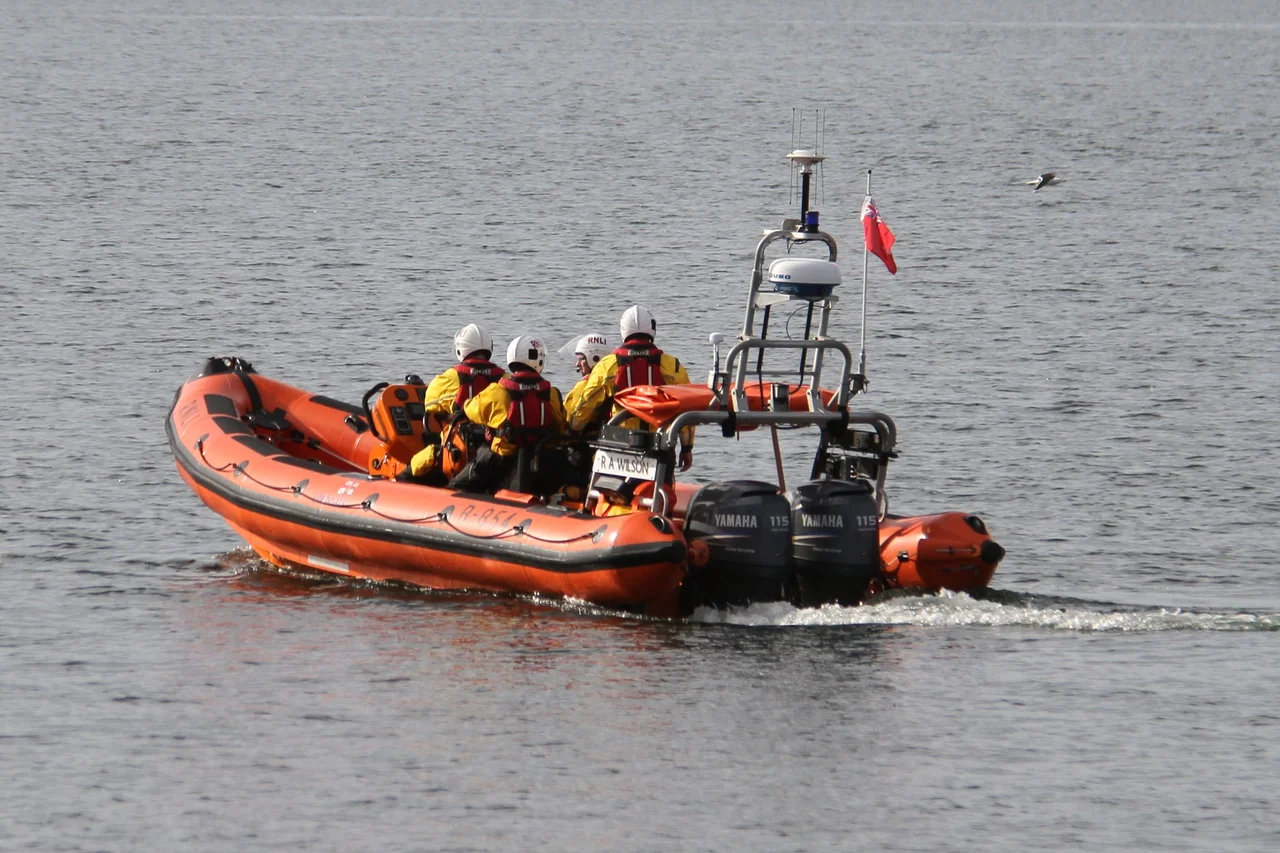
An early rescue came when six men aboard a drilling pontoon off Hunterston were in trouble. The pontoon was moving violently in heavy seas; the lifeboat took all six off and got them with their service launch back to Hunterston Jetty. Helm John H. Harrison, Robert Watson, and John Mackie each received a Framed Letter of Thanks signed by the Chairman of the Institution. By 1997 the station had a larger boat than the 1981 boathouse could accommodate alongside its Talus MB-764 amphibious launching tractor. A new boathouse was built with workshop, storage, and crew facilities, completed in February 1998. Princess Anne opened it formally in July 1998. The current lifeboat, R. A. Wilson (B-854), entered service on 6 November 2011, funded by Robert Amory Wilson. The Atlantic-class inshore lifeboat carries the kind of speed and stability that the 1964 D-class only hinted at.
Standing By
The station sits at the junction of Greenock Road and Barfields in Largs, looking west over the Firth of Clyde toward Great Cumbrae. From its launching ramp the boat can reach Cumbrae's shores in minutes and the open water beyond it in not much longer. The Firth is a working sea: ferries running to Cumbrae and Bute, dinghies racing in summer regattas, yachts threading the channels between islands, the Waverley paddle steamer making its summer calls. Most of the people who use these waters never need the lifeboat. The crews train, maintain the boat, and stand ready for the small percentage who do. The 1983 rescue made Largs famous in the lifeboat world, but it is the daily readiness, six decades and counting, that defines the station's actual work.
From the Air
Largs Lifeboat Station sits at approximately 55.80°N, 4.87°W, on the seafront of Largs in North Ayrshire, at the junction of Greenock Road and Barfields. Best seen from 2,000-4,000 feet, the station is at the southern edge of the town directly opposite Great Cumbrae across the narrow ferry channel. Nearest airports are Glasgow Prestwick (EGPK) to the south and Glasgow International (EGPF) about 22 nm northeast. The CalMac Largs-Cumbrae ferry route runs the channel just offshore; numerous yachts and pleasure craft work the Firth in summer. The towns of Largs to the north and Fairlie to the south flank the station along the coast road.
Nearby Stories
- Machrie Moor Stone Circles 2.6 km away
- Murder of Kriss Donald 3.7 km away
- Troon 5.5 km away
- Luss 6.8 km away
- HMS Vandal 11 km away
- Doune Castle 16 km away
- Knockshinnoch Disaster 17 km away
- Gulf of Corryvreckan 28 km away