.jpg)
Leal Senado Building
Portugal occupied the territory of Macau, but during the sixty years that Spain occupied Portugal, Macau refused to follow. From 1580 to 1640, the Iberian Union placed the Portuguese Crown under Spanish rule — and Macau's government simply declined to recognize the arrangement. It was an act of loyalty so stubborn that two centuries later, in 1810, Portugal's prince regent João formally rewarded the territory with a title: Leal Senado. Loyal Senate. The bronze plaque commemorating that honor still hangs inside the entrance hall of the building that bears the name.
A Site Older Than Its Walls
Long before the Portuguese built on this ground, a Chinese-style pavilion stood here. It served as the meeting point between Portuguese administrators and Ming dynasty officials — a neutral space where two systems of governance negotiated the terms of coexistence. The Portuguese recognized the value of this location as early as 1583, recording plans to purchase the pavilion and the Chinese houses behind it. But bureaucracy and price negotiations stretched on for two centuries. It was not until 1784 that the Portuguese government finally paid 80,000 taels and took ownership of the site.
The Leal Senado building constructed after that purchase deliberately looked backward. Its architects designed it in a plain style more typical of 14th- and 15th-century Portugal than the Pombaline style fashionable in Lisbon at the time. The choice may have been aesthetic, or it may have been a statement — a building that looked like old Portugal standing in territory far from home.
Loyalty Inscribed in Stone
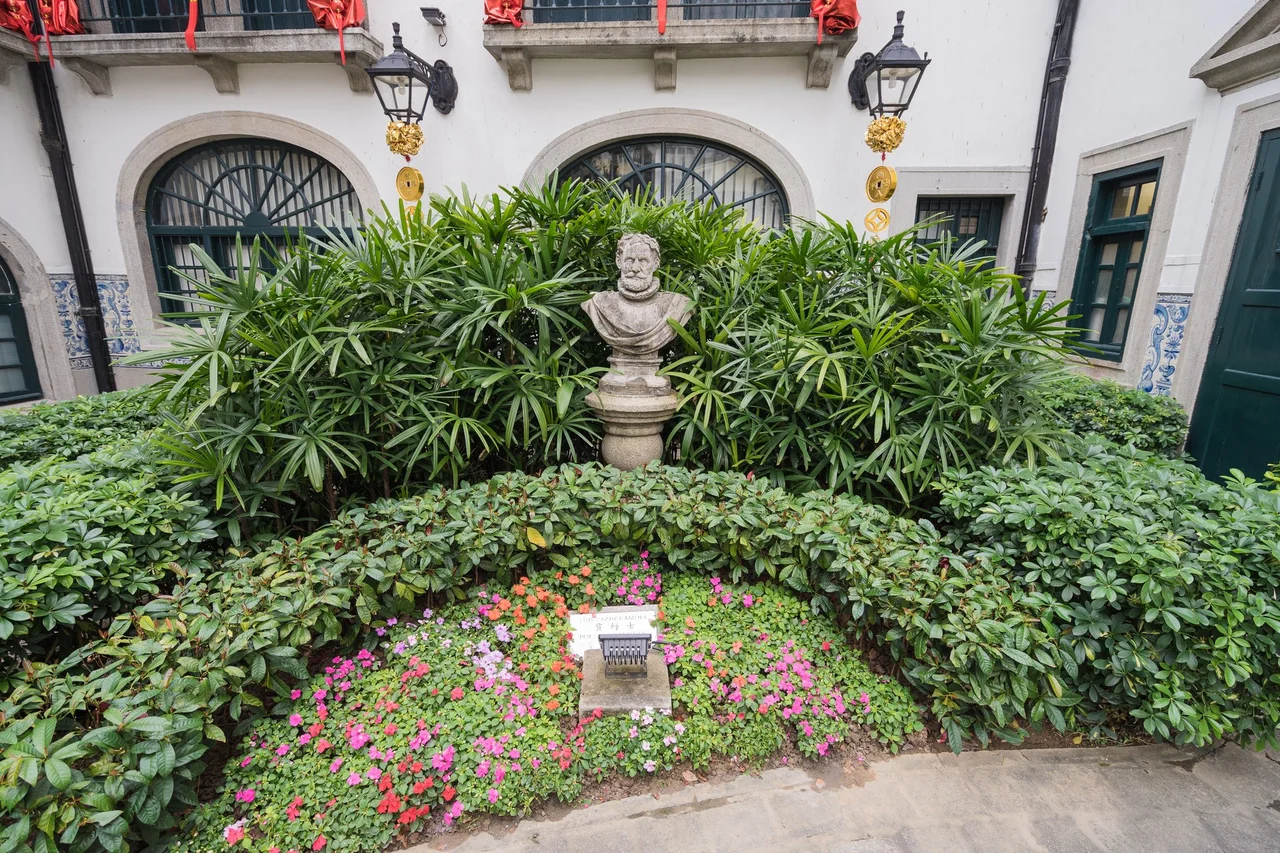
The entrance hall announces the building's identity immediately. The plaque ordered by Prince Regent João to commemorate Macau's refusal to bow to Spain occupies a prominent position, its text connecting a building completed in 1784 to an act of defiance from two centuries earlier. Throughout the colonial era, Portuguese rallies and official celebrations took place here. The building housed, at various points, a museum dedicated to the poet Luís de Camões, a post office, a court, and a prison — the full apparatus of colonial administration compressed into a single structure.
It was completely refurbished in 1904. A typhoon damaged it again in 1936, requiring further repairs. The building's history carries the marks of weather and time as plainly as any document does.
The Library That Traveled From Portugal
On the northwestern corner of the first floor, a public library opened its doors in 1929. Its design was borrowed from the library of the Mafra Convent in Portugal — classical proportions, decorated shelves, a sense that books deserve architecture worthy of their contents. The collection grew to hold around 18,500 volumes, with particular depth in foreign-language materials from the 17th century through the 1950s, focused on Portuguese history in Africa and the Far East.
That collection is a kind of mirror: a library built at the far edge of a colonial empire, specializing in the documentation of that same empire's reach across the world. Readers today can consult materials that record a version of history no longer celebrated but still worth understanding. The library remains accessible to the public, its original interior preserved along with the master walls and courtyard garden that have survived every refurbishment the building has undergone.
After the Handover
When Portugal returned Macau to China in December 1999, the Leal Senado building transitioned from the seat of colonial government to the headquarters of the Civic and Municipal Affairs Bureau — a change of administration without a change of address. The building became part of the UNESCO World Heritage Site Historic Centre of Macau in 2005, its Portuguese facades and colonial-era library now protected alongside the Chinese temples and Baroque churches that together define Macau's layered identity.
Senado Square unfolds from the building's front steps: a wave-patterned black-and-white mosaic plaza ringed by colonial-era facades painted in pale yellows and greens. Tourists photograph themselves against the building's neoclassical front. Inside, the exhibition hall on the first floor mounts art shows. The convention hall on the second floor hosts public meetings. The building that once governed an empire now manages a city — and that too is a kind of loyalty, to continuity if not to Portugal.
From the Air
The Leal Senado Building sits at 22.193°N, 113.539°E at the southern end of Senado Square, near the center of the Macau Peninsula. The square's distinctive mosaic paving makes the area identifiable from low altitude. Macau International Airport (VMMC) is located on Taipa Island approximately 4 kilometers to the southeast. The Cotai causeway bridges connecting the peninsula to Taipa provide useful orientation lines from the air. Recommended viewing altitude is 1,000–2,500 feet to appreciate the dense urban fabric of the historic center.
Nearby Stories
- 2024 Shenzhen Stabbing 0.8 km away
- Lantau Peak 1.5 km away
- Kweilin Incident 2.4 km away
- Taishan City 7 km away
- Wanshan Archipelago Campaign 38 km away
- Hong Kong 12 68 km away
- Battle of Nanpeng Island 82 km away
- Erhai Lake 1335 km away