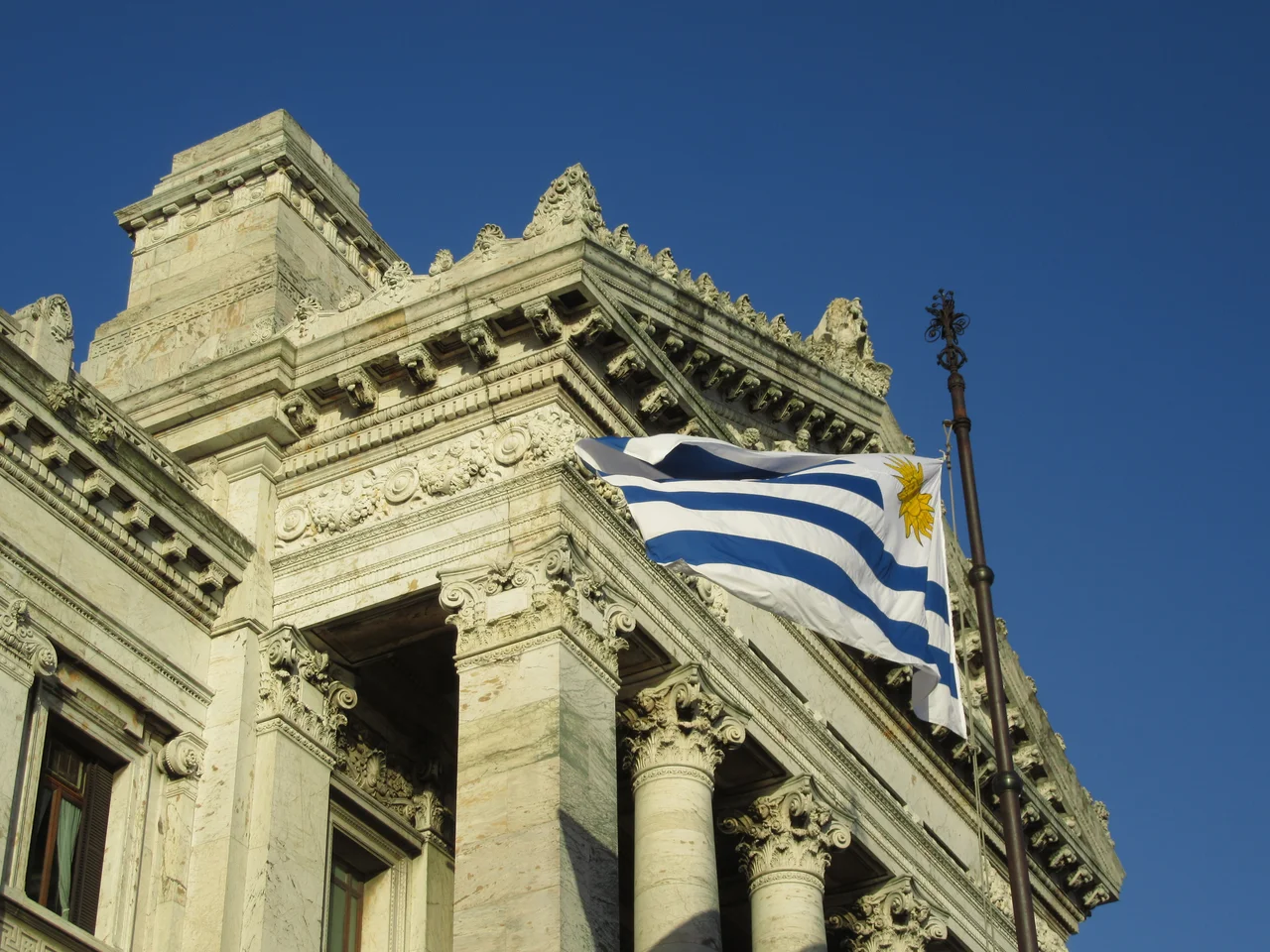

Legislative Palace of Uruguay
Stand at the foot of Libertador Avenue and the building seems less like a parliament than a temple. The Legislative Palace of Uruguay rises in pale Greco-Roman grandeur, its columns and pediments aligned precisely with the avenue's axis so that the whole street points toward it like an arrow. Inside, nearly every surface - walls, vaults, columns, floors - is sheathed in marble quarried from Uruguayan ground. It took the better part of three decades to build, and the country meant it to last forever: a house for its laws as solid and serious as the republic itself.
Three Decades in Stone
Construction began in 1904, championed by President José Batlle y Ordóñez, the reformer who shaped modern Uruguay. The design came from Italy - the architects Vittorio Meano and Gaetano Moretti - and the ambition was enormous: a Greco-Roman eclectic palace clad entirely in native marble, in colors and patterns drawn from quarries across the country. The work crawled forward across years and governments. Finally, on 25 August 1925, the palace was inaugurated to mark the centenary of Uruguay's Declaration of Independence. It holds three great halls, parliamentary offices, workshops in its basement, and an upper-floor library whose shelves carry more than a quarter of a million volumes.
The Hall of the Lost Steps
The building's soul is a corridor with a hauntingly beautiful name: the Salón de los Pasos Perdidos, the Hall of the Lost Steps. Inspired by Renaissance cathedrals, it runs beneath two vaults and a central skylight, dividing the chamber of the Senate from that of the Deputies, each entrance crowned with a semicircle of stained glass. The name evokes the countless footsteps of those who have paced here waiting - for a vote, a verdict, a decision. In glass cases the hall guards the republic's most sacred papers: the original Constitution of 1830 and the Declaration of Independence of 1825, the documents from which the nation traces its existence.
Where a Nation Says Goodbye
The Hall of the Lost Steps is also where Uruguay grieves its greatest figures. Their bodies have lain in honor here beneath the skylight while the country filed past to say farewell - the poet Juana de Ibarbourou, crowned 'Juana of America' in this very hall in 1929; the writer Mario Benedetti; the actress China Zorrilla; the painter Carlos Páez Vilaró; the author Eduardo Galeano; and Alcides Ghiggia, the footballer whose goal silenced the Maracanã and won Uruguay the 1950 World Cup. In a country that reveres its artists as much as its statesmen, the highest honor is to rest, however briefly, among the lost steps.
A Country in Marble
The decision to face the entire palace in Uruguayan marble was a statement of self-belief. Rather than import its grandeur, the young republic quarried it, drawing many different varieties of stone from across its own territory and arranging them in the facades, the columns, the vaults, and the floors. The result is a building that is literally made of the country it governs. It belongs to the era of José Batlle y Ordóñez, the president whose reforms - the welfare state, the separation of church and state, the eight-hour day - made Uruguay one of the most progressive nations of its age. The palace was meant to house that confident, modern republic, and to look every bit as permanent as the ideals it embodied.
History on the Walls
Elsewhere in the palace, Uruguay tells its own story in paint and gold. The Special Events Hall, its ceiling finished in 24-karat gold leaf, holds canvases depicting pivotal moments of the national past - among them El Éxodo del Pueblo Oriental, the great 1811 exodus led by Artigas - alongside portraits of the founding rivals Fructuoso Rivera, Manuel Oribe, and Juan Antonio Lavalleja. In the Lobby of Honor hangs La Jura de la Constitución, the swearing of the 1830 constitution. To walk these rooms is to read Uruguay's history written by its own hand, in marble, oil, and gold - a monument that is also an argument for the seriousness of self-government.
From the Air
The Legislative Palace stands in the Aguada neighborhood of Montevideo at roughly 34.891 degrees south, 56.187 degrees west, a short distance inland from the harbor. From the air it is one of the city's most recognizable structures: a large, symmetrical, pale stone building set at the head of Libertador Avenue, which runs dead straight toward its main facade - a useful navigational alignment. The wide Rio de la Plata lies to the south and the port of Montevideo to the west. Carrasco International Airport (ICAO: SUMU) is about 16 km east along the coast, while the closer Angel S. Adami Airport (ICAO: SUAA) lies to the city's northwest. Best viewed at lower altitudes in clear conditions, when the marble facade catches the light against the surrounding urban grid.
Nearby Stories
- Piriápolis 24 km away
- Minas 40 km away
- Tronador (rocket) 67 km away
- Nueva Helvecia 69 km away
- La Plata Museum 122 km away
- Battle of Sarandí 126 km away
- Mundo Marino 145 km away
- South Georgia Island 2584 km away