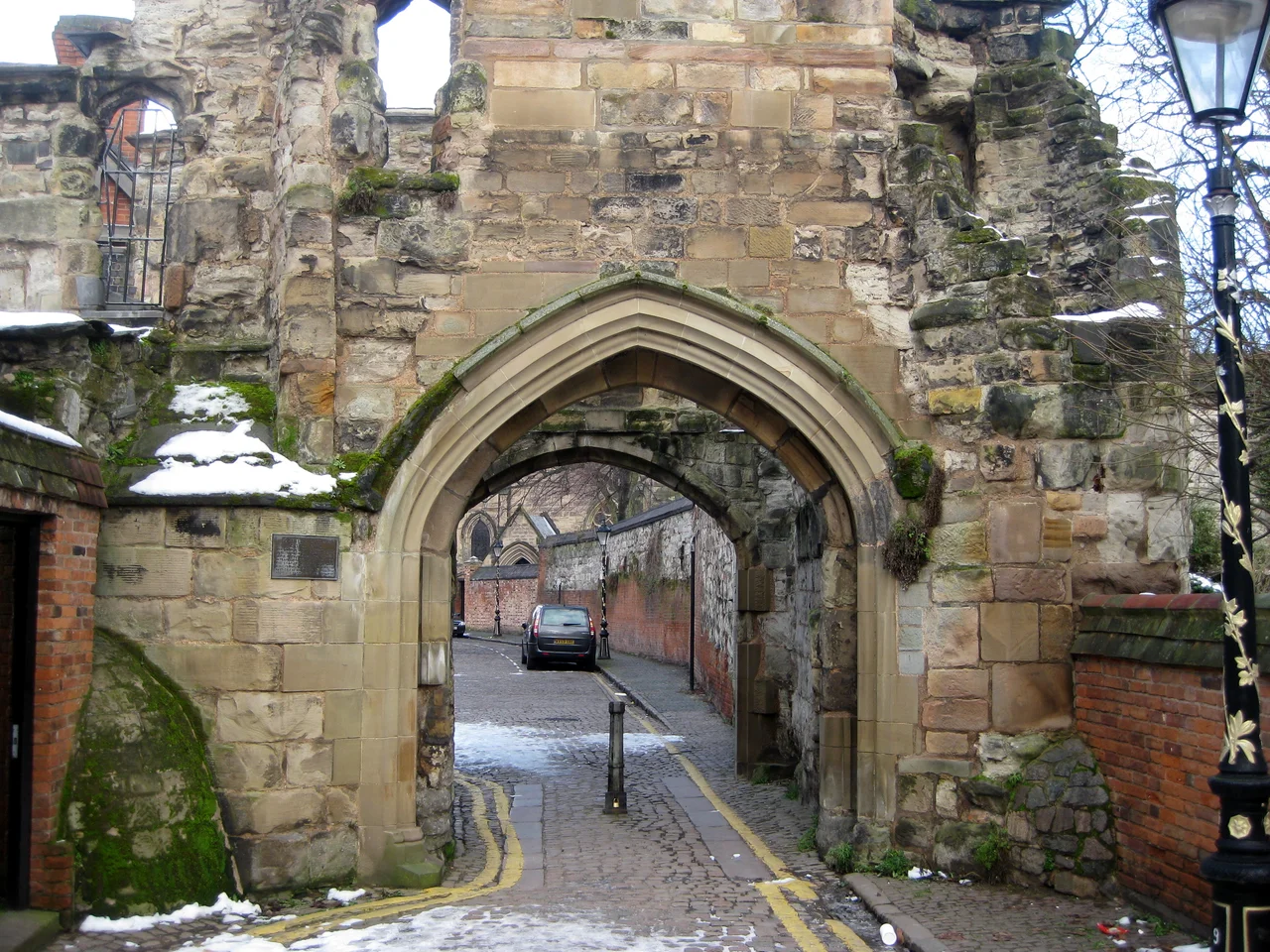

Leicester Castle
In 1426 the parliament of England sat in the Great Hall of Leicester Castle. It is remembered as the Parliament of Bats - not the flying mammal, but the cudgel. Henry VI was four years old. The kingdom was being run by an uneasy coalition of his uncles, and feeling among the lords was bad enough that they had been forbidden to bring swords to the assembly. They came with bats instead, hidden under their cloaks, ready to use if necessary. Leicester was chosen because London felt unsafe. The Great Hall served. The bats stayed, mostly, in the cloaks. England survived another year of the slow drift toward the Wars of the Roses. Nine and a half centuries earlier, the Romans had walled this same patch of ground in the southwestern corner of their town. The Normans built a castle over the Roman walls. Successive medieval rebuildings layered a Great Hall, a church, gateways, and a steep earthen motte onto the same site. Then the law moved in, and stayed for five hundred years.
A Norman Mound on Roman Foundations
The castle was built around 1070, a few years after the Norman Conquest, under the governorship of Hugh de Grandmesnil. The original earth motte stood 40 feet high - taller than it looks today, smoothed by centuries of weather and erosion. Robert de Beaumont, Count of Meulan, was granted the castle and the surrounding old Roman town by Henry I in 1107 and made the first Earl of Leicester. He undertook substantial building works in the bailey and founded a college of priests to serve a chantry in the castle's chapel - the chapel that would become the Church of St Mary de Castro, still standing today on the southern edge of the castle grounds. The earldom passed through the Beaumont family until 1175, when their political miscalculation caught up with them. Robert de Beaumont, the 3rd Earl, had backed the rebellion of Henry II's three eldest sons against their father. Henry II's forces laid siege to Leicester, burnt most of the town, and slighted the castle - meaning they partially demolished it and filled its ditches. According to the historian Sidney Painter, it was one of at least 21 castles Henry II ordered destroyed in the aftermath of that revolt. Leicester rebuilt itself.
A Royal Residence, Briefly
By the late 13th and 14th centuries the castle had become a place where kings stopped on their travels. Edward I stayed in 1300; Edward II in 1310 and 1311. John of Gaunt - the fourth son of Edward III, Duke of Lancaster, and one of the most powerful men in 14th-century England - died here in 1399. So did his second wife, Constance of Castile, five years earlier. Henry of Grosmont, the 1st Duke of Lancaster and one of the leading English commanders of the early Hundred Years' War, died at the castle on 23 March 1361. It was an official royal residence under Henry IV, Henry V, Henry VI, and Edward IV. But the late medieval kings preferred Westminster and Windsor for serious business, and by the mid-15th century Leicester Castle was being used mostly as a courthouse. The Great Hall, which had hosted the Parliament of Bats and the funerals of Lancastrian dukes, became the home of the Leicester County Assizes.
Gun Loops and a Reporter Named Barrie
Two unexpected episodes punctuate the castle's long courthouse career. In May 1645, during the English Civil War, Royalist forces under King Charles I and his nephew Prince Rupert of the Rhine besieged and captured Parliamentarian Leicester. A section of the castle wall adjacent to the Turret Gateway still shows the gun loops - the firing holes that the garrison hastily punched through the medieval wall to defend the position. The town was sacked. The defences did not hold. Two hundred years later, in 1832, a political election riot destroyed the third storey of the Turret Gateway - locally known as Prince Rupert's Gateway. And in the 1880s, a young Scottish journalist named J. M. Barrie spent many hours in the Great Hall as a reporter for the Nottingham Journal, covering assize cases. He would later create Peter Pan. Whether anything in the courthouse's procession of murderers, debtors and small thieves contributed to his imagination is unrecorded.
Queen Anne Skin, Medieval Bones
The Great Hall continued to serve as a courtroom until 1981, when Leicester Crown Court finally relocated to new premises on Wellington Street. That makes the castle's hall one of the longest-running judicial venues in English history - functioning as a court for roughly five centuries. The exterior you see today is largely Queen Anne, a brick frontage added in the 17th and 18th centuries to dignify the medieval shell. The medieval timber roof is still inside, hidden above a later ceiling. The motte still rises in the gardens. The Church of St Mary de Castro still stands, with its tall spire and 12th-century font where Geoffrey Chaucer's father is supposed to have been baptised. The Turret Gateway still stands, two storeys high instead of three, the gun loops still visible. De Montfort University now owns much of the site and has converted part of it into the Leicester Castle Business School. A castle, a parliament, a series of royal deaths, a Civil War siege, an election riot, five centuries of justice, and a finishing school for MBAs - few sites in Britain have layered quite so many different uses on quite so little ground.
From the Air
Leicester Castle sits at 52.6323°N, 1.1412°W on the eastern bank of the River Soar in central Leicester, just south of St Nicholas' Circle. From altitude, the castle motte is visible as a circular green mound rising from the surrounding urban grid, with the Great Hall and St Mary de Castro church flanking it. The site is immediately south of the Jewry Wall and north of De Montfort University. East Midlands Airport (EGNX) lies approximately 15nm to the northwest. The medieval street pattern of the surrounding Newarke quarter remains broadly intact and is identifiable from low altitude.
Nearby Stories
- National Shell Filling Factory, Chilwell 1 km away
- Staffordshire Regiment Museum 2 km away
- Rutland Water 3.3 km away
- Grantham 4.4 km away
- Wellingborough 9.9 km away
- Croxden Abbey 11 km away
- Bordesley Abbey 14 km away
- Electric Railway Museum 17 km away