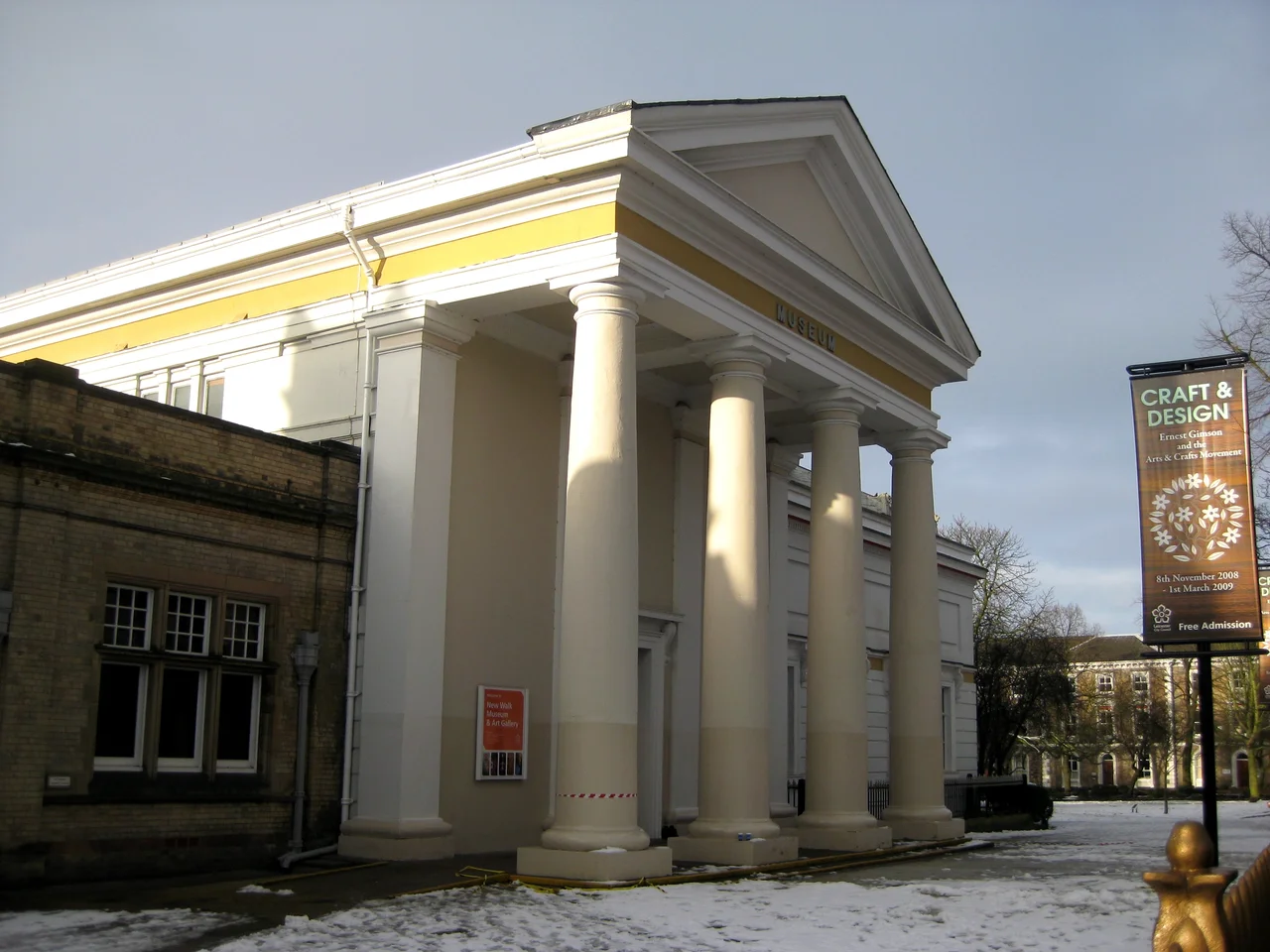

Leicester Museum & Art Gallery
In 1956, a fifteen-year-old schoolgirl named Tina Negus found a strange leaf-shaped impression in the rocks of Charnwood Forest. No one took her seriously. A year later, a fifteen-year-old boy named Roger Mason found the same fossil in the same forest, and the scientific world paid attention. The leaf was Charnia masoni, the first fossil ever found in Precambrian rock, a discovery that pushed back the known history of complex life on Earth by tens of millions of years. The original specimen, the holotype itself, lives a few miles away inside a red-brick museum on Leicester's New Walk. The display there now credits both Tina and Roger by name, an acknowledgment a long time coming.
A Hansom Cab Maker's Building
The museum opened in 1849 in a building designed by Joseph Hansom, the same Joseph Hansom whose name still travels through cities on the back of every hansom cab. He drew his ground plan with neoclassical columns and tall windows, the architecture of Victorian self-improvement, where citizens of an industrial city could come and be edified by science and art on a Sunday afternoon. The museum has expanded several times since, most recently in 2011, but Hansom's original facade still anchors the long terraced walk through Leicester's gentlest green corridor. New Walk itself is older than the museum, laid out in 1785 as a pedestrian promenade. The two have aged together. Joseph Hansom designed buildings for everyone from gentry to working knitters, but it is the cab and the museum that outlived him.
George the Sauropod and the Barrow Kipper
Two long-dead reptiles dominate the dinosaur gallery. George, more formally Cetiosaurus oxoniensis, is fifteen metres of Middle Jurassic sauropod hauled out of the Williamson Cliffe quarry in Rutland in June 1968. The skeleton is among the most complete sauropods anywhere in the world, although most of what visitors see is replica; the actual bones are too fragile to bear their own weight. The Rutland Dinosaur was opened to the public in 1985 by Janet Ellis, then a Blue Peter presenter, an unmistakably British moment in dinosaur history. The other resident is the Barrow Kipper, a flattened plesiosaur dug from the Lias mudstones of Barrow upon Soar in 1851 and so called because its preservation gave it the squashed aspect of a smoked fish. David Attenborough opened the renovated gallery in September 2011, returning Leicestershire's deep-time creatures to the centre of the museum's story.
Four Mummies and a Statue from a Bankruptcy
The Egyptology gallery holds four mummified people, named Pa-nesit-tawy, Pe-iuy, Bes-en-Mut, and Ta-Bes. They were once living individuals in the Nile valley, whose bodies were brought to England during the Victorian fashion for Egyptian antiquities. Pe-iuy was the first to arrive in Leicester, purchased in 1859 for £45, a sum that says as much about the era's casual trade in human remains as it does about the value of pounds in the 1850s. The museum has slowly expanded how it presents these people, devoting one wing to life along the Nile and another to death and burial, so that visitors meet them as individuals rather than as curiosities. A more recent acquisition is a statue of Sethmose and Isisnofret, husband and wife, purchased in 2020 from the assets of the bankrupt Thomas Cook Group, the travel firm whose own founder is buried just a mile away in Welford Road Cemetery.
Pictures Smuggled from Berlin
Leicester holds the largest collection of German Expressionist art in the United Kingdom. The works arrived in the 1930s through a single family. Alfred Hess was a Jewish industrialist and collector in Erfurt; his son Hans Hess worked as assistant curator at the New Walk Museum. As the Nazis prepared their 1937 Degenerate Art exhibition, an attempt to publicly humiliate the modernists they were already removing from Germany's museums, paintings by George Grosz, Wassily Kandinsky, Paul Klee, and Franz Marc made their way out of Germany and into the safer hands of the Hess family in England. Many of those works are still on Leicester's walls. They survived because individuals chose to act when official Germany chose not to. The museum's other prize from a different Attenborough, Richard, who in 2007 donated more than a hundred pieces of Picasso ceramic art, hangs in the same building.
From the Air
Leicester Museum & Art Gallery, 53 New Walk, Leicester (52.629 N, 1.128 W). Centred on the city's New Walk pedestrian promenade between London Road and the city centre, half a mile south of Leicester railway station. East Midlands Airport (EGNX) is the nearest commercial field, twenty miles north-west. The museum's red-brick frontage and the tree-lined New Walk are visible from low altitude over the city; from cruise, look for Leicester's distinctive bowl-shaped valley along the River Soar.
Nearby Stories
- National Shell Filling Factory, Chilwell 1 km away
- Staffordshire Regiment Museum 2 km away
- Rutland Water 3.3 km away
- Grantham 4.4 km away
- Wellingborough 9.9 km away
- Croxden Abbey 11 km away
- Bordesley Abbey 14 km away
- Electric Railway Museum 17 km away