
Leinster Nickel Mine
Five men climbed into an ore bucket at the Perseverance shaft on 27 April 1977, and the winder that should have lowered them gently let the bucket fall instead. They dropped thirty-five metres. All five died. This was before the mine had even properly opened, and it set a grim precedent for a place that would test the limits of deep, hard, remote work for the next half-century. Leinster became one of Australia's most important nickel mines and built an entire town to house its workforce, 982 kilometres from Perth in the red heart of the Northern Goldfields. Its story is one of immense wealth wrenched from the ground, and of the human price that wealth has always carried.
A Town Built for a Mine
The nickel here was found in 1971 by Western Selcast, and developing such a deposit in country this remote demanded everything be built from scratch. The Agnew Mining Company was formed in 1974, underground work began mid-decade, and a town rose alongside the mine to house the people who would run it. Leinster is a purpose-built company town, and an unexpectedly generous one: out in the spinifex it offers an Olympic-sized swimming pool, an eighteen-hole golf course and a full school, comforts almost surreal for a settlement this isolated. Premier Charles Court officially opened the mine on 5 November 1978. Ore concentrate left by road for Leonora, then by rail to the smelter at Kalgoorlie, beginning a supply chain that still threads across the state today.
Riding the Nickel Rollercoaster
Nickel is a commodity of violent extremes, and Leinster has been whipsawed by every swing. The price tells the story better than any narrative. When the mine was shut in the mid-1980s, nickel had collapsed to about US$1.70 a pound; by the time it reopened in 1989, the price had surged to US$8.30. Ownership changed hands with the cycles. BP gained control of part of the operation in 1985, then sold out in 1988, the same year MIM Holdings sold its share for A$120 million. WMC Resources reopened the mine in 1989 and ran it for years, until WMC itself was swallowed by mining giant BHP in 2005. By then Leinster employed more than eleven hundred people and anchored BHP's Nickel West division, briefly the largest nickel producer in the state.
The Cost Underground
The 1977 tragedy was not the only one. In 1981 a man was killed in an underground cave-in. On 11 December 1985, two miners died of asphyxiation below ground, the second while trying to rescue the first, a detail that says everything about the bonds formed in such work. In April 2010 another miner fell to his death in the underground operation. These were not statistics but men with families, doing dangerous work far from home so that metal could reach the surface. The 1977 disaster carried legal weight as well: four mine personnel, including the registered manager and the master shaft-sinker, faced manslaughter charges in the Kalgoorlie Supreme Court over the deaths. The mine's history of production cannot honestly be told without the history of those who did not come home.
From the Pit to the World
At full tilt, Leinster fed an industrial chain stretching the width of Western Australia. Nickel sulphide ore came from open pits and deep underground; concentrate was dried and railed to the Kalgoorlie smelter, then on to the Kwinana refinery, where it was finished into nickel metal of 99.8 percent purity and shipped out through Fremantle. The metal ended up in stainless steel and, increasingly, in the batteries powering the electric-vehicle revolution. Yet that very revolution helped undo the mine. A global glut of cheaper nickel, much of it from Indonesia, crushed prices, and in July 2024 BHP announced it would suspend all of Nickel West, including Leinster, placing the operations into care and maintenance from October. The decision affected around 1,600 workers, with a review not due until 2027. After nearly fifty years, the desert town built around the mine fell quiet, waiting to see whether the nickel price would ever call it back to life.
From the Air
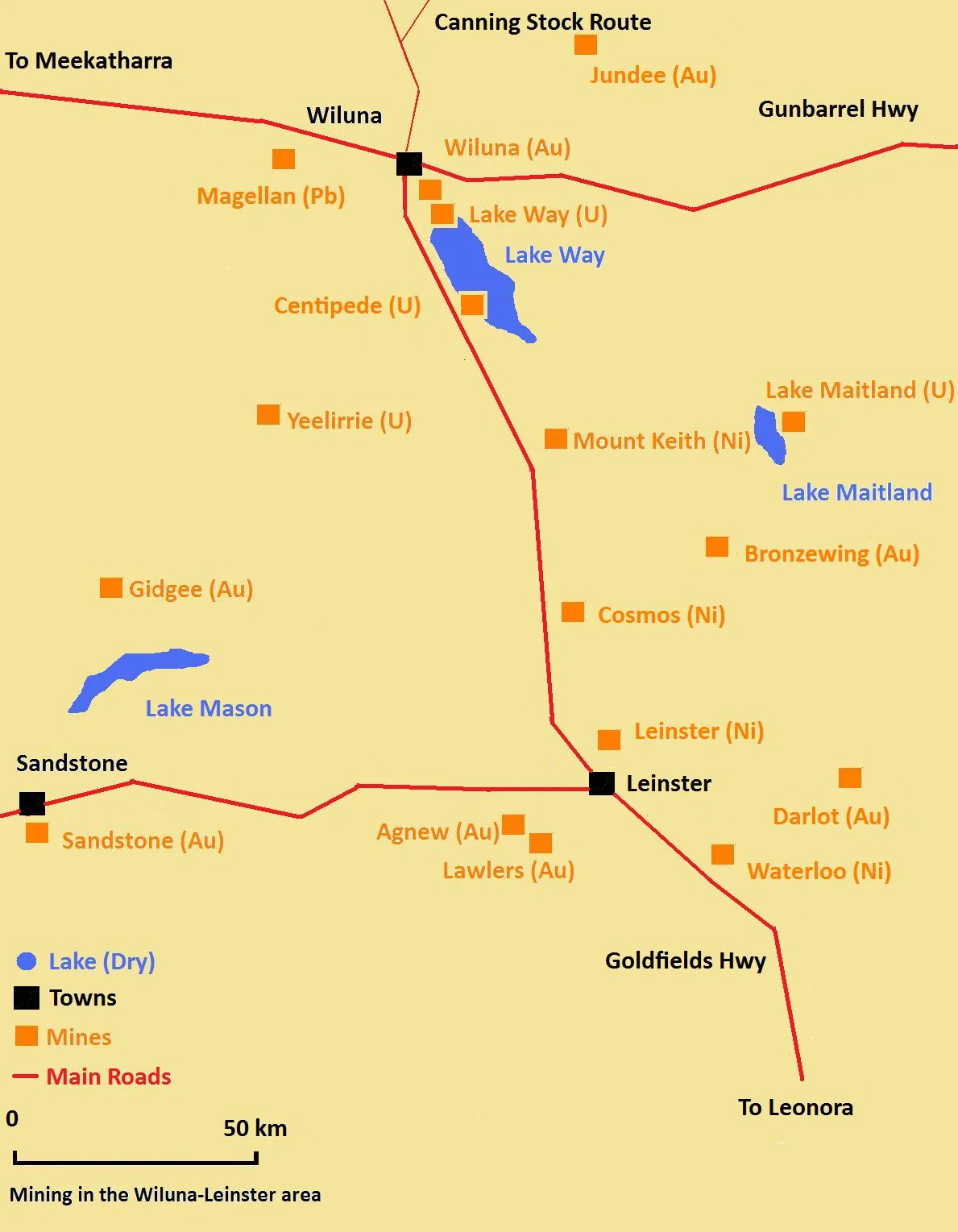
The Leinster Nickel Mine sits at 27.81°S, 120.70°E in the Northern Goldfields of Western Australia, roughly 5 km north of the town of Leinster in the Shire of Leonora. From the air the operation is unmistakable: large open pits, headframes, tailings storage and the grid of a company town set in flat red spinifex country. Leinster Airport (ICAO YLST) lies immediately adjacent and serves the fly-in fly-out workforce; Leonora Airport (YLEO) is to the south and Wiluna Airport (YWLU) to the north. The nearest major airport is Kalgoorlie-Boulder (YPKG), about 370 km south. Terrain is flat semi-arid plain with excellent year-round visibility, though summer heat generates strong thermals and dust haze. Expect mining-related light aircraft and helicopter traffic in the circuit; the site is active industrial airspace even during care-and-maintenance periods.
Nearby Stories
- Cosmos Nickel Mine 19 km away
- Banjawarn Station 36 km away
- Yeelirrie uranium project 40 km away
- Mulga Queen Community 74 km away
- Sandstone, Western Australia 93 km away
- The Great Emu War: When Australia Lost a War to Birds 382 km away
- Neale Junction 444 km away
- Rawlinna, Western Australia 546 km away