
Lepida Gorge
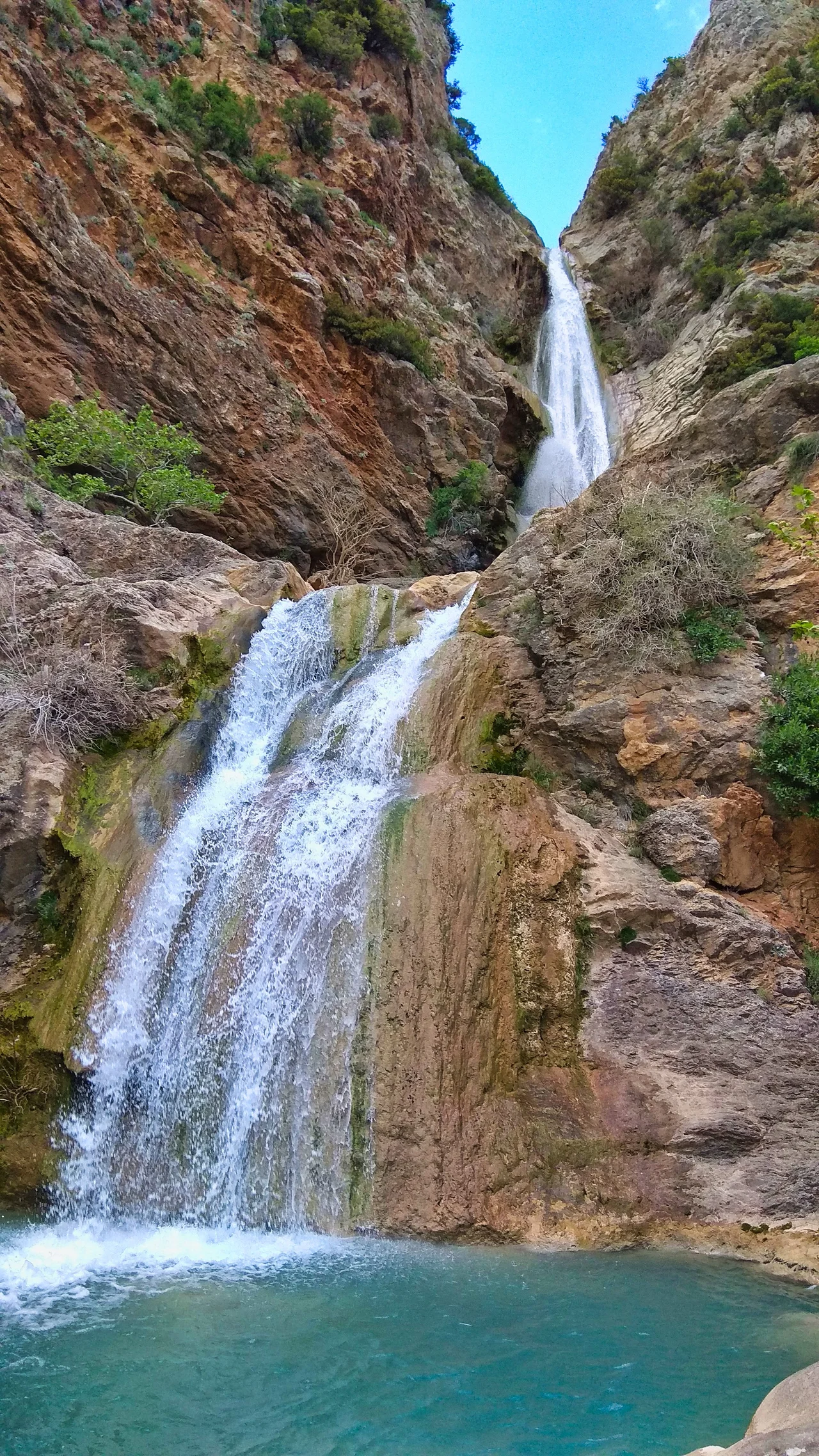
Five hundred meters is not a great length for a gorge. The Lepida Gorge on Mount Parnon in Arcadia compensates by going straight down. Within that half-kilometer of carved limestone, two waterfalls drop through the rock — one of 70 meters, the other of 45 — fed by springs that originate on the Xirokabi plateau high above, between the village of Agios Ioannis and the Malevi Monastery. In spring, when snowmelt swells the flow, the falls fill the gorge with sound and spray. By midsummer, they stop entirely. The gorge has a short season and uses it fully.
Water From the Plateau
The Xirokabi plateau sits at the upper end of the system, a high pasture ground between Agios Ioannis and Malevi Monastery. Water collects there — from rain, from snow, from the small springs that feed the highland — and begins its descent toward the Arcadian lowlands. As it drops from the plateau into the gorge, the river slows long enough to form small pools and lakes along its course before reaching the main drops. The upper waterfall, 70 meters high, stands 3 kilometers from Agios Ioannis; a dirt road brings visitors close, and then a 200-meter footpath leads to the base. The lower fall — called Melissi — sits 1.5 kilometers from the village of Platanos on the road toward Astros. Reaching it requires 800 meters of walking along the riverbed, moving against the flow. Both approaches are manageable on foot in spring conditions, though the riverbed walk becomes unnecessary when the water stops in summer.
The Canyoner's Season
The gorge is used for canyoning and rappelling, and the two waterfalls provide natural anchors for descent. Canyoning — the sport of descending water-carved passages using swimming, scrambling, and rope work — fits the Lepida Gorge precisely: contained, water-fed, with vertical drops worth rigging. The Parnon massif has several such gorges, and Lepida is among the better known for technical descents. Spring is the window; the water that makes the falls dramatic also makes the stone surfaces wet and grippy in the way that experienced canyoners prefer. By late summer, when the flow ceases, the same passages become dry rock corridors suitable for hiking but lacking the specific challenge the sport requires. The nearby ruins of Oria Castle — a medieval fortress — sit close enough to be combined with a visit, though the castle itself is a separate attraction on the edge of the Arcadian landscape.
Parnon's Hidden Interior
Mount Parnon — Parnonas in Greek — is the quieter of the Peloponnese's two great mountain ranges, less visited than Taygetos to the west but covering a substantial area of the eastern peninsula. Its interior holds a landscape of plateaus, gorges, monasteries, and villages that most visitors to the Peloponnese never reach. The Lepida Gorge is part of this interior: not on the main road between ancient sites, not easily reached without intention. The Xirokabi plateau above it, the Malevi Monastery 5 kilometers further along the mountain, the village of Agios Ioannis to the north — these places form a connected landscape, each one pointing toward the others. The old Oria Castle, near the gorge, is a medieval remnant among many in a region that was strategically important across multiple centuries of Byzantine, Frankish, and Ottoman control. Parnon does not announce itself; it rewards the traveler who turns off the main road.
From the Air
The Lepida Gorge is located at approximately 37.34°N, 22.63°E on the western slopes of Mount Parnon in Arcadia, Peloponnese. From the air, Parnon appears as a broad, forested ridge running roughly north-south; the gorge itself is too narrow to distinguish from altitude, but the Xirokabi plateau above it is visible as a high clearing in the forest. The Malevi Monastery sits in the same mountain sector to the southwest. Recommended viewing altitude is 6,000–10,000 feet for the full Parnon massif. The nearest major airport is LGKL (Kalamata International), approximately 80 km to the west. Spring offers the best conditions — visible snow on upper slopes and waterfall activity in the gorge below.
Nearby Stories
- Anthochori, Arcadia 2 km away
- Ancient Theatre of Argos 4.2 km away
- Hermione: The City at the Edge of the World 5.3 km away
- Kalamata Castle 5.6 km away
- Diocese of Amyclae 9.4 km away
- Agistri 15 km away
- Barony of Akova 21 km away
- SS Heraklion 86 km away