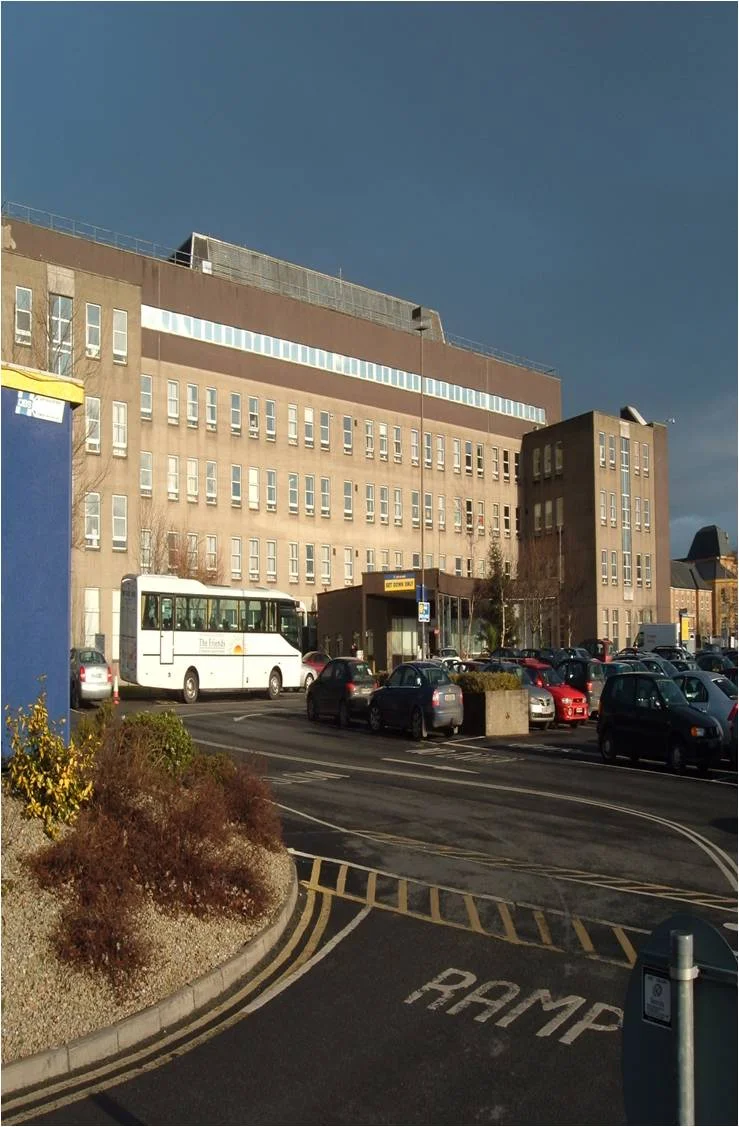

Letterkenny University Hospital
Hospital manager Sean Murphy could not believe how fast it happened. We had an hour, he said afterward, that changed the face of the hospital. On 26 July 2013, after a heatwave broke over Donegal in a single thunderstorm, the nearby river burst its banks and a wall of water poured through Letterkenny General Hospital - destroying the brand-new emergency department, the radiology department, the outpatient department, the kitchens, the pathology lab, the medical records, the wards. Raw sewage rose through the floors. Off-duty nurses ran back from town to help evacuate patients. A state of emergency was declared. Forty million euro in damage. The cause was banal: the drains outside the hospital had not been cleaned for seven months because of council cutbacks, and the floodwater had nowhere to go.
From Workhouse to University
The hospital has its origins in the Letterkenny Union Workhouse and Infirmary, designed by George Wilkinson and opened on Kilmacrennan Road in 1844 - one of those grim Victorian institutions that grew out of the Poor Law and stood as a final resort for the destitute. From the workhouse came the Letterkenny District Hospital, and from that the modern multi-storey block built in 1981. Some specialty services - dental, ophthalmic, parts of mental health - still operate across the road in St Conal's Hospital. In November 2015, the name changed officially to Letterkenny University Hospital, reflecting its teaching links with the University of Galway, Atlantic Technological University Letterkenny, and the Royal College of Surgeons in Ireland. The campus is now divided by the N56 road that carries traffic north and west into the rest of Donegal.
Clinton in the Ward
In 2006, Seamus Heaney, the poet who had won the Nobel Prize for Literature eleven years earlier, suffered a stroke. He was driven to Letterkenny with his wife. Bill Clinton, in Ireland at the time for the 2006 Ryder Cup in County Kildare, heard about Heaney's episode - as the poet himself wryly described it - and put a call through to the hospital. He said he was on his way. Clinton, as Heaney recalled it later, strode into the ward like a kind of god. He shook the hands of the four or five men sharing Heaney's ward, men in worse shape than the poet, then walked through the rest of the hospital greeting patients. They spoke for 25 minutes about Ulysses Grant's memoirs, which Clinton was reading at the time. The former president gave the whole hospital a terrific boost, Heaney said, then left directly for the airport. The hospital had hosted a president and a Nobel laureate. The visit took on the quality of folklore.
Other Days
Not every day is touched by visiting presidents. On 14 July 2009, a man brandishing an axe entered the hospital and barricaded himself into a staff room on floor E. He was making his way to intensive care to visit the husband of a deceased family member after taking a drug overdose in the aftermath of his own wife's death in a car crash. Family members and staff eventually talked him out. Another man, on a separate occasion, walked into the intensive care unit dressed as a priest with a knife concealed beneath his garments. He left the scene peacefully. The hospital sees what hospitals see: human catastrophe in many forms, and the staff who absorb it day after day. The new emergency department that the 2013 flood would destroy was approved in November 2008 - 22 million euro, three medical floors with 72 beds, 19 treatment spaces. Health Minister James Reilly opened it in 2013. It would last weeks.
And Then Again
The aftermath of the 2013 flood was bitter. Taoiseach Enda Kenny called the damage substantial and conceded that the hospital would be out of operation for a considerable time. He did not visit and was heavily criticised for not doing so. Fianna Fail leader Micheal Martin, who had announced the new emergency department a decade earlier, visited on 31 July. Junior health minister Kathleen Lynch came the same day - and became, during her visit, the first patient admitted to the post-flood hospital after taking ill herself. Patients were diverted to Sligo and across the border to Derry, putting strain on hospitals already at capacity. Nurses were told they would have to register in the UK to work the overflow in Derry. The mobile kitchens from the 39th G8 summit at Lough Erne were rushed in to cope with the destruction of the hospital's own kitchen. Five months after reopening, on 5 August 2014, the hospital flooded again. A local councillor demanded an independent inquiry into why the new wing had been built in a hollow. In January 2021, the hospital made international news again, briefly overwhelmed during the COVID-19 surge. The trolleys were back. The workhouse origins, somehow, felt less distant than the polished website might suggest.
From the Air
Coordinates 54.96 degrees N, 7.73 degrees W, in Letterkenny on the N56 road in County Donegal. Best viewed at 1,500 to 3,000 feet AGL to see the hospital campus, the dividing main road, and the town itself in the Swilly valley. Nearest airport is City of Derry Airport (EGAE) about 30 km east-northeast. Donegal Airport (EIDL) at Carrickfinn sits 55 km west. Letterkenny has a small private airfield (EILT) on its outskirts with hard and grass runways. Swilly valley weather is often damp; the same drainage patterns that flooded the hospital in 2013 and 2014 still shape the local hydrology.
Nearby Stories
- Donegal Castle 2.2 km away
- Greencastle, County Donegal 3.1 km away
- Dungiven 6.8 km away
- Dunaff 9.7 km away
- Tory Island 12 km away
- Omagh 18 km away
- Gweedore 19 km away
- Castlecaulfield 22 km away