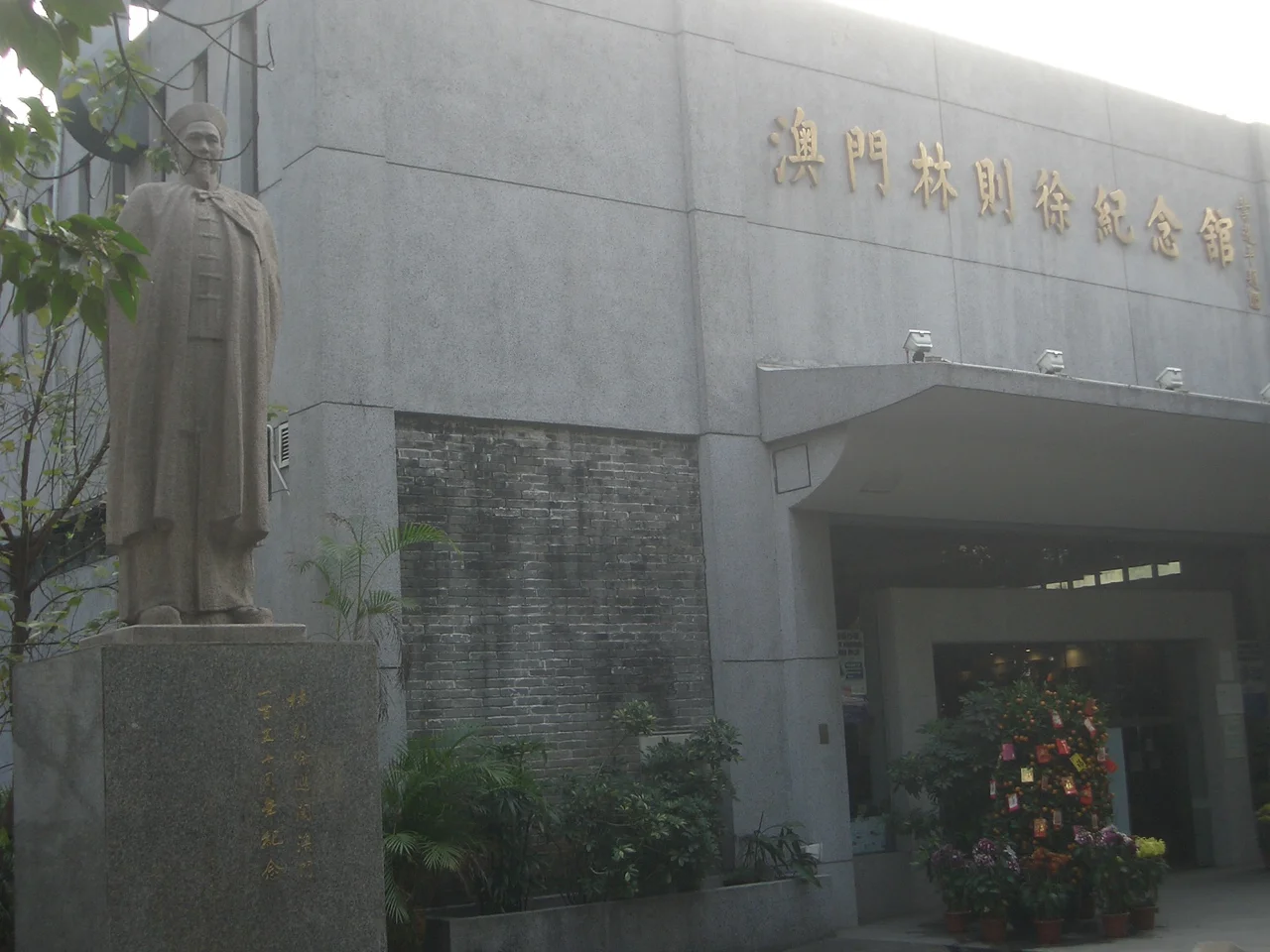

Lin Zexu Memorial Museum of Macau
On 3 September 1839, Commissioner Lin Zexu arrived in Macau. He had already made history. Two months earlier, Lin had supervised the confiscation and destruction of more than 1,200 tons of opium belonging to British and American merchants at Humen — a deliberate act of moral enforcement that the Qing Emperor had ordered and the British Empire would not forgive. His arrival in Macau carried the weight of everything that had happened at Humen, and everything that was about to happen: within a year, Britain would dispatch warships, and the First Opium War would begin. A small museum in the Nossa Senhora de Fátima parish now holds that moment.
The Commissioner Who Came to Macau
Lin Zexu was no minor official dispatched to handle a customs dispute. He was one of the most capable and morally serious administrators of the late Qing dynasty — a man who had written directly to Queen Victoria arguing, in measured and rigorous terms, that Britain had no right to profit from a trade that was destroying Chinese society. His letter was never formally acknowledged. Instead, he received the appointment to root out the opium trade in Guangdong Province, which he executed with thoroughness and conviction.
His visit to Macau in September 1839 was an inspection tour — part of his broader effort to understand the territory's role in the opium trade and to assess the situation of Chinese residents living under Portuguese administration. He walked a delicate diplomatic path, entering a territory that was neither fully Chinese nor fully Portuguese, during a crisis that was moving rapidly toward war.
What the Museum Holds
Completed in November 1997, the Lin Zexu Memorial Museum of Macau occupies a modest building in the northern part of the Macau Peninsula. A statue of Lin Zexu stands at the entrance, rising four meters — commanding without being grandiose. Four exhibition areas inside trace different aspects of the story: the ban on the opium trade and Lin's inspection of Macau; the "Everlasting Memorials" that document his official dispatches and moral arguments; "Eyes Opened to the World," which examines how Lin became one of the first Qing officials to systematically study Western technology and international affairs; and "Macao before the Inspection Tour," which provides context on what kind of place Macau was in the years leading up to 1839.
The museum opened as Macau was approaching its own historical pivot — the 1999 handover to China was two years away, and the question of how to situate Macau's history within the larger history of Chinese sovereignty was very much alive.
The Weight of an Unacknowledged Letter
What makes Lin Zexu's story both tragic and significant is that he was right. He understood, with unusual clarity, that the opium trade was a form of economic warfare — that Britain was exchanging a substance that generated addiction and social ruin for Chinese silver, draining the country while destroying its people. His arguments to Queen Victoria were logically coherent and morally straightforward. They were ignored.
Lin was demoted in 1840 — still during the war — and sent into exile in Xinjiang. He did not live to see how completely his warnings would be validated by subsequent history. The museum does not editorialize about this — the exhibition areas lay out the record, and the record speaks clearly enough. Lin Zexu came to Macau as a man trying to prevent a war. The war came anyway.
A Story Between Empires
The location itself carries meaning. Macau in 1839 occupied a peculiar position: a Portuguese enclave on Chinese territory, where Western merchants, Chinese officials, and colonial administrators negotiated the terms of coexistence daily. Lin's inspection tour forced a question that Portuguese administrators found uncomfortable — whose law applied here, and to whom? His presence made the lines visible.
Today, the museum sits in the same densely built neighborhood, a few blocks from the Kun Iam Temple where, five years after Lin's visit, the first U.S.-China treaty would be signed. The proximity is not coincidental — this part of Macau's peninsula was where the encounter between Chinese authority and Western ambition played out most directly in the mid-19th century. Walking between these sites, visitors move through the compressed geography of a world in the process of being reorganized.
From the Air
The Lin Zexu Memorial Museum sits at approximately 22.210°N, 113.547°E in the Nossa Senhora de Fátima parish, in the northern section of the Macau Peninsula. From the air, the peninsula's dense urban grid is most recognizable here by the green patches of Mong Ha Hill to the north and the open water of the Pearl River estuary to the west. Macau International Airport (VMMC) is on Taipa Island, roughly 5 kilometers to the southeast. Recommended viewing altitude is 1,500–3,000 feet.
Nearby Stories
- 2024 Shenzhen Stabbing 0.8 km away
- Lantau Peak 1.5 km away
- Kweilin Incident 2.4 km away
- Taishan City 7 km away
- Wanshan Archipelago Campaign 38 km away
- Hong Kong 12 68 km away
- Battle of Nanpeng Island 82 km away
- Erhai Lake 1335 km away