.jpg)
Llanaelhaearn Lifeboat Station
Captain John Alexander Strachan was at the helm of the SS Cyprian on 14 October 1881, off the southern edge of Caernarfon Bay, when the worst storm of the year tore his steamship apart. Twenty-eight people were aboard. A boy - a stowaway no one had known was on the ship - emerged from somewhere below decks as the Cyprian broke up. Strachan took off his own life-jacket and put it on the boy. The boy was one of only eight survivors. The captain was not. When the story reached a paint manufacturer's widow in Henley-on-Thames, she sent eight hundred pounds to the RNLI to build a lifeboat - one that would carry Strachan's ship's name and serve the coast where he had drowned.
Black Friday
The fourteenth of October 1881 was a catastrophe of national proportions for the British fishing fleet. More than a hundred ships went down across the British Isles in the storm, and at Eyemouth on the Berwickshire coast - the town that still remembers the day as Black Friday - twenty fishing boats were lost in a single morning, taking 189 men with them. The Cyprian was much larger than the Eyemouth boats, a Liverpool-based steamship of about a thousand tons running south through the Irish Sea towards the Mediterranean with general cargo. When the hurricane-force south-westerlies hit her she was driven helpless onto the rocky coast south of Caernarfon Bay. Twenty of her people died, including Strachan.
The Widow Noble's Gift
Mrs John Noble had married into Noble's Paints & Varnishes, a successful manufacturing firm based in the Thames Valley, and lived at Park Place in Henley-on-Thames. The Cyprian story reached her through the newspapers and moved her deeply enough to act. She sent the RNLI an unsolicited donation of eight hundred pounds - a very substantial sum in 1881, perhaps eighty thousand in modern terms - with a specific request: that it be used to fund a new lifeboat on the Caernarfonshire coast, in memory of Captain Strachan. The RNLI committee met on 2 February 1882 and accepted her terms. They began to look for a site.
Trefor, Not Llanaelhaearn
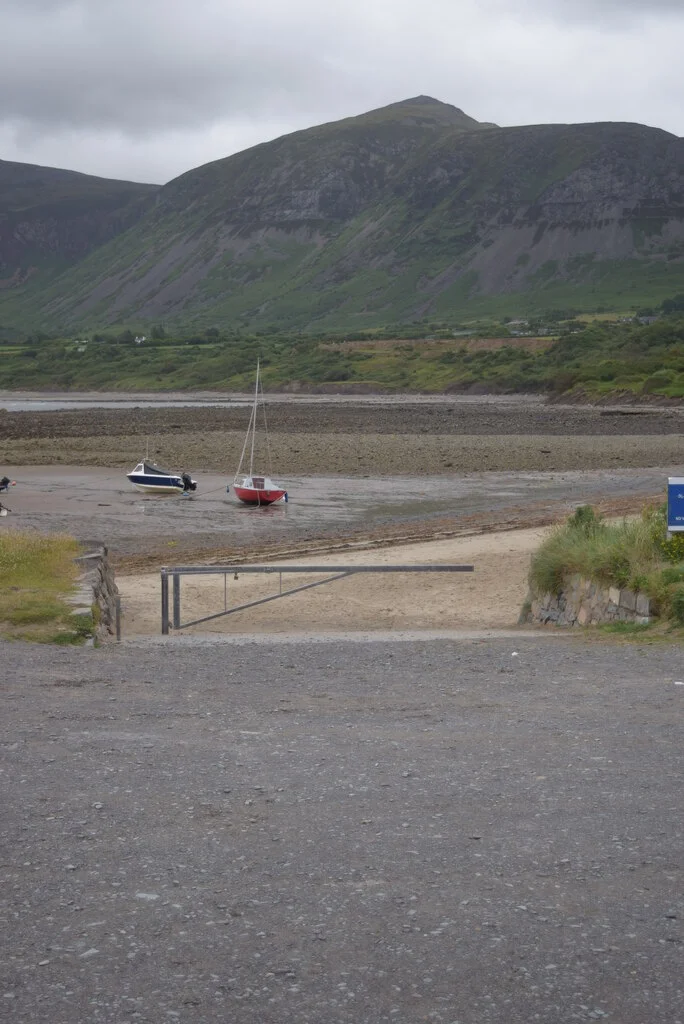
The name on the station tells one story and the geography another. The lifeboat was officially Llanaelhaearn Lifeboat Station, named for the parish, but in fact it stood two miles north-west at Trefor harbour - a small port that had been built around the shipment of granite from the quarries at Trefor Mountain via a private quarry railway. The stone pier and harbour were a ready-made base for a lifeboat. The RNLI's records described the location as commanding the entrance to the Menai Straits, the Carnarvon bar, and the dangerous south shore of the bay. The boathouse was built by G. Roberts of nearby Caernarfon for 425 pounds, with a Woolfe of Shadwell 37-foot self-righting pulling-and-sailing lifeboat costing 392 pounds and 10 shillings. A transporting carriage came in at 132 pounds.
The Lifeboat Cyprian
On 1 July 1882 the new lifeboat was exhibited at Henley-on-Thames - a piece of public theatre that let Mrs Noble see the boat her money had built and reminded the genteel Thames Valley of the lifeboatmen on the Welsh coast they would never meet. The boat was named Cyprian, with the RNLI's official number ON 238. After the ceremony she was taken by rail to Caernarfon and sailed down to Trefor, arriving on 19 April 1883. Her first call came on 12 December 1883: the Liverpool vessel Lady Hicks was in trouble offshore. The launch went badly. A huge wave hit the lifeboat in the shallow water of the harbour mouth, capsized her, broke both her masts. The Cyprian self-righted as designed, the crew regained the boat, but she was driven back ashore. The Lady Hicks's own crew got themselves to land in the ship's boat. No lives were lost, but the rescue had failed.
Eight Launches, Two Lives, Closure
Over eighteen years the Cyprian was launched on service eight times and saved two lives. Those numbers, by modern RNLI standards, sound small; in the context of late-Victorian coastal rescue they were unremarkable for a station that covered a quiet stretch of bay with relatively little traffic. By April 1901 the lifeboat itself was found to be unfit for further service, and the RNLI made the strategic call: with another station at Porthdinllaen a few miles south and a third nine miles north-west, Trefor could close. The boat was sold locally. The boathouse became a quarry store, then a private home, and was demolished in the 1960s. All that survives now is a launchway slope cut through the stone pier - the only trace, on the Trefor waterfront, of a captain who died in the storm of 1881 and a widow who turned that death into a boat.
From the Air
53.00°N, 4.42°W on the north-east coast of the Llŷn Peninsula at Trefor, between Porthdinllaen to the south and Caernarfon to the north. Best viewed at 1,500-2,500 ft to make out the stone pier of the old granite-shipping harbour, with the Yr Eifl mountain group rising directly behind. EGCK (Caernarfon) is the nearest active airport, 8 nm north-east.
Nearby Stories
- GeoMôn 1.9 km away
- Battle of the Conwy 3.2 km away
- Irish Sea Bridge 5.2 km away
- Ysbyty Ifan 10 km away
- Machynlleth 16 km away
- Barmouth Lifeboat Station 23 km away
- Irish Sea 27 km away
- HMS Tyler 32 km away