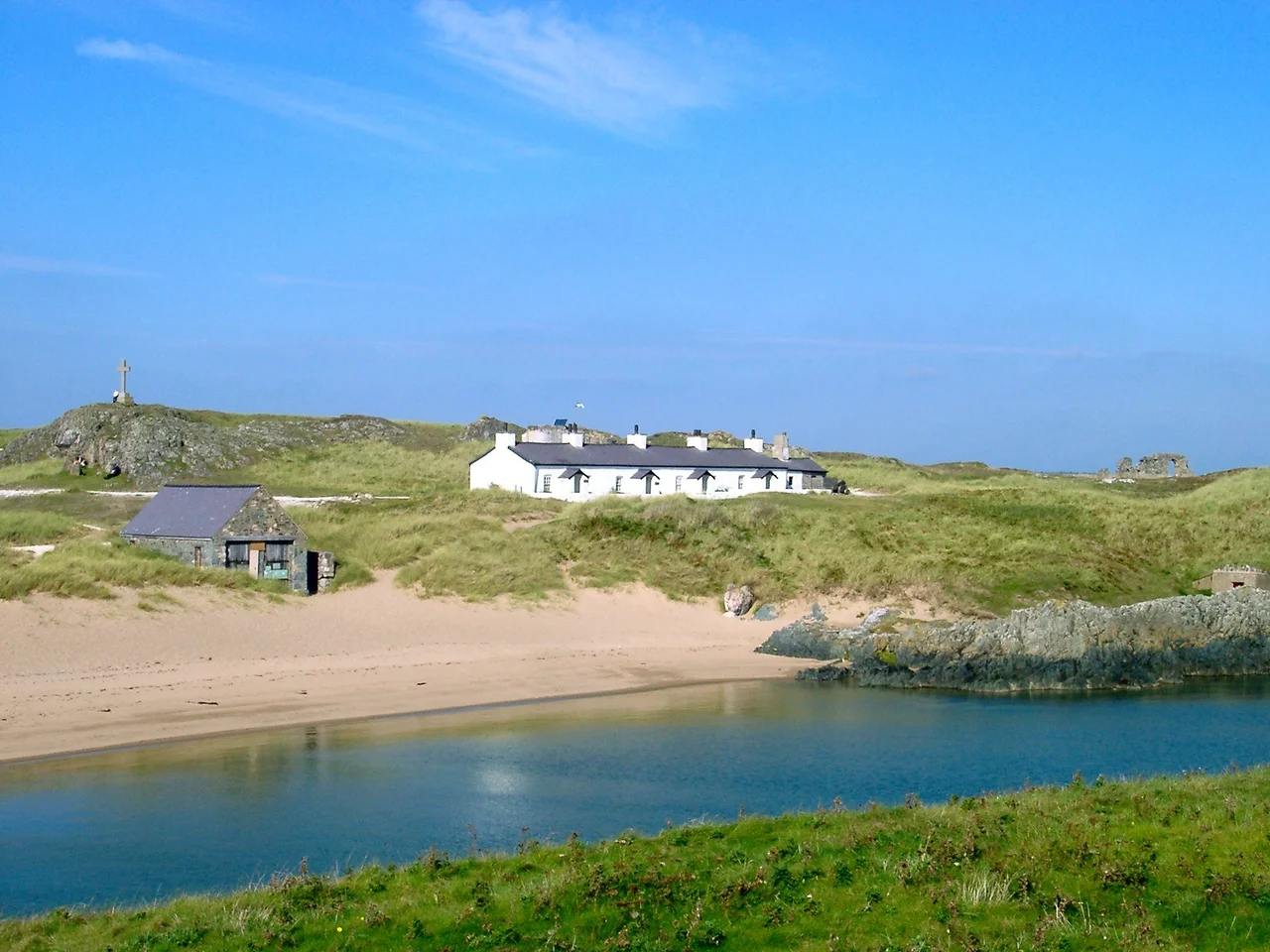

Llanddwyn Lifeboat Station
On 7 February 1846, the merchant ship Heywood ran onto a sandbar called North Bank with twenty-two souls aboard. The lifeboat that put out from Ynys Llanddwyn - a tidal island so remote it could only be reached on foot at low water - brought all twenty-two back alive. The station that launched her had no full-time crew, no telegraph, no slipway worth the name. What it had were a row of pilots' cottages and a few extra hands from the village of Newborough, willing to row into a winter sea on the chance that someone out there needed pulling from it. The Llanddwyn Lifeboat Station served for eighty-one years before the same problem that closed it in 1836 closed it again, for good, in 1907.
The First Boat, 1826
Ynys Llanddwyn was already populated when the first lifeboat arrived. A row of stone cottages on the island housed the pilots who guided merchant ships up the Menai Strait toward Caernarfon. The Caernarfon Harbour Trust placed a boat there in 1826, betting that the pilots could double as rescue crew when ships hit trouble in Caernarfon Bay. The arithmetic never quite worked. There were usually too few pilots on the island at any one moment to launch a boat that needed at least six oars. A handful of rescues may have been attempted; records are spotty. By 1835 or 1836 the boat had been pulled back to Caernarfon, where the crew problem was less acute. The lesson - that geography and rescue work do not always cooperate - would have to be relearned.
The Second Boat, 1840
In 1840 the Anglesey Association for the Preservation of Life from Shipwreck tried again. They bought a 26-foot lifeboat from Taylor of Limehouse for £65, built a 32-foot boathouse on the island, and enrolled four extra men from Newborough village to thicken the crew. This time it stuck. The Heywood rescue six years later proved the model. So did a much grimmer night the following year. On 16 September 1847, the lifeboat was launched in heavy seas to help the Soane of Boston; she capsized and was washed ashore, drowning crew member William Owen. The other men righted her, set out again, and brought every member of the Soane's crew home. In 1855 the RNLI took over management of the station. In 1861 they built a new boathouse for £130 and stationed a 30-foot self-righting boat - the first generation of a design that could roll over in a wave and pop back upright. In five years that boat saved twenty-nine lives.
The John Gray Bell
In 1866 the station received a new boat with a story. John Gray Bell had been a bookseller in Manchester and an honorary secretary of the RNLI's Manchester branch. When he died, donations in his memory funded a Llanddwyn lifeboat that took his name. After the boat was completed in Caernarfon, she was draped in flags and paraded through the town to the harbour, then launched and rowed across the Menai Strait to her station. The carriage that would haul her up and down the beach was ferried to the island free of charge on the steamer. The John Gray Bell served until 1885, when she was replaced by the Richard Henry Gould (ON 66) - a 34-foot, ten-oared self-righting boat from Forrestt of Limehouse, built for £327. She was the last lifeboat Llanddwyn would ever hold.
Quiet Closure
Twenty-two years of service brought the Richard Henry Gould only ten launches and just two lives saved. The shipping had changed. Steam was replacing sail, and ships in trouble were now further out or differently in trouble than they had been in the 1840s. The crew problem returned in its old form. Newborough's young men were drifting away from the village, and getting anyone reliably to the island - across mud flats and tide - in time to launch was becoming impossible. In 1907 the RNLI made the same decision the Caernarfon Harbour Trust had made seventy-one years earlier: Llanddwyn was simply too remote. The station was formally closed. The pilots' cottages still stand on the island. The boathouse ruin is still visible, looking out across the bay toward water that has not been any less dangerous since.
From the Air
Coordinates 53.135°N, 4.414°W on Ynys Llanddwyn, a slender tidal island reaching out from the southwest coast of Anglesey into Caernarfon Bay. Caernarfon Airport (EGCK) sits 10 km southeast across the bay, and RAF Valley (EGOV) lies 15 km northwest. The island is unmistakable from the air as a long, low promontory pointing south-southwest, with two small white lighthouses near its tip. The ruined boathouse and pilots' cottages cluster near the landward end. Best viewed at 1,500 to 3,000 feet at low tide, when the connecting sand causeway from Newborough Forest is fully exposed.
Nearby Stories
- Wakestock 1.7 km away
- Trefriw 3.8 km away
- Irish Sea 8.7 km away
- Irish Sea Bridge 20 km away
- East–West Interconnector 30 km away
- Machynlleth 36 km away
- HMS Tyler 41 km away
- New Brighton Lifeboat Station 54 km away