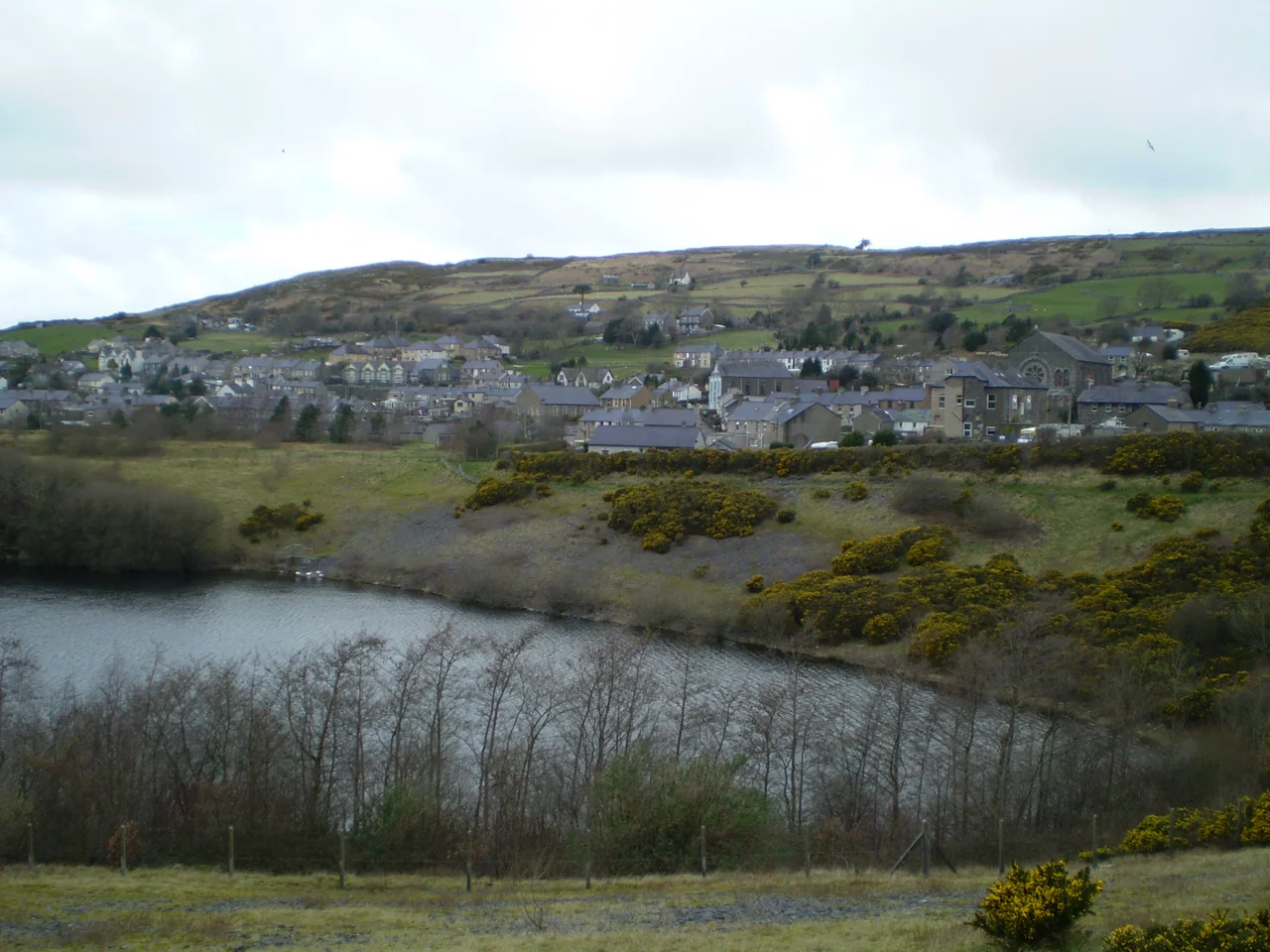

Llanllyfni
On the morning of 6 July each year, the village of Llanllyfni holds a fair. It has held the same fair on the same day for at least two hundred years -- St Rhedyw's Day, named for the fourth-century saint to whom the parish church is dedicated. The village sits in the floor of the Nantlle Valley, four miles inland from Caernarfon, surrounded by mountains that were quarried for slate from the late eighteenth century until the late twentieth. Eighty-five percent of its residents speak Welsh as their first language. Among them, when he was a small boy, was the man whose voice would one day fill opera houses from La Scala to the Met.
St Rhedyw and the Christmas Service
Eglwys Sant Rhedyw, the parish church, has stood on this site since at least the fourth century, though the present building dates from much later. Rhedyw is one of the obscure early Welsh saints whose feast day survives in the local calendar despite his vita being almost entirely lost to history. The church still holds a traditional Plygain service at 7 a.m. on Christmas morning -- a Welsh devotional tradition combining hymns and carols, often unaccompanied and sometimes sung competitively between local choirs and individual voices. Plygain comes from the Latin pulli cantio, the cock-crow, the moment between night and dawn when the service begins. Llanllyfni's Plygain is one of the oldest in continuous celebration anywhere in north-west Wales. Two other places of worship have served the village: the Baptist Capel Ebeneser, which is still open, and Capel Moriah, which closed in recent years. Once there were five cemeteries; one, Mynwent Bara Caws, dates from the early eighteenth century.
Bryn Terfel's Primary School
Bryn Terfel grew up at Pant Glas on the edge of the Nantlle Valley, attended Ysgol Gynradd Llanllyfni, the village primary school, and then Ysgol Dyffryn Nantlle, the secondary school a mile down the road in Penygroes. He went on from there to the Guildhall School of Music in London, won the Lieder Prize at the 1989 Cardiff Singer of the World competition, and built one of the most distinguished bass-baritone careers of his generation. Terfel has sung Wotan at Bayreuth and Falstaff at La Scala. He performed at the opening ceremony of the 2012 London Olympics. He is also a fluent Welsh speaker who has done more than perhaps anyone alive to bring the Welsh musical tradition to international audiences. The walk between his old primary and secondary schools is less than a mile. The houses he passed, the chapel his family used, the streets where he played as a boy are all still here, mostly unchanged. World-class voices come from improbable places.
The Quarryman's Arms and Bryn Fôn
Llanllyfni once had at least five pubs. Two of them survive as private houses, including the King's Head; the rest are gone. The last to close was the Quarryman's Arms, which burned down and was demolished. The singer and actor Bryn Fôn -- a different Bryn, another product of Llanllyfni who attended the same schools as Terfel -- wrote a song called 'Quarry (Man's Arms)' about the lost pub. Bryn Fôn lives locally and is one of the best-known Welsh-language popular musicians of his generation; his band Sobin a'r Smaeliaid has been touring Wales for decades. The village has produced an unusual share of cultural figures for its size: alongside Terfel and Bryn Fôn, the writer Mathonwy Hughes, the founder of Ysgol Glanaethwy Cefin Roberts, and the writer and actor Wynford Ellis Owen all grew up here. In the eighteenth century, the village figure of Martha'r Mynydd convinced her neighbours of the existence of invisible people -- one of those folk traditions that may speak to a more ancient strand of belief in the Tylwyth Teg, the fairy folk of Welsh tradition.
Quarries, Football and the Welsh Tongue
Llanllyfni existed before the slate quarries opened, but it grew as they grew. The village stretches along the floor of the Nantlle Valley, almost conjoined with Penygroes to the north and Talysarn to the south-east. The Nantlle Ridge rises to the south, with Craig Cwm Silyn at 2,408 feet as its high point and one of the finest ridge walks in Snowdonia. The football club, C.P.D. Llanllyfni, was set up in 2005 and rose from the Caernarfon and District League through the Gwynedd League to the Welsh Alliance League in four seasons, playing on the King George V playing field beside the Memorial Hall in the middle of the village. The Neuadd Goffa -- Memorial Hall -- is still the centre of social life, hosting concerts, drama, the local branch of Merched y Wawr, and meetings in Welsh. The community recorded 1,256 residents at the 2011 census. Most of them speak Welsh as their first language, and intend to keep doing so.
From the Air
Located at 53.05N, 4.28W in the floor of the Nantlle Valley, about 7 miles south-east of Caernarfon. Caernarfon Airport (EGCK) lies 4nm north-west. Best viewed at 1,500-2,500ft AGL. The village sits on the south side of the valley, the Nantlle Ridge rising to the south (Craig Cwm Silyn 2,408ft) and Mynydd Mawr (Elephant Mountain) to the north. The Afon Llyfni runs through the village from east to west.
Nearby Stories
- GeoMôn 1.9 km away
- Battle of the Conwy 3.2 km away
- Irish Sea Bridge 5.2 km away
- Ysbyty Ifan 10 km away
- Machynlleth 16 km away
- Barmouth Lifeboat Station 23 km away
- Irish Sea 27 km away
- HMS Tyler 32 km away