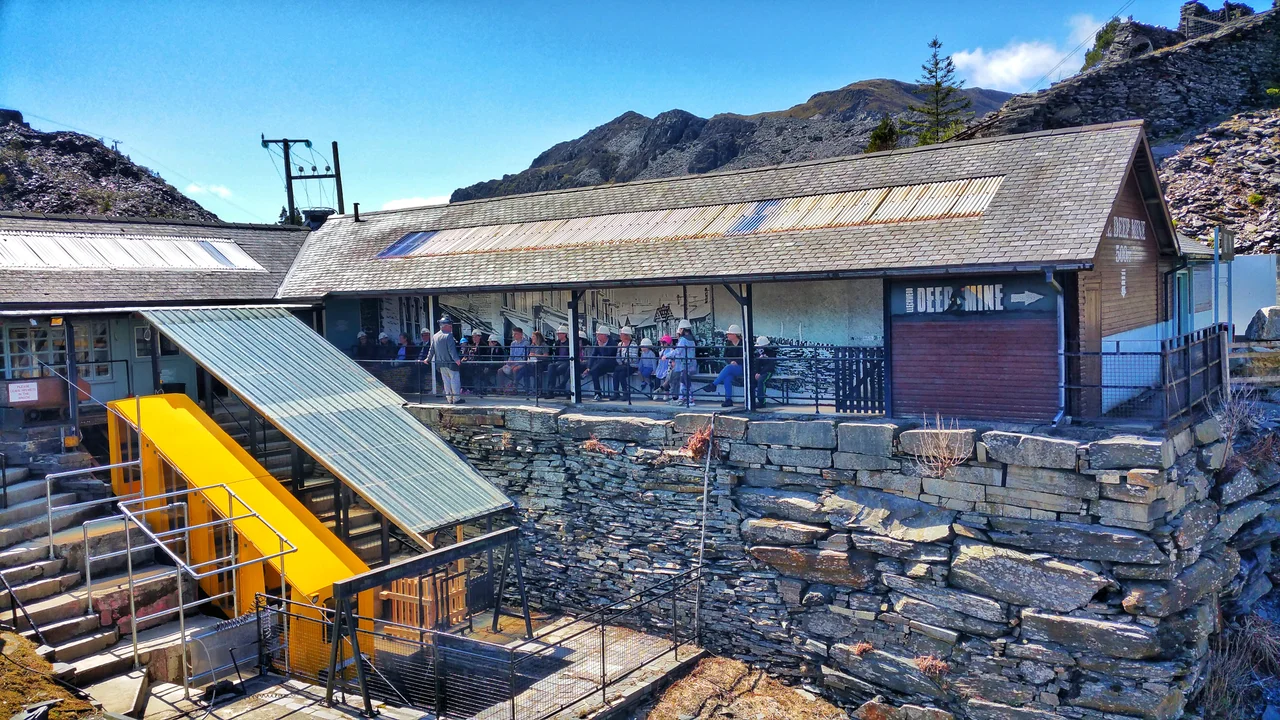

Llechwedd Slate Caverns
There is a particular smell to a slate cavern - cold stone, mineral water, and the faint resin of old timber. At Llechwedd, on the slopes above Blaenau Ffestiniog, that smell sits in chambers the size of cathedrals, hollowed out by Victorian quarrymen working by candlelight. The men are long gone. What they left behind is a labyrinth large enough that, today, visitors descend into it on a passenger railway pitched at thirty degrees, the steepest narrow-gauge passenger line in the United Kingdom, falling more than five hundred feet underground in minutes.
Down the Deep Mine
The Deep Mine Railway opened in 1979. Its gradient is one in one point eight, which means for every metre forward the train drops more than half a metre down. Carriages hang from a cable and creep into a dark cut in the hillside, then plunge through the rock as the daylight collapses to a postage stamp behind them. At the bottom, visitors step out into a series of tunnels and chambers that quarrymen abandoned more than a century ago. In 1992 the displays here were rebuilt using audio-visual technology supplied by Eurodisney - an odd partnership, but the storytelling fits. The 2014 refurbishment combined the old Deep Mine with the original 1972 Miners' Tramway into a single guided Victorian Mine Tour.
Trampolines in the Dark
What do you do with an empty chamber the size of a parish church, deep underground? In 2014 a company called Zip World had an answer: hang trampoline nets across it at three different heights, connected by slides and walkways, and sell tickets. The attraction is called Bounce Below. The nets glow in lurid coloured floodlight, and on a busy day the chamber rings with the shouts of people bouncing across a void of cold air that, only a generation ago, was filled with the silence of abandoned rock. The neighbouring chamber holds Zip World Caverns, which opened in 2015 - a course of underground zip lines threading between the slate walls. Outside on the mountain runs Zip World Titan, billed as the longest zip course in Europe.
The Industry's Memory
Slate built this corner of Wales. At the trade's nineteenth-century peak, Blaenau Ffestiniog roofed the new industrial cities of England, Ireland, and much of Western Europe; the quarrymen developed a culture of poetry, choirs, and chapel-going alongside the brutal work of splitting rock by hand in damp, candle-lit chambers. Many died in falls, in roof collapses, or slowly, of silicosis. Llechwedd's tours try to centre that experience rather than romanticise it. Mannequins in waxy candlelight depict twelve-year-old boys learning the trade. Audio guides narrate the Quarrymen's Strike of 1900, a three-year industrial dispute that broke families and left the slate industry in slow decline.
The Award Wall
Llechwedd has been honoured almost since it opened to visitors. In 1976 it won the British Tourist Authority's Come to Britain award. In 1980 it took the Silver Otter from the British Guild of Travel Writers, and a third British Tourist Authority award the same year - the first British attraction to collect three of them. The site has continued to evolve. In January 2019 a television crew commandeered the caverns for a week to shoot Y Siambr, broadcast later that year on S4C and described as the world's first ever underground game show. The mountain that once shipped slates to Hamburg and Sydney now ships entertainment to homes across Wales.
Standing at the Bottom
There is a moment partway through the tour where the guide turns off the lights. Not all the lights - they leave a single candle burning on a ledge, the way a quarryman would have worked. The chamber goes dim, then deep. You feel the temperature, the still air, the absence of any sound that did not arrive with you. You think about the boys who climbed down here on rope ladders in the dark, every day for forty years, and the slate roofs in distant cities that owe their existence to that climb. Then the lights come back, and you climb out into the rain of Snowdonia, and the world above looks rearranged.
From the Air
Located at 53.00 degrees north, 3.94 degrees west, on the hillside immediately north of Blaenau Ffestiniog in the eastern Snowdonia. From 3,500-5,000 ft AGL look for the grey terraces of slate spoil that drape the mountainside above the town - they are visible for miles. Nearest airports: Caernarfon (EGCK) 22 nm northwest, RAF Valley (EGOV) 34 nm northwest, RAF Shawbury (EGOS) 58 nm east. Mountain weather is changeable; low cloud often hides the town.
Nearby Stories
- Barmouth 1.6 km away
- Beaumaris Castle 3.1 km away
- Trearddur Bay Lifeboat Station 3.9 km away
- Rhuddlan Castle 4.6 km away
- Tudweiliog 12 km away
- Battle of Maes Moydog 16 km away
- Ruthin Castle 19 km away
- HMS Whirlwind (R87) 51 km away