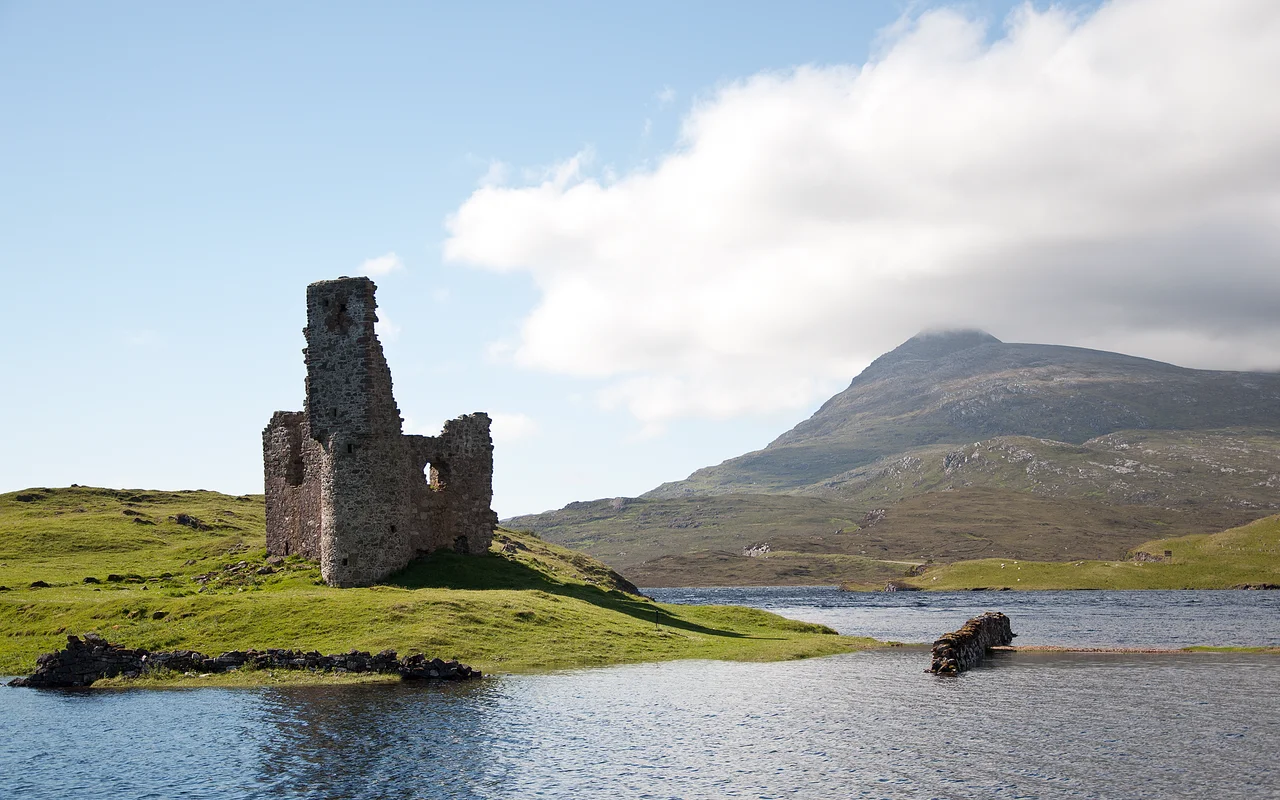

Loch Assynt
Around 1.2 billion years ago, an asteroid hit northwest Scotland. The impact threw up an enormous cloud of vapour and melted rock that scattered material across a wide region around what is now Ullapool. Geologists from Aberdeen University identified the strike in the early 2000s by tracing distinctive shocked minerals in sandstones. They consider it the largest meteorite impact ever found in the British Isles. The crater was buried under sandstone almost immediately, which is why the evidence survived. The locals around Loch Assynt have always had a different explanation. They blame the devil.
A Loch Carved Between Mountains
Loch Assynt is a freshwater loch in Sutherland, eight kilometres northeast of Lochinver, sitting in one of the most spectacular settings in the Scottish Highlands. To the south rises Canisp, to the north Quinag - both Corbett-grade peaks of Torridonian sandstone. The loch itself is 9.65 kilometres long and about 1.5 kilometres at its widest, with a maximum depth of 86 metres. Its drainage basin extends over 111 square kilometres, fed by Lochs Awe and Loch Leitir Easaidh. The loch's general axis runs west-northwest to east-southeast, though it bends sharply southwest at its western end near Loch Assynt Lodge before discharging into the sea via the River Inver, down to Lochinver.
The Mermaid of Assynt
Stories whispered in Inchnadamph, the small settlement at the loch's eastern head, tell of Eimhir, the lost daughter of MacLeod of Assynt. The clan chief promised her in marriage to the devil - in some versions explicitly, in others to a stranger who turned out to be Clootie, an old Scottish name for him. Rather than honour the bargain, Eimhir threw herself off the cliff at Ardvreck. The stories disagree on what happened next. The common version says she plunged not to her death but into the caves beneath the loch, becoming the elusive mermaid who still lives in those underwater chambers. When the loch rises above its normal level, locals say those are Eimhir's tears. Some glimpse her weeping on the rocks - half woman, half sea creature.
Clootie's Revenge
In the legend, Clootie was not amused by the broken promise. The story continues that he summoned meteoric rocks from chaos to obliterate Inchnadamph and MacLeod's kingdom in retribution. Folklorists note the obvious overlap with the actual geology: northwest Scotland really was struck by an object from space, and the rocks around Ullapool genuinely do record that impact. Another version of the legend explains the Moine Thrust - the great geological fault that runs through Assynt and made the area a place of pilgrimage for nineteenth-century geologists. Clootie's rage, this version says, produced a tectonic rumbling that thrust the European plate westwards. The science is more complex, but the story honours the same observation: this is land with a violent past visible in its rocks.
Three Generations of Survey
The loch was systematically surveyed in 1909 by Sir John Murray and Laurence Pullar as part of their Bathymetrical Survey of the Fresh-Water Lochs of Scotland, published the following year. Their work mapped depths, currents and shorelines across hundreds of Scottish lochs and remains the foundation of much modern limnology. Their measurements for Loch Assynt - a maximum depth of 86 metres, a volume of approximately 250 million cubic metres - have held up across more than a century of modern instrumentation. The same loch they rowed across, dropping their lead lines, is the loch that holds Eimhir's tears, that absorbed the asteroid's afterglow, and that today reflects the ruined silhouette of Ardvreck Castle on its still mornings.
From the Air
Loch Assynt stretches at 58.18°N, 5.05°W. From the air it appears as a long, narrow body of water running west-northwest to east-southeast, flanked by the sharp profile of Quinag to the north and Canisp to the south. Ardvreck Castle is the small ruin on the loch's north shore promontory. Nearest airport is Inverness (EGPE), 70 nm to the southeast. Recommended viewing altitude 2,500-4,000 ft to take in the loch's length, the surrounding peaks, and the route west down to Lochinver.
Nearby Stories
- Loch Shin 2.2 km away
- HMS Nelson (28) 2.5 km away
- An Teallach 9.6 km away
- Battle of Drumnacoub 11 km away
- Kinlochbervie 12 km away
- Fyrish Monument 21 km away
- The Minch 21 km away
- German submarine U-905 25 km away