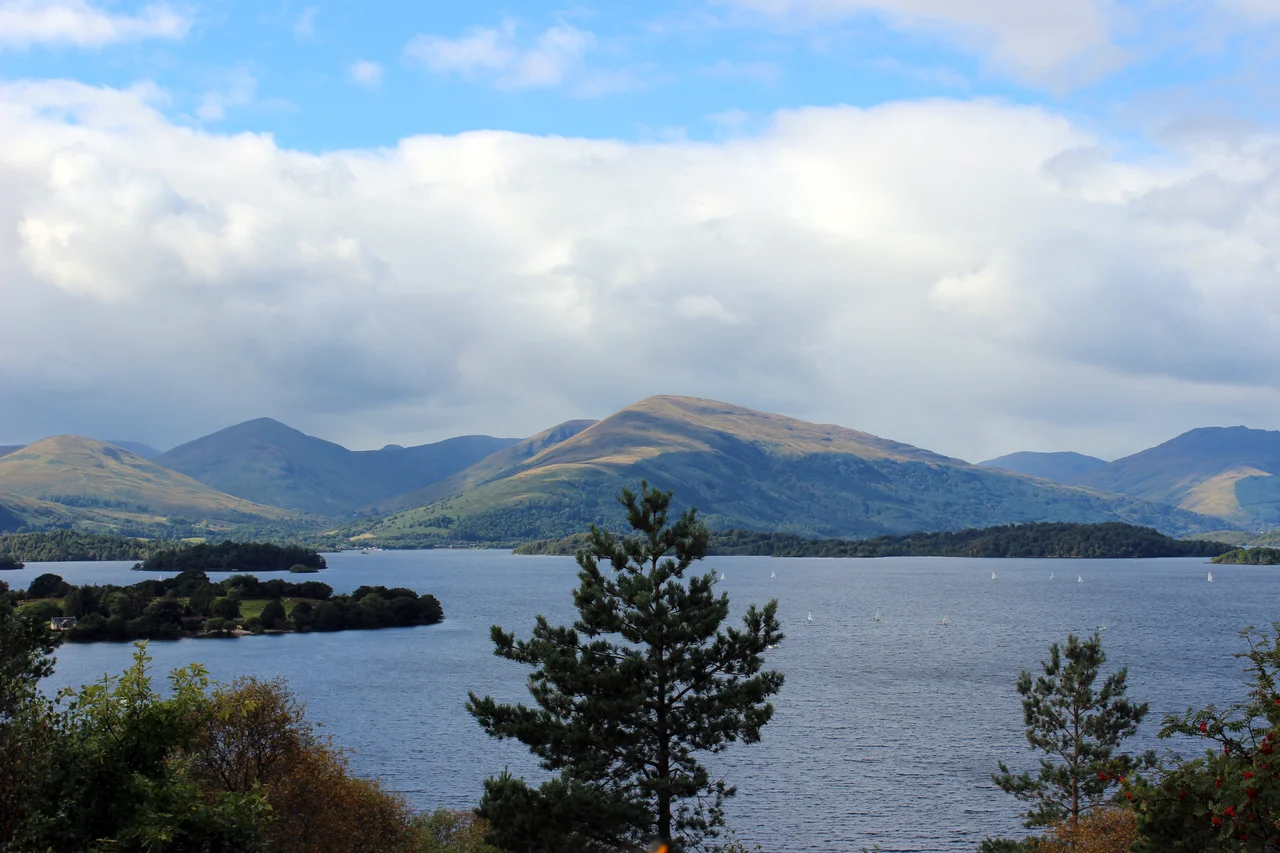

Loch Lomond
Oh, ye'll tak the high road, and I'll tak the low road. A song first published around 1841 made these particular twenty-three miles of fresh water the property of every person who has ever felt homesick for somewhere they may never see again. One story holds that a Jacobite soldier wrote it during the bitter retreat from England in 1745-46. Another says it came from a Scotsman awaiting execution in enemy captivity, the low road being the fairy path by which a soul could return home to the place it had loved. Whichever version you trust, the song has fixed Loch Lomond in the imagination of strangers, and approaching its bonnie banks today, you find a place that earns the sentiment without straining for it.
An Inland Sea Strung with Islands
The loch is enormous. Its waters fill a long trough carved by glaciers along the Highland boundary fault, the geological seam where lowland Scotland meets the mountains proper. To the south, the loch broadens into something more like a bay, scattered with low wooded islands. To the north, it narrows sharply between steep walls, with Ben Lomond rising on the eastern shore and the A82 squeezing along the western edge. There are more species of fish here than in any other Scottish loch: powan, lamprey, brook trout, perch, loach, common roach, flounder. The hills above hold black grouse, ptarmigan, golden eagles, pine martens, red deer, and mountain hares. And on the island of Inchconnachan, surreally, a small colony of red-necked wallabies has been hopping among the bracken for decades, descended from a private menagerie released in the 1940s.
The Beavers Return
In January 2023 a family of beavers came home to Loch Lomond after four centuries of absence. RSPB Scotland released an adult pair and their five offspring into the southeastern shallows under licence from NatureScot. The family had been translocated from Tayside, where their dam-building had begun to cause problems no one could mitigate. Here, in the protected reedbeds of the national nature reserve, they have room to engineer wetlands without flooding anyone's potato field. The Scottish dock, a plant unique in Britain to these shores, grows around Balmaha on the eastern bank, first identified here in 1936. The catchment also wears the full alphabet of conservation labels - SAC, SPA, Ramsar site, national scenic area - because the loch is one of the most ecologically rich pieces of water in the country, and Scotland has decided to defend it on every front.
Crannogs and Longships
People first came to these shores around 5,000 years ago, in the Neolithic, and left traces at Balmaha, Luss, and Inchlonaig. They built crannogs - artificial islands of timber and stone - out in the shallows. One such crannog off the island of Clairinsh is known as 'The Kitchen', and may later have served as a meeting place for the chiefs of Clan Buchanan, whose seat had been on Clairinsh since 1225. Centuries later, during the early medieval period, Viking raiders worked out a portage shortcut: they sailed up Loch Long from the sea, hauled their longships overland at the narrow neck at Tarbet (the name is Gaelic for 'isthmus'), refloated them in Loch Lomond, and sacked the islands. The trick was audacious. The damage was real.
The Paddle Steamer at Balloch
Loch Lomond has been a tourist destination for so long that when James Boswell and Samuel Johnson visited the islands in 1773, Boswell remarked it would be pointless to attempt a description - the loch was already too famous to need one. Today the southern shore at Balloch still hums with arrivals: cruise boats from Luss, Tarbet, Inversnaid, and Rowardennan, kayakers and paddleboarders, the West Highland Way starting its long climb up the eastern bank. At Balloch pier, volunteers are restoring the Maid of the Loch, the last paddle steamer built in Britain, built in Glasgow and launched at Balloch in 1953 and operated on the loch for twenty-eight years before being laid up. The Loch Sloy hydroelectric scheme on the west bank can spin up to 152.5 megawatts in five minutes from standstill - the largest conventional hydro station in the UK, designed to catch sudden spikes in demand from the National Grid.
Why the Song Will Not Let Go
There is a reason Loch Lomond has become shorthand for Scotland itself. Brigadoon borrows it. The Adventures of Tintin gave Captain Haddock a whisky brand named for it. A 1998 Bollywood film used the banks as backdrop for a song sequence. The original 1841 lyric works because it admits the simplest truth about leaving home: the high road and the low road eventually arrive at the same place, but one of you may not be coming back. Standing on the eastern shore at dawn, with mist on the water and Ben Lomond's shoulders catching the first light, you understand why a soldier facing death in 1746 might have written down what he could not bear to lose. The bonnie, bonnie banks are still here. Some of them are still waiting.
From the Air
Loch Lomond stretches roughly north-south at 56.15N, 4.65W, a 23-mile slash of dark water visible from cruising altitude in clear weather. Best viewed at 4,000-6,000 ft AGL for shape and scale. Ben Lomond (974 m / 3,196 ft) marks the eastern shore as a distinctive Munro peak. The narrow northern arm squeezes between mountains; the southern basin broadens with visible islands (Inchmurrin, Inchcailloch, Inchconnachan). Nearest airports: Glasgow International (EGPF) ~20 nm south, Glasgow Prestwick (EGPK) ~30 nm south-southwest. Loch Lomond Seaplanes operated here 2004-2025 from a base near Cameron. Watch for low cloud spilling down the Highland glens; viz can drop quickly in autumn and winter.
Nearby Stories
- Ardchattan Priory 4.3 km away
- Old Firm 5.5 km away
- Callander 9.1 km away
- Skelmorlie Castle 10 km away
- Loch Fyne 11 km away
- HMS Vandal 21 km away
- Fortingall 22 km away
- Rannoch Moor 23 km away