
Old Firm
By the start of 2026, Celtic and Rangers had played each other 449 times in major competition. Rangers led by a single match: 172 wins to 171, with 106 draws. Between them the two Glasgow clubs hold 55 Scottish league titles each at the start of 2026 (Celtic winning a record-breaking 56th in May 2026), 76 Scottish Cups and 50 League Cups, sums that make them, by trophy count, among the most decorated football clubs in the world. Every other Scottish club competes inside their gravitational field, mostly without escaping it. The phrase the Old Firm captures the rivalry and the symbiosis: two clubs that have grown to financial scale at the expense of everyone else by needing each other to exist.
Why Old Firm
Nobody is entirely sure where the phrase comes from. One explanation has commentators at one of the very first matches between the clubs describing them as like two old, firm friends. Another, perhaps more plausible, traces it to a satirical cartoon in the Scottish Referee newspaper before the 1904 Scottish Cup final, depicting an elderly man with a sandwich board reading Patronise The Old Firm: Rangers, Celtic Ltd, a joke about the mutual commercial benefit both clubs derived from their rivalry. There is also the bare fact that both Celtic and Rangers were among the original eleven members of the Scottish Football League when it formed in 1890. At the turn of the 21st century the two clubs jointly registered Old Firm as a trademark; the registration was confirmed as still being renewed in 2021.
A Sectarian Inheritance
The rivalry has always been more than football. Rangers grew through the late 19th and 20th centuries as a club associated with Protestantism, Unionism and, particularly through the Govan shipyards, the Protestant working class. Celtic was founded in 1887 by Brother Walfrid, a Marist monk from Ballymote in County Sligo, to raise money for poor Irish Catholic immigrants in Glasgow's East End. For decades Rangers maintained an unwritten policy against signing Catholic players, broken in 1989 when Graeme Souness signed Maurice Johnston. The two clubs' rivalry has reflected and amplified sectarian divisions in west central Scotland for more than a century, drawing in flags, songs, identities and grievances far older than either club. Anti-sectarian campaigns like Nil by Mouth have worked to change the surrounding culture, with measured success.
Stadium Records and the Ibrox Disaster
The stadium attendance records at both Ibrox and Celtic Park were set at Old Firm matches. Ibrox recorded 118,567 in January 1939, still the largest crowd for any domestic league match anywhere in the United Kingdom. Celtic Park's official figure of 83,500 was set the previous January, with estimates suggesting 92,000 were inside and roughly 10,000 more locked outside the gates. Since the redevelopments of the 1990s, all the major Scottish grounds are all-seater, with capacities now between 50,000 and 60,000. Those pre-war figures will never be matched. The 1971 Ibrox disaster, in which 66 Rangers supporters died in a crush on Stairway 13 leaving an Old Firm match, sits permanently inside the history of the fixture, a reminder that what looks from outside like commercial spectacle was for one family after another a tragedy.
Dominance and the 2012 Reset
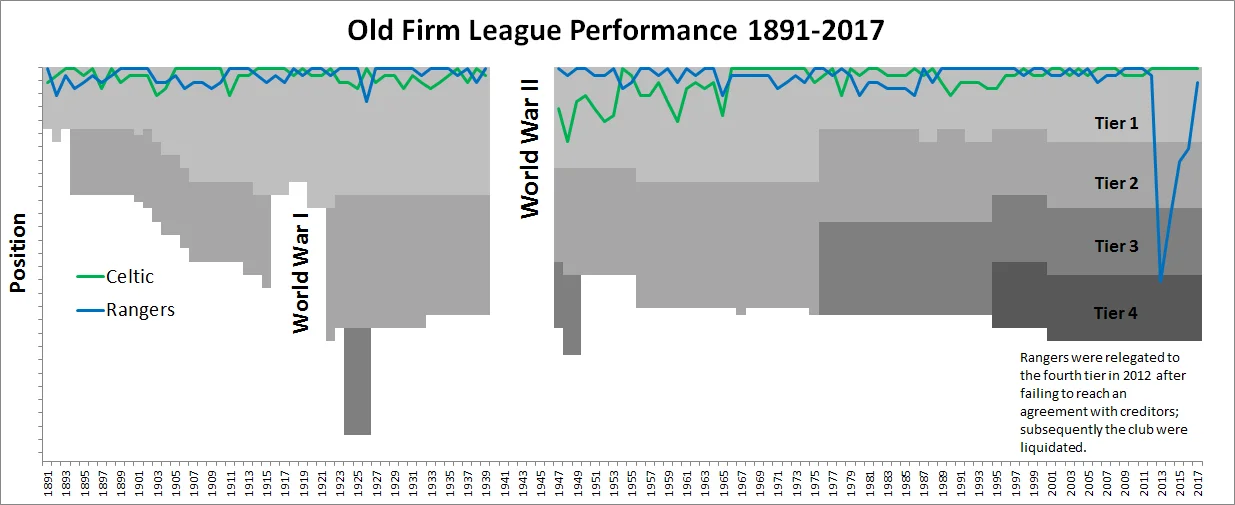
Since the 1985-86 season, one half of the Old Firm has won the Scottish league every year. In all but one of the seventeen seasons between 1995-96 and 2011-12 both clubs finished in the top two. Then in 2012, Rangers' holding company entered liquidation and the club had to apply to enter the bottom division of Scottish football. They climbed back through the divisions and returned to the top flight, winning the 2020-21 Premiership and denying Celtic a tenth consecutive title that would have eclipsed records set in the 1960s and 1970s and matched in the 1980s and 1990s. Many Celtic supporters argue the current Rangers is a distinct legal entity from the pre-2012 club, and prefer the term Glasgow derby. The fixture's commercial weight has not diminished. In 2005 the two clubs were estimated to be worth £120 million a year to the Scottish economy.
A Disproportionate Shadow
The disparity is striking. The Scottish Premiership posts some of the best per-capita attendances in Europe, but roughly two thirds of those crowds are at Ibrox or Celtic Park, with the remaining third divided among 40 or so other clubs. A study by the CIES Football Observatory ranked Celtic 16th and Rangers 18th in the world for stadium attendance between 2013 and 2018, despite Rangers spending three of those seasons in the lower divisions. Celtic's share of the national audience reached 36.5 percent, the highest concentration of any club in the leagues studied. The Old Firm matches themselves remain among the most-watched club fixtures in world football. Around them sits a Scottish league system whose other clubs spend most of their time trying to compete, and most of their conversation reckoning with what it means when two clubs in one city carry that much of the weight.
From the Air
Celtic Park sits at approximately 55.85 N, 4.21 W in Glasgow's East End. Ibrox Stadium is at approximately 55.85 N, 4.31 W in Govan, on the south side of the River Clyde. The two grounds are about 3.5 miles apart, both visible as large green football pitches from cruising altitude. Hampden Park (Scotland's national stadium and frequent neutral venue for Old Firm cup finals) lies at approximately 55.83 N, 4.25 W in the south of the city. Glasgow Airport (EGPF) is approximately 5 nm west of the city centre.
Nearby Stories
- HMS Gannet 3.6 km away
- Luss 5.3 km away
- Oliver Castle 6.8 km away
- Battle of Bannockburn 6.9 km away
- Beith 7.9 km away
- Pentland Hills 7.9 km away
- Lochleven Castle 16 km away
- Cumnock 17 km away