
Locke: The Town They Built But Could Not Own
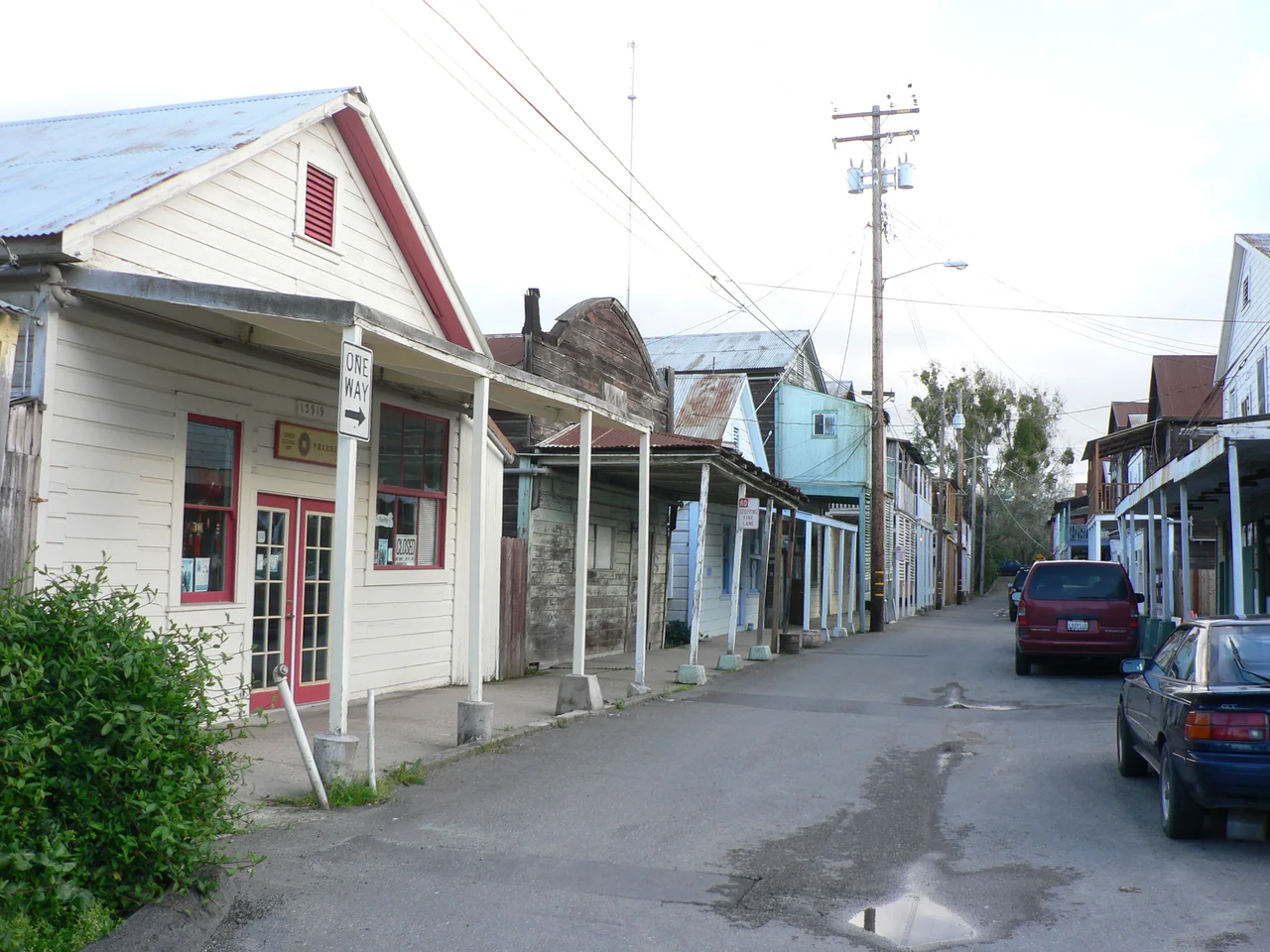
The buildings lean. After more than a century on delta peat soil, the wooden storefronts along Main Street in Locke tilt at angles that look precarious but have held for decades. The warped facades are part of the charm now, but the tilt tells a deeper story: these structures were built quickly, by people who had just lost everything in a fire, on land they were forbidden by law to purchase. The California Alien Land Law of 1913 barred Asian immigrants from buying farmland, so when Cantonese-speaking immigrants from Zhongshan in Guangdong province arrived here in 1915, they leased the ground from George Locke and built a town on someone else's property. They could not own a single acre of the 14 they transformed. That legal fiction -- residents without title, a community without sovereignty -- defined Locke for nearly nine decades.
Fire and Relocation
On October 7, 1915, fire swept through the Chinatown and Japantown districts of nearby Walnut Grove, leaving hundreds of immigrant families homeless. The community fractured along linguistic lines. Taishanese-speaking Chinese stayed in Walnut Grove to rebuild. The Cantonese-speaking Zhongshan Chinese, led by businessman Lee Bing, chose a different path -- they walked a mile north to land owned by George Locke, a rancher whose family had held the parcel since 1883, when it was deeded as part of a 490-acre tract. Locke and his business partner Samuel Lavenson had both been drawn to the area by the Gold Rush decades earlier. Now the Zhongshan immigrants negotiated a lease, and within months Lee Bing had financed the construction of nine buildings along a new Main Street. Gambling halls, a Chinese language school, merchant stores, and a movie house filled the narrow thoroughfare. Locke became, in the words often used to describe it, a town built by the Chinese, for the Chinese.
Dollar-a-Day Levees
Before Locke was a town, the delta was a swamp. Miwok and Maidu peoples had lived on this land for centuries, and tribal burial grounds still exist on the Locke parcel. The transformation of delta wetland into farmland began with the Swampland Reclamation Act of 1861, which aimed to drain and stabilize what legislators called wasted land. The labor fell to contracted workers -- many of them Chinese immigrants -- who were paid the equivalent of less than a dollar a day. They built hundreds of miles of levees in waist-deep water where malaria still raged, reclaiming 88,000 acres of delta swampland for agriculture. The reclaimed land produced asparagus, potatoes, sweet potatoes, white beans, pears, and apples. Locke's population swelled and contracted with the growing seasons, as laborers arrived for planting and harvest and dispersed when the work was done. The town existed to serve the people who had reshaped the delta with their hands.
A Community Without Deed
For all its vitality, Locke carried a fundamental contradiction. Its residents built and maintained every structure, ran every business, and sustained the community through decades of agricultural labor -- but they owned none of it. The Alien Land Law ensured that. The town thrived through the 1920s and 1930s as a self-contained Chinese American enclave with its own school, its own social organizations, its own commercial district. After World War II, younger residents began leaving for Sacramento, San Francisco, and other cities that offered education and professional work beyond farming. The town's population dwindled. Buildings aged without investment. The leaning storefronts that now charm visitors were once simply signs of neglect born from the impossibility of building equity in property you could not own. It was not until 2004 -- eighty-nine years after the town's founding -- that the land was finally made available for purchase by the people who had been living on it for generations.
Landmark and Living Town
Recognition came in stages. The Locke Historic District was added to the National Register of Historic Places on May 6, 1971, and designated a National Historic Landmark on December 14, 1990 -- cited as a unique example of a historic Chinese American rural community. At the north end of Main Street, the restored Locke Boarding House museum, now owned by California State Parks and staffed by volunteers, preserves the daily texture of life in the old town. Locke celebrated its centennial in 2015 with a large gathering on May 9. But Locke is not a museum piece frozen in amber. Fire struck again on July 3, 2016, destroying the second floor of the Locke Country Store and a building behind it, a reminder of how fragile wooden structures on delta soil remain. The town has been the subject of books including Jeff Gillenkirk's award-winning Bitter Melon and Shawna Yang Ryan's novel Water Ghosts, and Clint Eastwood used its Main Street as a stand-in for Kansas City in his 1988 film Bird.
Fourteen Acres of Persistence
From the air, Locke is barely visible -- a single narrow street of wooden buildings pressed between the Sacramento River and the levee road. State Route 160 runs past without fanfare. The town occupies just 14 acres, bounded by the river on the west, Locke Road on the north, Alley Street on the east, and Levee Street on the south. Its scale is part of its power. This was never a city or even a proper village by most measures. It was a handful of buildings erected by people who had been burned out of one home and denied the right to own another, who built anyway and stayed for a century. The structures lean, the wood darkens, and the peat soil settles beneath foundations that were never meant to be permanent. But Locke endures -- the only rural town in America built entirely by Chinese immigrants, standing as proof that a community does not need a deed to put down roots.
From the Air
Located at 38.25°N, 121.51°W on the east bank of the Sacramento River, about 30 miles south of Sacramento along State Route 160. From the air, Locke appears as a thin line of dark wooden buildings running north-south between the river levee and the road -- easy to miss at higher altitudes but distinctive at 1,500-2,500 feet AGL. The Sacramento River and its delta channels provide clear navigation references. Nearby airports include Sacramento Executive Airport (KSAC) approximately 25 nm north and Stockton Metropolitan Airport (KSCK) approximately 30 nm south. The nearby cluster of tall broadcast towers at Walnut Grove (up to 2,048 feet) are a significant aviation hazard and visual landmark.
Nearby Stories
- Eight Hours at the Good Guys 2.9 km away
- Joint Genome Institute 4.9 km away
- Where Salt and Fresh Water Negotiate 8.1 km away
- The Glory Hole: Monticello Dam and the Drain That Swallows a Lake 10 km away
- Gold Country 22 km away
- Altamont Free Concert 27 km away
- From Aluminum to Ammunition to Aviation Fuel 28 km away
- Sutter's Mill 34 km away