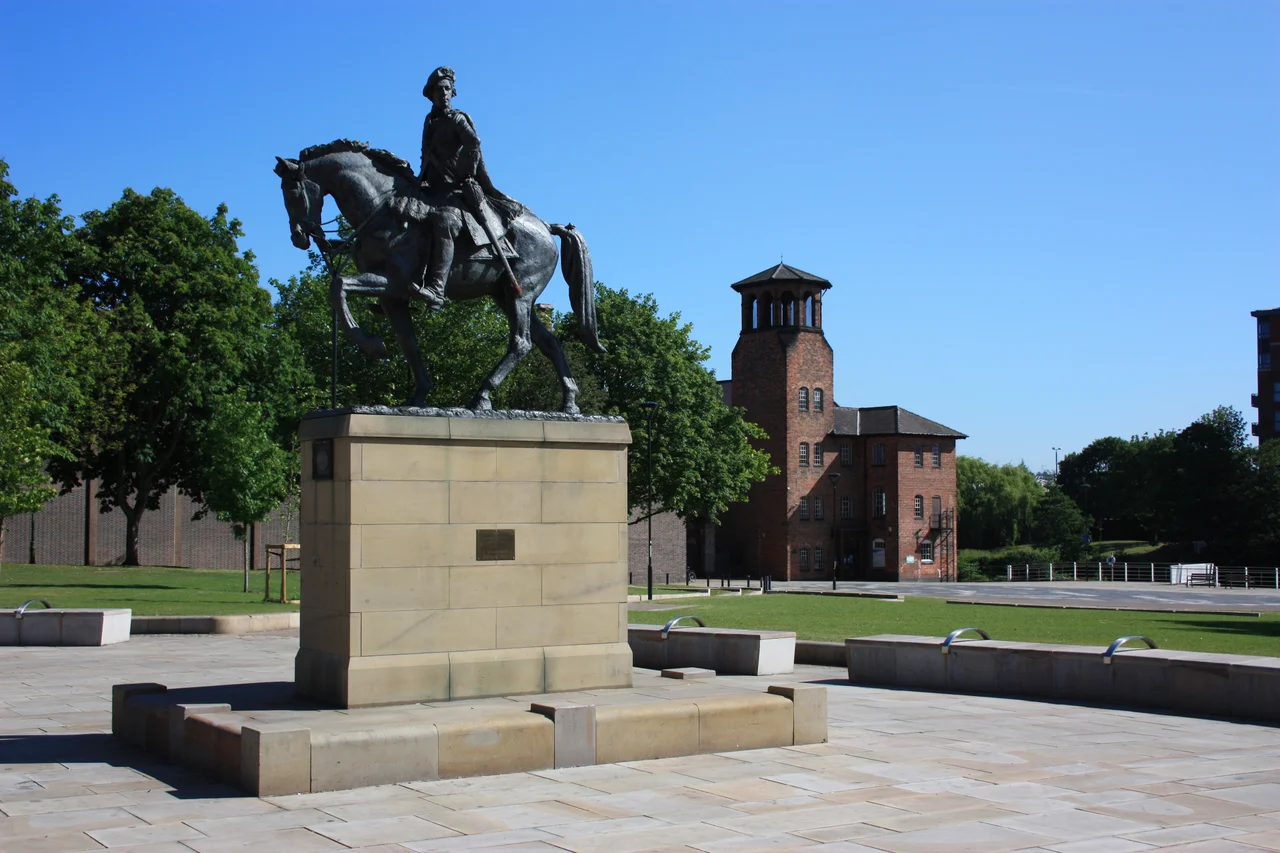

Lombe's Mill
John Lombe sailed for Piedmont in 1716 with a notebook and a plan. The plan, by any modern definition, was industrial espionage. Italian silk throwsters, the artisans who twisted raw silk into strong thread on water-powered machines called filatoios and torcitoios, had a monopoly on the technology that supplied half of Europe with luxury yarn. Lombe got himself hired into one of their mills, sketched the workings of the machines in secret, and slipped out of Italy with the drawings and a few sympathetic Italian craftsmen who came back to England with him. Within five years he and his half-brother Thomas had built a mechanised silk mill on an island in the River Derwent in Derby. It was probably the first fully mechanised factory in the world. Within six years John was dead, almost certainly poisoned, and the King of Sardinia was widely blamed.
The Spy and the Architect
Derby was already a place where ambitious mill ideas got tested. In 1704 a Derby silk merchant named Thomas Cotchett had built a small water-powered silk mill on the west bank of the Derwent, just upstream from the future Lombe site. Cotchett's mill failed, but it left behind something invaluable: George Sorocold, the Derby-based engineer who had designed it. When John Lombe returned from Italy in 1717, he, his half-brother Thomas Lombe, and Sorocold immediately set to work. Between 1717 and 1721 Sorocold built the new mill on an island downstream, drawing power from an undershot waterwheel seven metres in diameter and two metres wide. The building was 33.5 metres long, 12 metres wide, and 17 metres tall, raised on a series of stone arches that let the Derwent flow through underneath. It was 5 storeys high. A vertical shaft ran the full height of the mill and drove horizontal line shafts on each floor, which in turn drove the great circular Italian throwing and doubling machines. About 300 people worked inside. Compared to the cottage spinning that had dominated English textile production, the scale was a category change.
Patent and Vendetta
In 1718 Thomas Lombe secured a 14-year royal patent protecting the design. The Lombes had not invented the filatoio or the torcitoio, those machines had been refined in Italy over centuries, with illustrations of similar circular hand-powered throwing machines surviving from 1487 and externally water-powered versions documented from around 1500. What the Lombes had done was steal the design, scale it up, build it inside one large heated building, and patent it in a country that, until that moment, had to import almost all of its high-quality silk thread. Victor Amadeus II, the King of Sardinia and ruler of Piedmont, was furious. He immediately placed an embargo on the export of raw silk to England, an attempt to starve the new mill of its raw material. The embargo did not work for long, but the legend that followed is more vivid: John Lombe died suddenly in November 1722, age 29, after what looked like prolonged poisoning. One persistent local story, never proved, holds that an Italian woman recently arrived in Derby was suspected of administering small doses with the help of two of John's own Piedmontese workers. She was questioned and released. Whatever the truth, the timing was suggestive enough that Derby remembered it for centuries.
Heat, Stinks, and Noise
Thomas Lombe took over the business after John's death and ran it until his own death in 1739. The mill was a brutal place to work. Silk would only twist properly in warm, humid conditions, which in Derby meant artificial heating that filled the rooms with steam and burning lubricant. William Hutton, who worked at the mill as a child apprentice in the 1730s, later recalled the long hours, the low wages, and the beatings. Work stopped only for drought, hard frost, or breaks in the silk supply, although the children got unofficial holidays during elections and the Derby races in August. Visitors came as tourists. James Boswell, Samuel Johnson's biographer, dropped by in September 1777. Lord Torrington wrote of the "heat, stinks and noise." The Victorian writer Fairholt was so disturbed in 1835 by the sickly appearance of the children that he said so in print. None of this stopped the model from spreading: when the Lombe patent lapsed in 1732, identical mills sprang up in Stockport and Macclesfield.
The 1833 Lock-Out
Almost a hundred years after the mill opened, the same building hosted one of the earliest organized struggles in British labour history. In November 1833 a sustained industrial dispute broke out in Derby, with mill owners including Taylor's Silk Mill, then operating in Lombe's old building, refusing to employ workers who joined a union. By February 1834 the workers had formed the Grand National Consolidated Trades Union, several months before the Tolpuddle Martyrs were transported. Taylor reported in April that two-thirds of his machinery was running again and many former workers were trying to be rehired. Some never were. According to the Derby Mercury, certain blacklisted unionists were never able to find another job in Derby. The Derby Trades Union Council still organizes an annual march to commemorate the lock-out on the weekend before May Day, a quiet local rite that ties the city's modern labour identity directly back to John Lombe's mill.
The 1910 Fire
On 5 December 1910 at five o'clock in the morning, fire broke out in the Sowter Brothers flour mill next door. It spread into the silk mill and gutted the building. The east wall collapsed into the river. The borough fire brigade and the Midland Railway Company between them managed to save the shell of the stair tower and the outline of the original five-storey doorways, which can still be seen today inside the existing staircase. The mill was rebuilt, but only to three storeys instead of five. The connection with silk had already ended around 1908; from then the building was making fly papers and cough medicines. From the 1920s onwards it served as stores and workshops for the local Electricity Authority, hidden behind a power station, almost forgotten by the public until the power station came down in 1970. In 1974 the survivors reopened as Derby's Industrial Museum. A small bronze bas-relief sculpture of John Lombe is mounted on the nearby Exeter Bridge, looking out over the island where his stolen idea changed the world.
From the Air
Lombe's Mill site stands at 52.93°N, 1.48°W on an island in the River Derwent at the north edge of central Derby. From the air the island is a sharp triangle defined by the main river to the east and the mill leat to the west, with the modern Derwent road crossing just downstream. The cathedral tower is a few hundred yards south. East Midlands Airport (EGNX) lies 9 nautical miles to the southeast. Birmingham (EGBB) is roughly 32 nm to the southwest. Recommended viewing altitude is 1,500 to 3,000 feet to make out the island geometry and the surviving stair tower of the rebuilt mill.
Nearby Stories
- Prestbury, Cheshire 4.2 km away
- Stoke-on-Trent 5 km away
- Bingham, Nottinghamshire 8.6 km away
- Beauchief Abbey 9.6 km away
- Shot at Dawn Memorial 9.6 km away
- White Ladies Priory 13 km away
- Oakham 23 km away
- Battle of Gainsborough 24 km away