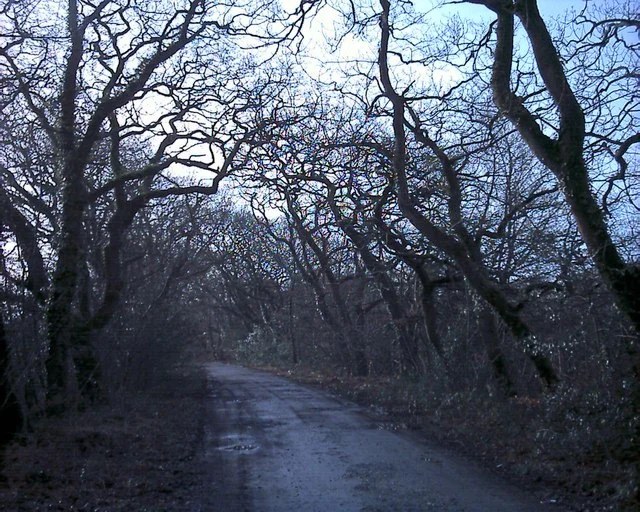

Lon Goed
Stand at Afon Wen on the A497 between Criccieth and Pwllheli, look inland, and you will see what looks like a green tunnel running north into the foothills of Eifionydd. Five miles of straight track, lined on both sides with oak and beech planted two hundred years ago, climbing gently toward the slopes of Mynydd Cennin. This is Lon Goed -- the wooded lane -- and it is the most famous walking track on the Llyn Peninsula not because of any battle, ruined castle or saint's well, but because of one Welsh poem.
John Maughan's Drainage Project
Lon Goed is not a natural feature. It was deliberately planted between 1819 and 1828 by John Maughan, the steward of Plas Hen -- the estate now called Talhenbont -- near Llanystumdwy. The original purpose was prosaic. A track ran from the coastal hamlet of Afon Wen up to Hendre Cennin on the slopes of Mynydd Cennin, used to move agricultural produce between the estate's lowland fields and its upland farms. Maughan rebuilt and improved the route, planting two rows of trees down its length to provide a windbreak and -- more importantly -- to help drain the boggy ground. The roots of the oaks and beeches stabilised the soil and pulled water from the surface. For half a century the lane served as a working route for horse-drawn carts. When the Carnarvonshire Railway opened in 1862 between Bryncir and Afon Wen, goods began moving by train instead, and Lon Goed quietly stopped being commercial infrastructure. The trees kept growing.
Williams Parry and the Poem
In the early twentieth century, the poet R. Williams Parry walked Lon Goed in the autumn and wrote a Welsh-language poem called simply Eifionydd. The literary editor Meic Stephens called it one of the most famous poems in the Welsh language. Williams Parry, who lived from 1884 to 1956, grew up in Talysarn in the slate-scarred Nantlle Valley, and his poem deliberately contrasts the quarrying district he came from with the green wooded calm of Eifionydd to the south. The trees of Lon Goed, the slow lane, the rural quiet -- these were the elements that the poet set against the industrial scars of his home valley. In the 1970s the Welsh Arts Council printed a poster of the poem illustrated by Sue Shields's painting of a wooded lane; it has been reprinted many times since. The lane is now what the poem made it: a place that Welsh readers know not just as scenery but as cultural shorthand for everything Eifionydd represents.
Storm Darwin and the Bardic Chair
In February 2014 Storm Darwin -- which had caused the worst storm damage in Ireland on record -- crossed the Irish Sea and made landfall in Gwynedd. The wind felled an oak on Lon Goed that had been planted around 1820 in John Maughan's original scheme. The tree was almost two hundred years old. A local farmer donated a section of the trunk to the organisers of the 2023 National Eisteddfod of Wales, held that year in nearby Boduan. The Eisteddfod's bardic chair -- the prize awarded each year to the winner of the strict-metre poetry competition -- is traditionally one of the most prestigious objects in Welsh culture. The sculptor Stephen Faherty was commissioned to make the 2023 chair from the felled Lon Goed oak. Rather than cutting the wood into pieces and jointing them, Faherty carved the entire chair from the single piece of oak. The poet Alan Llwyd won it. The bardic crown that same year, designed by the jeweller Elin Mair Roberts, also took inspiration from Lon Goed. One storm, one tree, two cultural prizes.
Walking It Now
Lon Goed runs five miles from Afon Wen north-east and then north to Hendre Cennin. It is still unpaved, still wooded, still lined with the trees Maughan planted. The Welsh Arts Council managed the trees through a government employment scheme in 1977-78, and various local conservation efforts have continued since. Walkers and horse riders use it; you can link it to the Lon Eifion cycle route at its northern end. In autumn the oaks and beeches turn yellow and copper, and the green tunnel becomes a gold one. Walking it for the first time, the surprise is how straight it is. Welsh lanes typically wind around field boundaries and contour lines. This one is engineered -- a stewards' improvement project that turned into a poem that turned into a national symbol. John Maughan, who probably thought he was just laying drainage, ended up planting two of Welsh culture's most enduring trees: an actual oak now carved into a bardic chair, and a metaphorical one that grows in every Welsh-speaker's memory of Williams Parry.
From the Air
Located at 52.91N, 4.32W in rural Eifionydd, running from Afon Wen on the A497 north-east and then north to Hendre Cennin on the slopes of Mynydd Cennin. Caernarfon Airport (EGCK) lies 11nm north-east. Best viewed at 1,500-2,500ft AGL. From the air the lane appears as a remarkably straight line of dense tree canopy running through otherwise open farmland -- nearly five miles of green corridor in a landscape that is mostly hedge-bordered fields.
Nearby Stories
- GeoMôn 1.9 km away
- Battle of the Conwy 3.2 km away
- Irish Sea Bridge 5.2 km away
- Ysbyty Ifan 10 km away
- Machynlleth 16 km away
- Barmouth Lifeboat Station 23 km away
- Irish Sea 27 km away
- HMS Tyler 32 km away