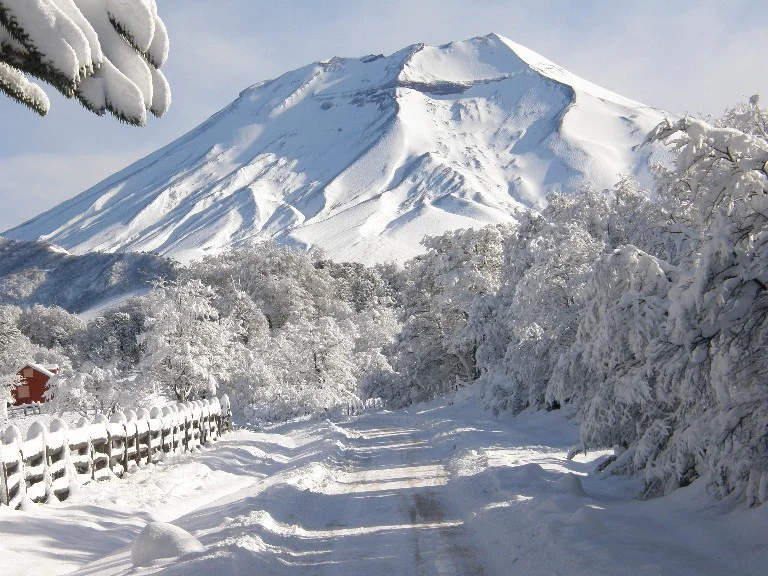

Lonquimay (volcano)
On Christmas Day in 1988, Lonquimay gave Chile a gift no one wanted. A vent split open on its flank and began to erupt, and the timing earned the event a name that has stuck ever since: Navidad, Christmas. For thirteen months the mountain poured out lava and ash, and when it finally fell quiet in 1990, the landscape had changed. Where there had been an open slope, a brand-new cinder cone now stood, born of that long winter of fire and named for the day it began.
A Truncated Cone in the Cordillera
Lonquimay reaches 2,865 metres in the La Araucania Region of Chile, a snow-capped stratovolcano shaped like a cone with its top sliced off. Its rock is mostly andesite, with streaks of basalt and dacite woven through, the record of countless eruptions stacked one atop another since late in the Pleistocene. It keeps powerful company. Tolhuaca volcano stands immediately to its northwest, and to the south rise Sierra Nevada and the restless giant Llaima. Around its base spreads the protected wilderness of Malalcahuello-Nalcas, a landscape of araucaria forest and old lava that softens the mountain's hard volcanic bones.
The Birth of Navidad
The 1988 eruption was, in geological terms, an act of construction. For three weeks beforehand the ground had trembled with rising magma, and when the flank vent finally opened on December 25 it began not to destroy the mountain but to add to it. Over thirteen months the eruption heaped up loose cinder and rock into an entirely new cone, growing it more than 200 metres high. Lava flowed from the vent and crept northeast down the slope, and as the months passed the flow slowed and the vent narrowed, yet by the end the andesite had still run more than ten kilometres from its source. The eruption rated a 3 on the Volcanic Explosivity Index, enough to loft ash into the troposphere and inflict serious local damage.
A Mountain at Its Limit
Scientists who have modelled the inner architecture of Lonquimay have reached a striking conclusion: the volcano has essentially grown as tall as it ever will. The plumbing beneath it now favours the flanks over the summit, which is why Navidad erupted from the side rather than the peak. Any future large eruption, the research suggests, will most likely break out low on the mountain again, building new cones across its slopes rather than raising the summit any higher. Lonquimay, in other words, has finished growing up and may now only grow outward, one flank eruption at a time.
The Cost on the Ground
For the people living below, the eruption was measured not in cubic kilometres of lava but in loss. The ash that drifted from Navidad carried a heavy load of fluorine, and as it settled across some 800 square kilometres of grassland it poisoned the pasture. Livestock that grazed the contaminated grass sickened and died; a veterinarian in the town of Lonquimay tallied 4,158 animals lost, among them more than two thousand goats and nearly fifteen hundred sheep, the herds on which mountain families depended. In July 1989 the authorities began evacuating thousands of residents from the town of Lonquimay and the nearby Bernardo Nanco area. Only one person died, an elderly man whose lungs gave out after long exposure to the ash, but the toxic fallout lingered in the soil and water for as long as two years, a slow tax exacted on the communities the mountain had chosen for neighbors.
The Quiet Years
Most of the time, Lonquimay does none of this. The snow gathers on its truncated cone through the long austral winter, and the araucaria forests of Malalcahuello-Nalcas stand undisturbed at its feet, their thousand-year-old crowns indifferent to a mountain that erupts only on the timescale of human generations. The pewen, sacred to the Mapuche, have weathered far more eruptions than any person ever will. It is worth remembering, looking up at that serene white peak, that geology measures patience differently. A mountain that built a new cone within living memory is not finished; it is merely resting between sentences.
From the Air
Lonquimay volcano stands at 38.38 degrees south, 71.59 degrees west, in Chile's La Araucania Region, a snow-capped truncated cone reaching 2,865 meters within the Malalcahuello-Nalcas protected area. It is easily identified by its neighbors: Tolhuaca volcano sits immediately to the northwest, and the Navidad cinder cone, formed in the 1988 to 1990 eruption, rises on its flank with a lava flow running roughly ten kilometers to the northeast. A viewing altitude of 8,000 to 11,000 feet frames the cone, the dark Navidad flow, and the surrounding araucaria forest. The nearest major airport is La Araucania International (ICAO: SCQP) near Temuco, about 100 km west-southwest. Lonquimay is an active volcano; monitor ash advisories during eruptive periods. Mountain weather is changeable, with heavy winter snow (June to August); clearest conditions come in the austral summer, December through March.
Nearby Stories
- Alto Biobío 22 km away
- Kingdom of Araucanía and Patagonia 27 km away
- Malleco Viaduct 38 km away
- Cerro Ñielol Natural Monument 42 km away
- Huerquehue National Park 53 km away
- Vaca Muerta 76 km away
- Zapala 86 km away
- Chos Malal 107 km away