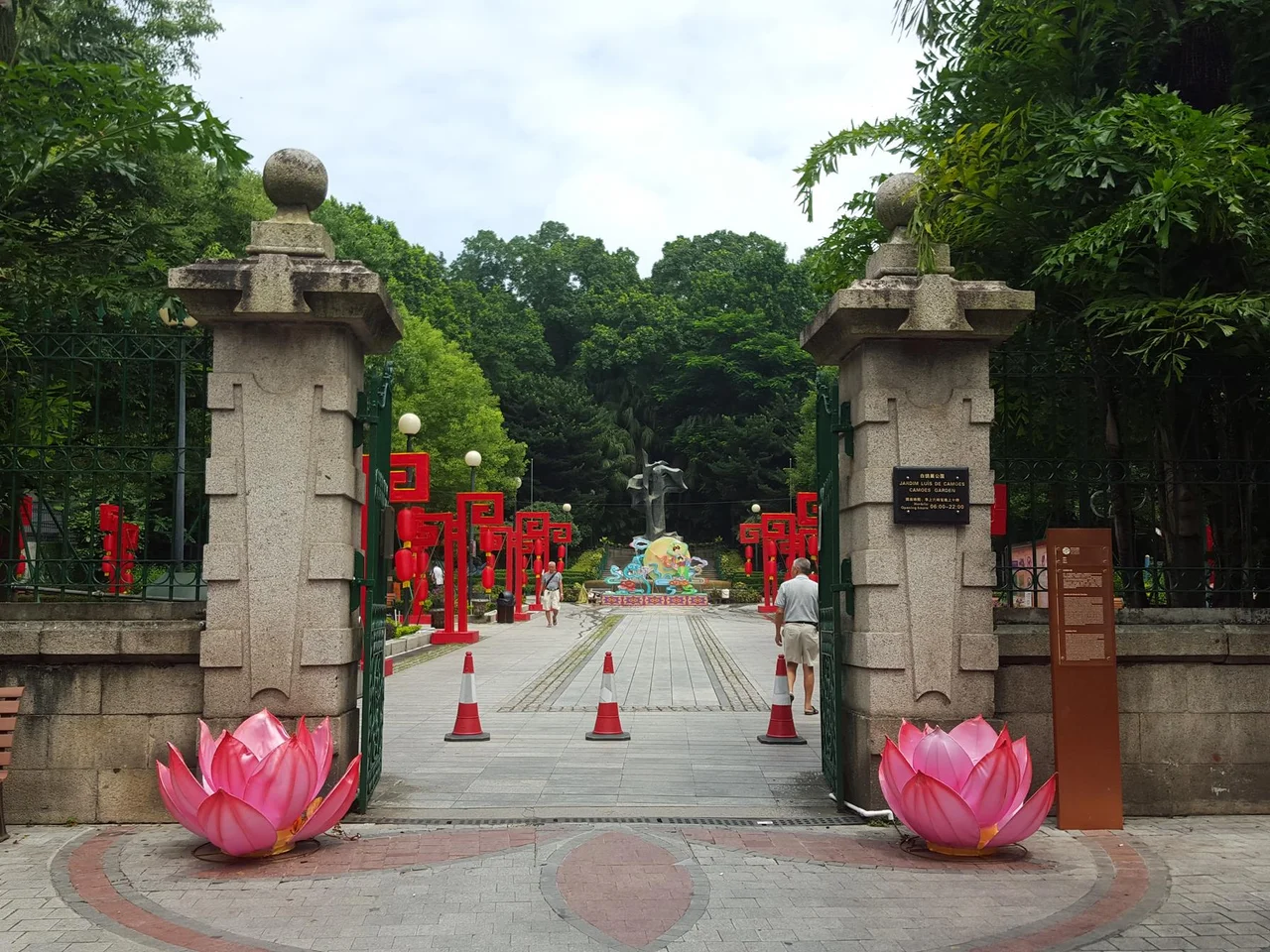

Luís de Camões Garden
The garden has been called the lungs of the city, and in a territory as densely built as Macau, that is not a metaphor. It is nearly the only metaphor. Covering about 26,000 square meters on a rocky hillside in the Santo António parish, the Luís de Camões Garden is the oldest public park in Macau — a title the territory's 33 other public gardens cannot contest. Its Chinese name, Pak Kap Chau, has largely given way to its Portuguese one. Its historical name, Colina da Fénix, Phoenix Hill, has been almost entirely forgotten. But the hill itself endures, and the trees that cover it still exhale into a city that badly needs the air.
The Company That Gardened on Phoenix Hill
Before it was a public park, the site was the Macau headquarters of the British East India Company. The Company operated in Macau as a necessary presence — a foothold for British commercial interests in a region otherwise controlled by the Portuguese, the Chinese, and later the competing ambitions of both. The estate on Phoenix Hill served as the Company's local residence and administrative center during the period when Macau was still one of the primary trading points in the region.
The garden flourished under Company management. Among the guests who passed through was Lord George Macartney, who had led a famous — and famously unsuccessful — diplomatic mission to the Qing Emperor in 1793. That mission, which failed to establish formal diplomatic relations between Britain and China, foreshadowed the tensions that would later boil into the Opium War. That Macartney visited this garden in Macau places the site squarely within the larger story of British-Chinese relations in the late colonial era.
Transition: The English Leave, the Poet Arrives
The British East India Company vacated the site in 1835 — its commercial dominance in the region was fading, and Macau's role in the trade routes was shifting. Shortly after the English left, the Portuguese owner who took the property installed a grotto on the rocky hillside, dedicated to the 16th-century poet Luís de Camões. The choice of Camões was deliberate and meaningful. Camões is the defining figure of Portuguese literary identity — the author of *Os Lusíadas*, the epic poem that celebrates Vasco da Gama's voyage to India and the founding of Portugal's maritime empire. Installing his grotto in Macau, at the far edge of that empire, was an act of cultural inscription.
The government of Macau purchased the property in 1885 for 35,000 patacas. The acquisition was supported by João Scarnichia, then Captain of the Port of Macau, and approved by Governor Tomás de Sousa Rosa. The following year, 1886, it opened as a public garden — and has remained one ever since.
The Casa Garden and Its Neighbor
Adjacent to the park stands Casa Garden, the former residence of the East India Company administrator. After the Company's departure, Casa Garden went through several incarnations: it housed the Luís de Camões Commercial and Ethnographic Museum from 1937 to 1989, then became the headquarters of the Fundação Oriente and a gallery space. Together with the garden and the nearby Old Protestant Cemetery, it forms part of Macau's UNESCO World Heritage Site — three adjacent properties, each carrying a different strand of the territory's layered past.
The Old Protestant Cemetery is worth noting in this context. In a Catholic-dominated Portuguese colony, Protestant merchants and their families needed somewhere to bury their dead. The cemetery became their place, and it remains today a quiet, well-maintained space filled with the headstones of British, American, and Dutch traders whose names would otherwise have been entirely erased from Macau's record.
The Oldest Park, Still Open
The garden opens at six in the morning and closes at midnight — hours that reflect its role in daily Macanese life rather than its status as a tourist attraction. In the early hours, residents come for exercise and quiet. Through the day, tourists arrive to photograph the grotto and the bust of Camões. In the evenings, the rocky paths and tree canopy offer relief from the heat and noise of the surrounding city.
Free admission and convenient bus access ensure the garden remains genuinely public. In a city whose economy has restructured massively around casino tourism, the Luís de Camões Garden holds a different kind of value — a shared space that belongs to everyone, as it has since the Portuguese government opened it to the public in 1886. Phoenix Hill has been many things. As a public garden, it has lasted longest.
From the Air
The Luís de Camões Garden sits at approximately 22.201°N, 113.539°E in the Santo António parish, on a rocky hill in the northwestern quadrant of the Macau Peninsula. From the air, the green canopy of the garden stands out clearly against the dense urban fabric around it. The nearby Old Protestant Cemetery and Casa Garden are adjacent to the east. Macau International Airport (VMMC) is on Taipa Island, roughly 5 kilometers to the southeast. The Garden of Luis de Camoes can be oriented to from the air by looking for the distinctive elongated green patch northwest of Senado Square. Recommended viewing altitude is 1,500–3,000 feet.
Nearby Stories
- 2024 Shenzhen Stabbing 0.8 km away
- Lantau Peak 1.5 km away
- Kweilin Incident 2.4 km away
- Taishan City 7 km away
- Wanshan Archipelago Campaign 38 km away
- Hong Kong 12 68 km away
- Battle of Nanpeng Island 82 km away
- Erhai Lake 1335 km away