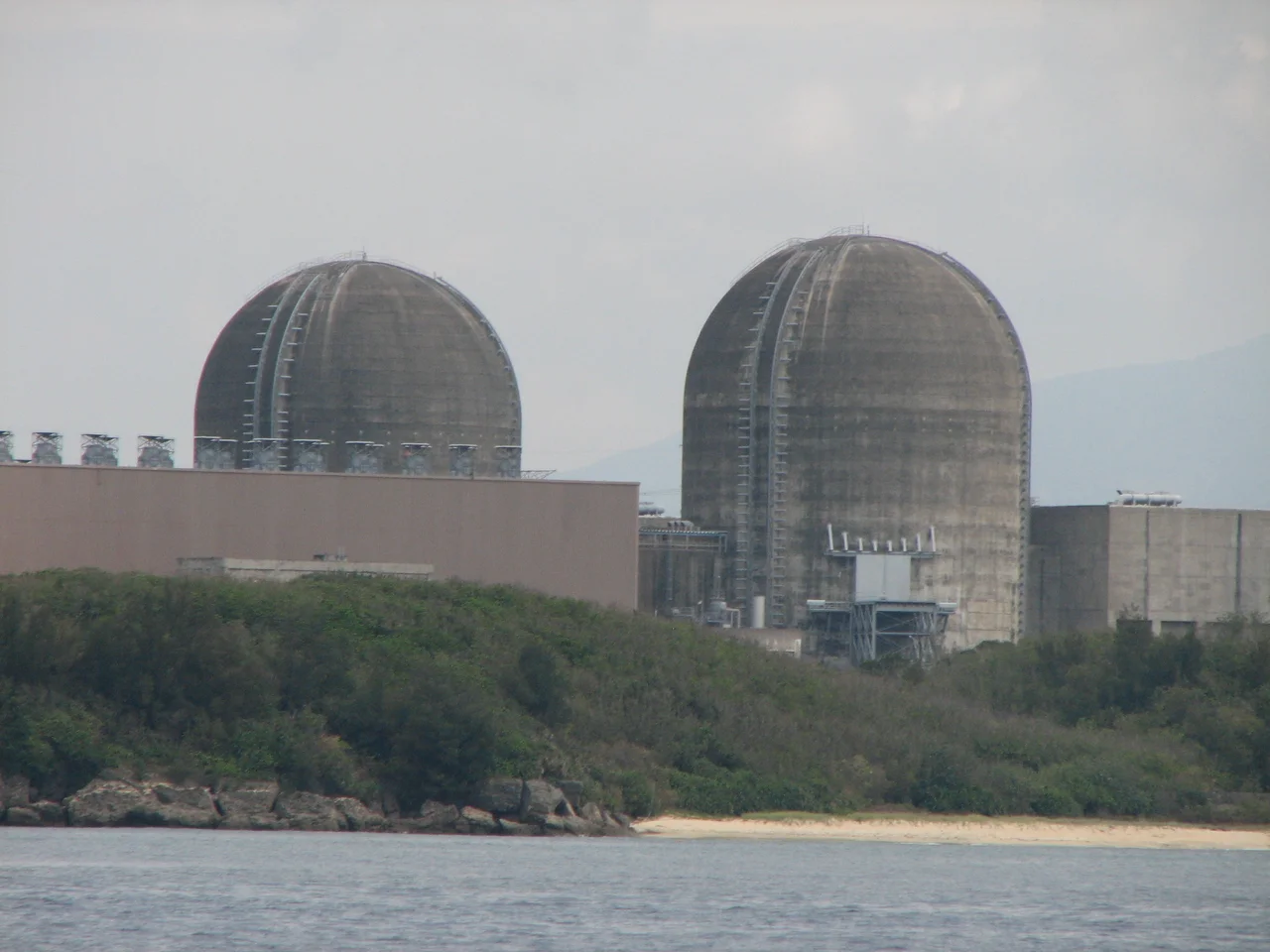

Maanshan Nuclear Power Plant
From the beach at South Bay in Kenting, tourists in swimsuits and sunscreen have always been able to see the domed containment structures of the Maanshan Nuclear Power Plant on the headland to the west. It is an unlikely juxtaposition — one of Asia's most popular beach resorts sharing a coastline with a nuclear generating station — and it captured something essential about Taiwan's energy story: a small, densely populated island with almost no fossil fuel reserves, doing what it had to do. For forty years, Maanshan's two reactors generated enough electricity to power millions of homes. The last reactor was disconnected from the grid on May 17, 2025.
The Third Plant
Maanshan was Taiwan's third nuclear power plant, and when its second reactor came online in 1985, it became the island's second-largest generating facility by capacity. Each of the two units was a three-loop Westinghouse pressurized water reactor, the same fundamental design used in commercial plants across the United States and Europe. Each steam generator contained 5,626 U-bend tubes made of thermally treated Inconel 600 alloy — components that would become the subject of close engineering attention over the following decades. At full output, the plant could generate approximately 15 terawatt-hours of electricity per year, a figure that represented a substantial fraction of Taiwan's generating capacity at the time. The site was chosen in part for its coastal location, which provided an essentially unlimited supply of seawater for cooling — and an unobstructed view from the Kenting waterfront.
Four Decades of Incidents
The plant's operational record was long and largely uneventful in the ways that matter most, but not without incident. In July 1985, a turbine blade failure led to a fire and reactor trip at Unit 1; the resonant torsional vibration from the electrical system had driven the blades to failure, and repairs took eleven months. In September 1988, a control rod assembly at Unit 1 was found stuck in a partially inserted position after a reactor trip, and subsequent investigation revealed cracks in multiple rods caused by hafnium's volumetric growth against its stainless steel cladding. Taipower replaced all hafnium-containing rods with a different alloy. The year 2005 brought a cluster of incidents — logic card malfunctions, valve positioner failures, a water hammer in the steam lines — each traced to a specific mechanical cause and resolved through targeted repairs. In December 2006, the Hengchun earthquake triggered a SCRAM at Reactor 2; engineers inspected the facilities afterward and found no damage.
The Question of Renewal
As the reactors approached the end of their forty-year operating licenses — Unit 1 in 2024, Unit 2 in 2025 — Taiwan found itself in an intensifying debate about nuclear energy's role in its future. The island had committed to a nuclear-free policy in 2017, a goal shaped by public anxiety after Japan's 2011 Fukushima disaster. But rising electricity demand, the difficulty of expanding renewable capacity quickly enough, and concerns about grid stability gave the debate new urgency. In May 2025, Taiwan's Legislative Yuan passed a bill permitting operators to apply for twenty-year license renewals of active plants. President Lai Ching-te held firm nonetheless, stating that Maanshan's second reactor would shut down as scheduled, because restarting it would require a substantial review process the timeline did not permit. The last reactor was disconnected on May 17, 2025. A referendum on restarting the plant was put to voters on 23 August 2025; despite 74 percent of votes cast being in favour, low turnout meant the result fell short of the one-quarter-of-all-voters threshold required to pass.
What Remains on the Headland
The physical plant occupies a headland on the western shore of the Hengchun Peninsula, where the warm currents of the Taiwan Strait meet the shallower waters near South Bay. The containment domes, visible from the beach for as long as anyone in Kenting can remember, now sit silent. Taiwan entered what officials called the "nuclear-free homeland era" in May 2025, a phrase that carried both political weight and practical consequence for a grid that must balance the energy demands of a modern industrial economy with the realities of an island that cannot import electricity. Decommissioning a nuclear plant is a decades-long process, and Maanshan will remain a feature of the Kenting coastline for many years to come — familiar to beach visitors, no longer humming with chain reaction, slowly being unmade.
From the Air
Maanshan Nuclear Power Plant sits at approximately 21.958°N, 120.752°E on the western shore of Taiwan's Hengchun Peninsula. The containment domes are among the most visually distinctive features on the peninsula from the air. Approaching from RCKH (Kaohsiung International), roughly 70 kilometers to the north-northwest, pilots can orient using Cape Eluanbi's lighthouse at the island's southern tip, then track north along the western coast to identify the plant on its headland site. South Bay beach is immediately to the east, and the forested ridgeline of Kenting National Park rises behind it. Recommended viewing altitude for the full peninsula context is 3,000 to 5,000 feet, where both coastlines and the nuclear site become visible simultaneously.
Nearby Stories
- Mudan Incident 2 km away
- Lanyu Flying Fish Cultural Museum 30 km away
- Zhaori Hot Spring 59 km away
- Ten Drum Rende Creative Park 88 km away
- Mavulis Island 89 km away
- Barclay Memorial Park 121 km away
- 1991 Eruption of Mount Pinatubo 722 km away
- Scarborough Shoal 762 km away