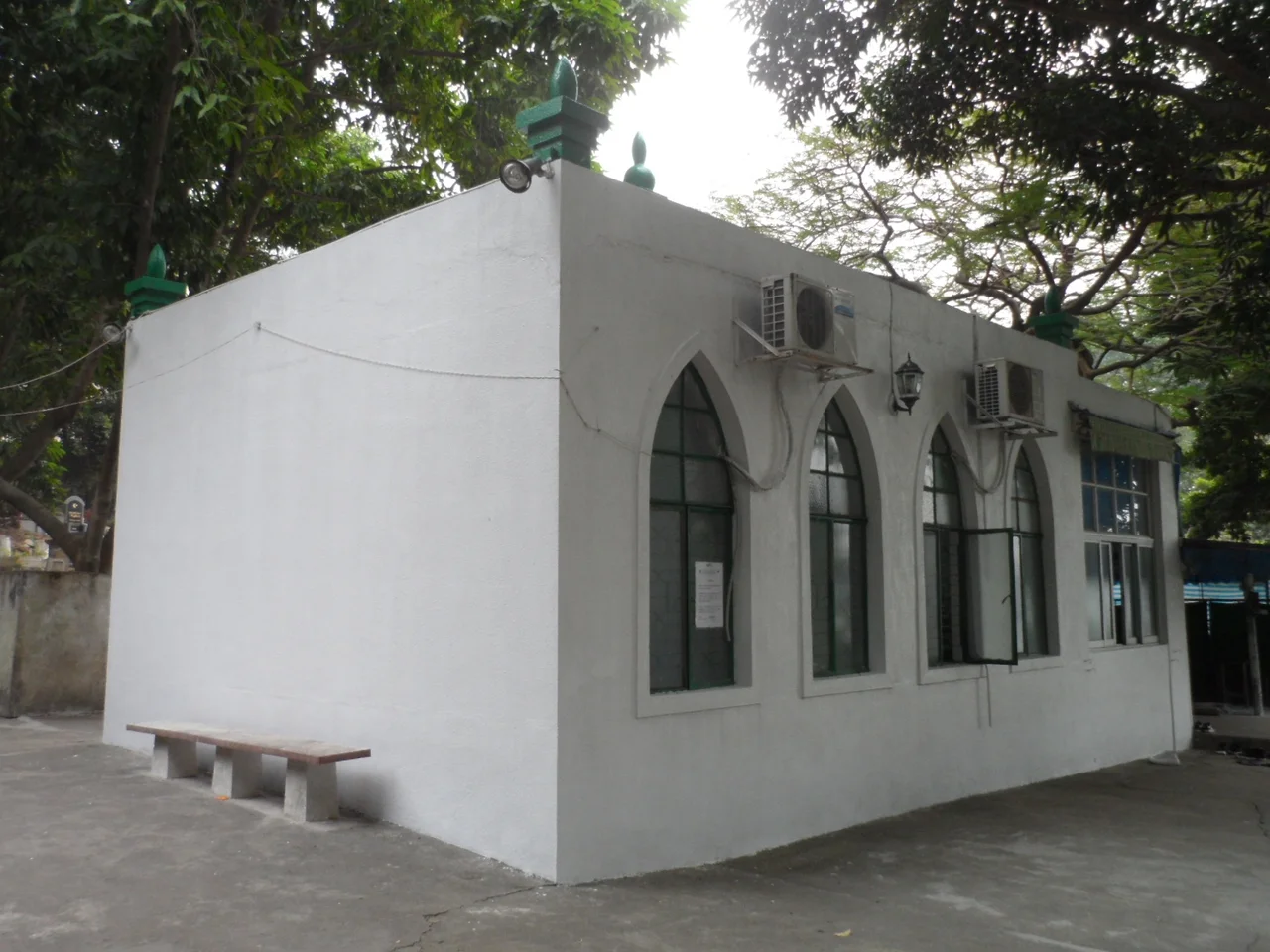

Macau Mosque and Cemetery
The men who built this place never intended to stay. Recruited from South Asia to serve in the Portuguese colonial army, they arrived in Macau as soldiers in someone else's empire, far from the communities and languages and landscapes that had shaped them. The Portuguese brought them; Islam traveled with them. Somewhere in the negotiation between those two facts — between service and faith, between displacement and belonging — a mosque took shape. The tombs in the cemetery beside it are dated back hundreds of years. Those dates are not just a record of individual deaths. They are evidence that Macau's Muslim community planted itself so deeply that it survived the dissolution of the empire that brought it here, the transfer of sovereignty from Portugal to China, and a pandemic-era closure order. The mosque is still open.
Soldiers Who Stayed
The history of Islam in Macau begins with colonial logistics. The Portuguese military that maintained Macau's position in the Pearl River Delta drew soldiers from across its far-flung empire, and among those recruits were Muslims from South Asia. Precisely when the first mosque was established is not recorded with certainty, but the cemetery headstones tell their own story — some of the tombs date back hundreds of years, establishing that a Muslim community was present in Macau well before the modern era. They prayed, they buried their dead, they organized. The entrance gate to the mosque compound was donated by Halima binti Sheik on 27 June 1973, in memory of Adam Sheik, a small act of commemoration that connects the living community to its founding generations.
The Only Mosque in Macau
The Macau Mosque and Cemetery is the sole mosque and Muslim burial ground in the territory. The mosque building itself measures approximately 6.5 metres by — a compact space able to accommodate around 100 worshipers — situated in the parish of Nossa Senhora de Fátima, a name that layers Catholic geography over a Muslim place of worship in a way that feels entirely characteristic of Macau. The complex includes not just the mosque but a sahn (the open courtyard traditional to mosque architecture), the cemetery, the headquarters of the Islamic Association of Macau, a wudu ablution area, and — reflecting the practical needs of a community — a badminton court and playground. The Islamic Association of Macau, which manages the mosque's daily operations, was founded in 1935 during the Portuguese colonial period.
A Living Community
On Sundays the mosque fills. Worshipers who cannot attend on weekdays due to work schedules gather for Quran study and Islamic education. Weddings are celebrated here. During Eid al-Adha, the community marks the feast in the traditional manner — cattle are slaughtered at the Macau slaughterhouse — a practice that continues in a city dominated by casinos and where the Muslim community remains a small but persistent minority. The community's size fluctuated during the COVID-19 pandemic, when the government ordered the mosque closed for a month. It is a reminder of how small a congregation can become vulnerable, and also of how resilient it has proven to be, existing as it does in a territory whose identity has been shaped by Portuguese Catholics and Chinese Buddhists and Taoists, with no particular provision for the people the Portuguese army once brought with it.
Plans and Patience
The community has been waiting a long time for more space. In 1996, the Islamic Association submitted a redevelopment plan to the Portuguese Macau government; it was not approved. In 2006, they applied to build a new, larger mosque on adjacent land. Renovations were eventually completed in late 2007. The planned new mosque — double the current size, totaling 1,881 square metres, rising 50 metres high and capable of holding 600 worshipers — remains in the future tense, along with an Islamic center, a halal restaurant, a hostel, and a 38-story residential tower on the site. Transport connections via the Zona do Nordeste station of the Macau LRT were also proposed, though the LRT line itself has been placed on hold. In the meantime, the small mosque in Nossa Senhora de Fátima parish continues to serve the congregation it has always served: the descendants and successors of soldiers who stayed.
From the Air
The Macau Mosque and Cemetery is located in the northeast portion of Macau Peninsula at approximately 22.203°N, 113.554°E, in the Nossa Senhora de Fátima parish. From the air, this area presents as a dense mid-rise residential and commercial district — the mosque itself is not easily distinguished from the surrounding urban fabric, but the cemetery adjacent to it provides a visible break in the roofline. Macau International Airport (VMMC) lies approximately 4 km to the southeast on Taipa island. The Guia Fortress and lighthouse on Guia Hill, about 600 metres to the southwest, is the most useful aerial landmark for orienting within the northern peninsula. A low-altitude approach from the northeast over the Pearl River estuary provides the clearest view of this part of the city before turning toward the VMMC runway.
Nearby Stories
- 2024 Shenzhen Stabbing 0.8 km away
- Lantau Peak 1.5 km away
- Kweilin Incident 2.4 km away
- Taishan City 7 km away
- Wanshan Archipelago Campaign 38 km away
- Hong Kong 12 68 km away
- Battle of Nanpeng Island 82 km away
- Erhai Lake 1335 km away