
Macau Tower
Stanley Ho Hung-Sun was in Auckland, New Zealand, standing at the base of the Sky Tower, when he decided Macau needed one too. The story is not especially complicated — a powerful man saw something impressive and wanted it for his city. What followed was a $130 million construction project that started in 1998, produced a 338-metre tower designed by the same architect as Auckland's original, and gave Macau one of its two defining skyline silhouettes. The other is the Grand Lisboa hotel, which Ho's family also built. Together they stand over a city that has become the world's most concentrated gambling economy, anchored by structures that announce, from any direction, that Macau takes its ambitions seriously.
A New Zealand Idea in a Chinese City
Gordon Moller, the architect who designed Auckland's Sky Tower, designed the Macau Tower as well. The engineering firm Beca Group, also from New Zealand, handled the structural work. The client was Sociedade de Turismo e Diversões de Macau, the gaming and tourism conglomerate controlled by Stanley Ho. Construction started in 1998 and the tower opened in 2001. At 338 metres from ground to highest point, it is a member of the World Federation of Great Towers — an organization whose member list reads as a kind of catalogue of cities that needed to prove something about themselves. Macau's proof was already well underway in the casino district, but the tower made that ambition vertical and impossible to miss from across the Pearl River estuary.
The Outer Rim
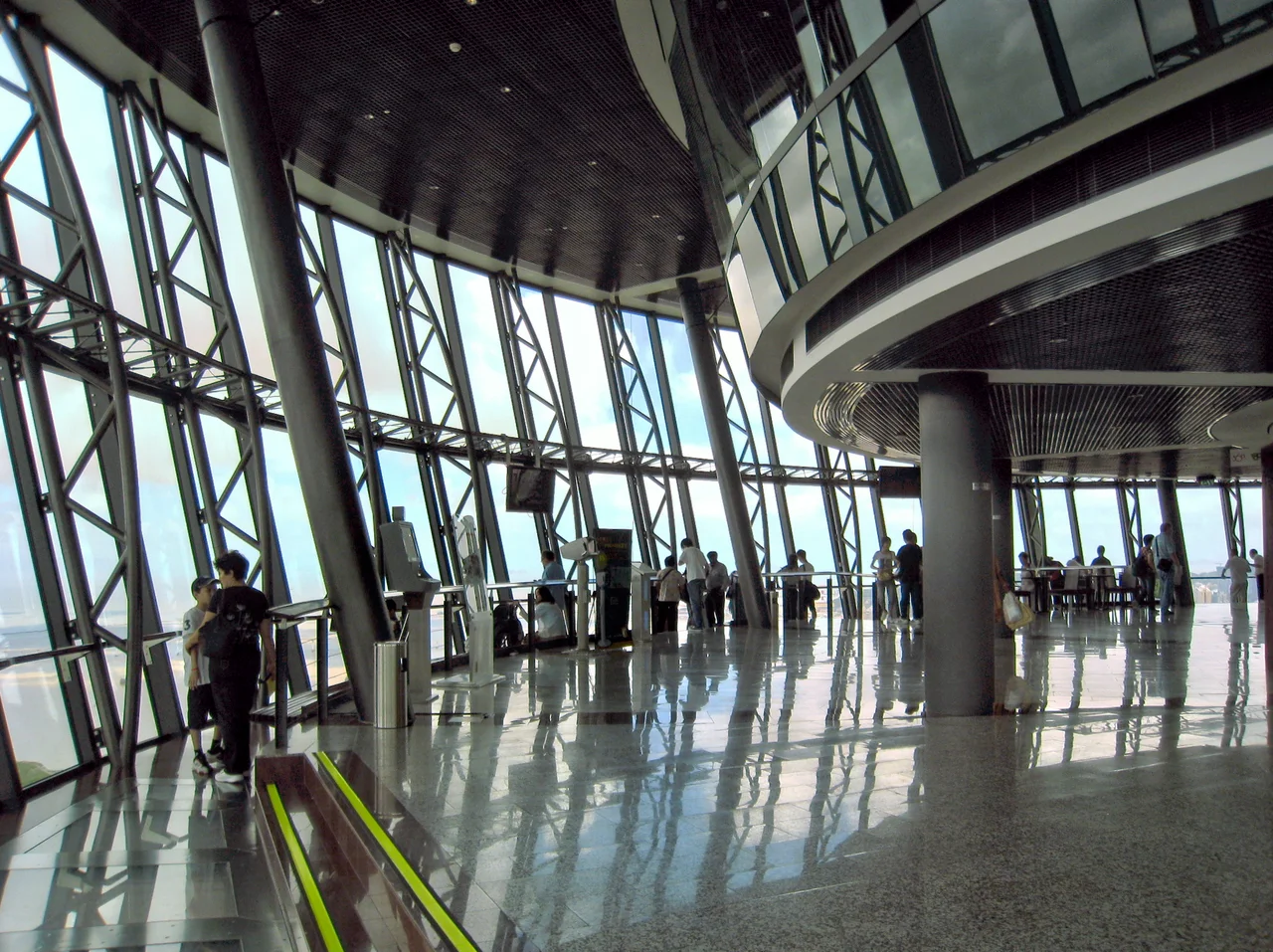
The observation deck is standard tower fare: views, restaurants, theaters, shopping. What made the tower famous in adventure-tourism circles is the outer rim. At 233 metres above ground, AJ Hackett — the New Zealand company that pioneered commercial bungee jumping — operates what is classified as the highest commercial skyjump in the world and the second highest commercial decelerator descent facility in the world, after the Stratosphere tower skyjump in Las Vegas at 252 metres. Visitors can also walk around the outside of the tower at deck level — the Skywalk X experience — attached to the structure but exposed to the open air at more than 200 metres. The tower does not present these options apologetically. The platform exists because someone looked at a 233-metre drop and thought: people will pay for this.
Cameras and Celebrity
The tower has attracted a steady stream of television productions over the years, drawn by the combination of height, spectacle, and a city that photographs dramatically. Anthony Bourdain bungee-jumped from it for a No Reservations episode. Jack Osbourne did the same for his Adrenaline Junkie series. American variety show runners used it for Amazing Race challenges — it appeared in The Amazing Race: All-Stars (April 2007), The Amazing Race Canada 2 (2014), and two episodes of The Amazing Race Asia 3. A South Korean Running Man episode dispatched its cast to complete sky jump, mast climb, and sky walk missions here. A 2018 Instagram post by an America's Next Top Model contestant described a photoshoot during which hailstones and gale-force winds hit them at height and the tower was closed to the public below due to the weather. The tower has become, in the language of reality television, a location.
What It Means to the Skyline
Macau's historic center — the UNESCO-listed concentration of Baroque churches, Portuguese civic buildings, and Chinese temples in the old peninsula — is a place of low rooflines and cobblestoned squares. The Macau Tower and the Grand Lisboa operate in a different register entirely. From the air approaching VMMC, or from the ferry deck crossing from Hong Kong, these two structures establish the city's scale before anything else becomes visible. The tower's needle profile against the haze of the Pearl River Delta is the same profile Auckland sees across the Waitemata Harbour — the same DNA, transposed 9,000 kilometres. Stanley Ho saw something in Auckland and wanted it for Macau. Looking at the tower today from the observation deck, you can see roughly 80 kilometres in clear conditions — the Chinese mainland, the bridges to Zhuhai and Hong Kong, the South China Sea. Whether Ho expected all of that is not recorded.
From the Air
Macau Tower stands at approximately 22.180°N, 113.537°E in the Sé district on the southern portion of Macau Peninsula, close to the Nam Van Lakes reclamation. At 338 metres, it is the single most conspicuous structure in the Macau skyline from any direction and serves as an unmistakable visual navigation aid. Approaching from the west or south over the Pearl River estuary, the tower's slender needle is typically visible at 20+ nautical miles in clear conditions. Macau International Airport (VMMC) is approximately 3.5 km to the southeast on Taipa island; the tower is directly in line with one of the common approach paths, making altitude awareness critical at lower flight levels. The Grand Lisboa hotel's distinctive gold-and-lotus silhouette is approximately 700 metres to the northeast. Recommended viewing altitude for a full appreciation of the tower and surrounding delta geography is 3,000–5,000 feet on a clear day.
Nearby Stories
- 2024 Shenzhen Stabbing 0.8 km away
- Lantau Peak 1.5 km away
- Kweilin Incident 2.4 km away
- Taishan City 7 km away
- Wanshan Archipelago Campaign 38 km away
- Hong Kong 12 68 km away
- Battle of Nanpeng Island 82 km away
- Erhai Lake 1335 km away