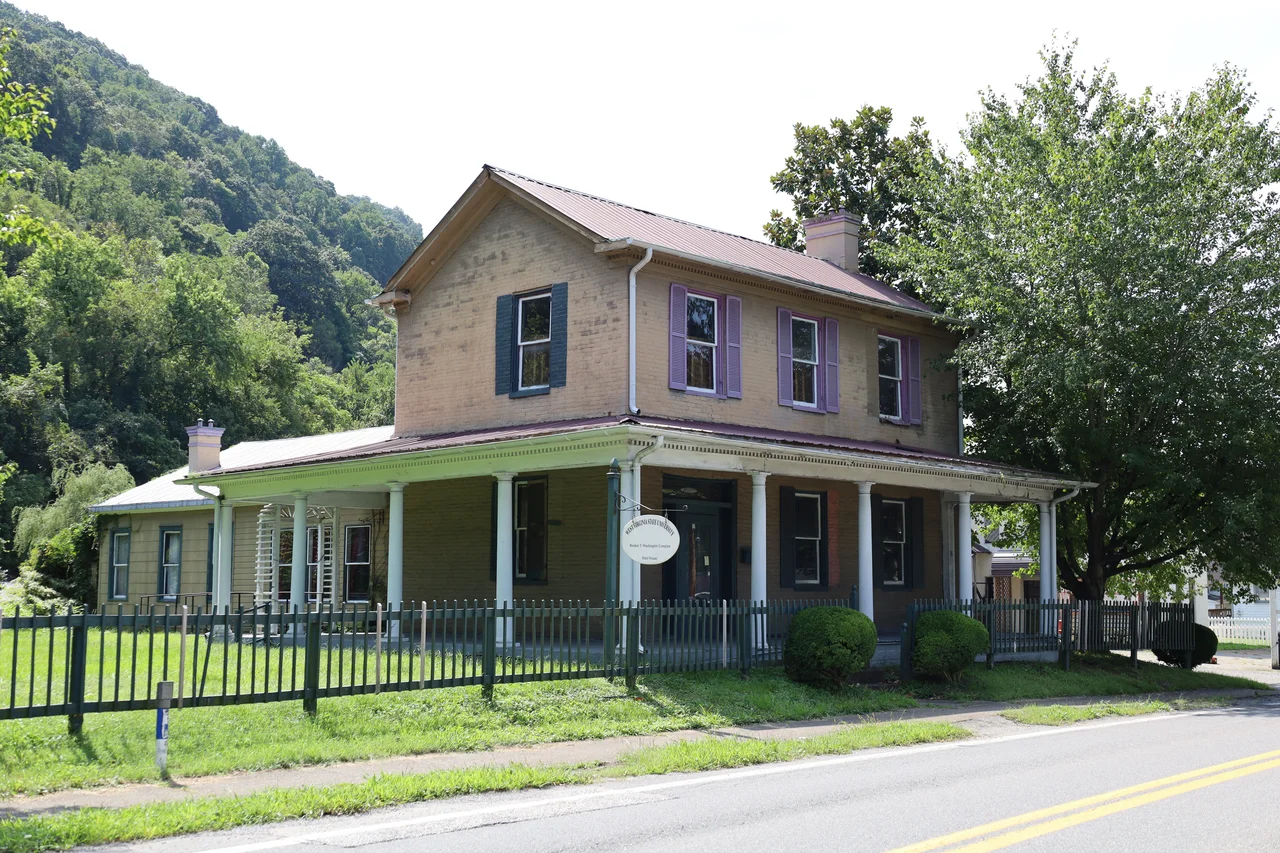

Malden Historic District
Long before coal, there was salt. The flat land along the Kanawha River near what is now Malden, West Virginia, sat above brine springs that the Shawnee and earlier peoples had used for centuries. American settlers arrived in the 1790s, learned the brine works, and by the 1820s had built one of the largest salt-producing operations west of the Alleghenies. At its peak in the 1840s, the Kanawha salt district produced about three million bushels a year, supplying the meat-packing industry of Cincinnati and the entire western frontier. The town of Malden grew up around the works. Today's Malden Historic District preserves 95 contributing buildings from that era and after - residential, commercial, ecclesiastical, and industrial - including the African Zion Baptist Church and the modest community where a nine-year-old Booker T. Washington arrived with his family in 1865.
Salt and the Brine Wells
Salt-making in the Kanawha Valley used an unusual technology. Workers drilled wells - some of them 1,000 feet deep, among the deepest holes ever drilled in early-nineteenth-century America - to reach the salt brine that lay beneath the Carboniferous bedrock. The brine was pumped to the surface, fed into long evaporation pans, and boiled over coal fires until the water evaporated and the salt crystallized. The process was labor-intensive and required enormous quantities of fuel; the Kanawha salt industry was the first large-scale American consumer of bituminous coal. By the 1820s, the technology had been refined enough to scale up. Enslaved laborers did much of the actual work - this was an industrial economy built on enslaved labor in a slave state.
The 1840s Peak
At its height around 1845, the Kanawha district had more than fifty salt furnaces operating between Malden and the surrounding towns of Cedar Grove, Belle, and present-day Charleston. Production reached three million bushels a year. The salt was shipped down the Kanawha to the Ohio River and from there to Cincinnati's meatpackers, who needed enormous quantities of salt to preserve pork for shipment east and abroad. The wealth concentrated in the hands of a relatively small number of salt families - the Lewis, Dickinson, Shrewsbury, Ruffner, and other clans whose surviving Federal-style houses are now contributing properties to the historic district. The Richard E. Putney House, built in 1836, and the Kanawha Salines Presbyterian Church, completed in 1840, capture the architectural ambition of the salt-boom era.
Decline, and What Came After
The Kanawha salt industry was already in decline by the time the Civil War arrived. Cheaper salt from Syracuse, New York, and from new Midwestern sources had begun to undercut the Kanawha producers, and the war's disruption finished the collapse. By 1880, most of the furnaces were closed. The economy shifted: from salt to coal, then to chemicals as the twentieth-century industrial boom brought DuPont, Union Carbide, and others to the lower Kanawha. Malden itself stopped growing. The buildings the salt boom had produced - the brick houses, the church, the commercial blocks, the company structures of the former J. Q. Dickinson & Company - simply stayed where they were, lightly modified through the twentieth century, gradually becoming an accidentally preserved historic district. The 1980 National Register listing recognized what had survived.
Washington Among the Furnaces
Booker T. Washington's family arrived in Malden in 1865, after emancipation. His stepfather had found work in the salt works. The young Washington worked first in a salt furnace and then, by the late 1860s, in a coal mine. He attended the African Zion Baptist Church, founded in 1852 by free Black families and the oldest African American Baptist church in West Virginia. Up From Slavery describes his Malden childhood in detail - the salt town, the church, the industrialist Lewis Ruffner in whose household Washington worked as a teenager, the slow accumulation of literacy and ambition that would carry him to Hampton Institute in 1872. The historic district preserves much of the physical context Washington describes: the church, the salt-era houses, the riverside flats where the furnaces stood. The salt-boom architecture and the African American community institutions occupy the same several blocks of the same small town.
Flying Over the Old Salt Works
From the air, Malden reads as a small riverfront community pressed between the Kanawha River and the bluffs of the lower Kanawha Valley, about five nautical miles east of downtown Charleston. The historic district occupies a few city blocks of mixed brick and frame buildings, with the African Zion Baptist Church standing as a small white frame structure among the larger nineteenth-century houses. The river bends gently here, with the I-77/I-64 corridor running across the bluffs to the south. The salt brine wells and furnaces are mostly invisible on the modern landscape; the few archaeological features that remain are not legible from cruising altitude. The town's small footprint preserves an outsized piece of West Virginia's industrial and African American history.
From the Air
Located at 38.30°N, 81.56°W along the Kanawha River in Kanawha County, West Virginia, about 5 nm east of downtown Charleston. The historic district covers a few blocks of mixed brick and frame architecture in this small community. Nearest airport: Yeager Airport (KCRW) at Charleston about 6 nm west. The district is small from cruising altitude; use Malden's riverbank location as orientation. Best photographed from 2,000-3,500 feet AGL.
Nearby Stories
- Summersville, West Virginia 5.8 km away
- Westsylvania 13 km away
- Toyota Motor Manufacturing West Virginia 13 km away
- Upper Big Branch Mine Disaster 14 km away
- Logan County, West Virginia 16 km away
- Hobet Coal Mine 18 km away
- Robey Theatre 26 km away
- Greenbrier County, West Virginia 36 km away