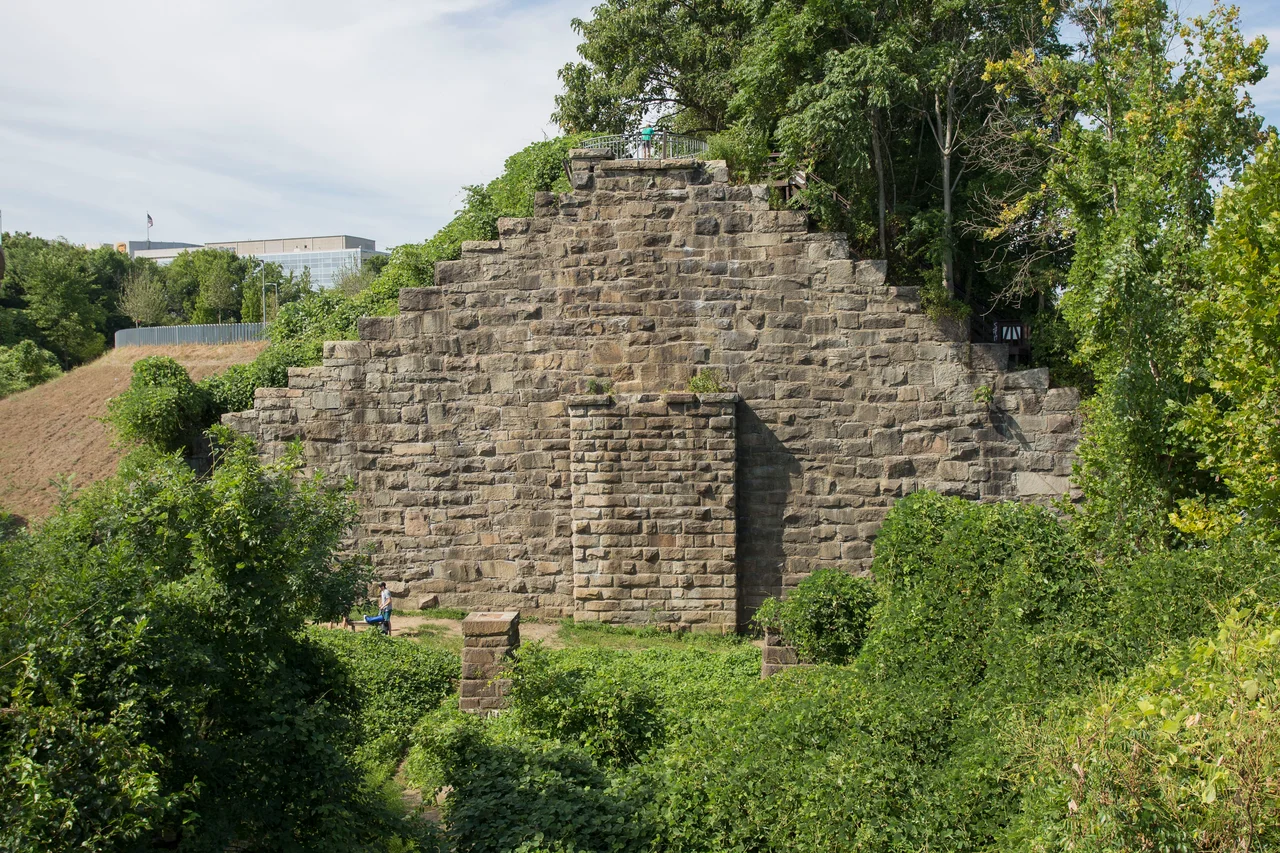

Manchester Wall
The bridge is gone, but the pillars remain. Three blocks of nineteenth-century granite still rise from the south bank of the James River, anchored where the Richmond and Petersburg Railroad once threw its trusses across the falls. The trains stopped running decades ago, the deck was dismantled, and what should have been demolished masonry instead became something nobody planned: a sixty-foot vertical playground in the middle of a state capital. On any warm evening, you will find climbers chalking their hands at the base, while joggers on Brown's Island watch them disappear, one finger pocket at a time, up the side of an abandoned piece of industrial Virginia.
Granite Ghosts of the Railroad Age
The Richmond and Petersburg Railroad spanned the James for much of the nineteenth century, stitching the tobacco port of Manchester to the capital across the falls. Bridges burn and bridges fall - the James was rebuilt, replaced, and rerouted many times across the war years and after - but the heavy granite piers proved harder to remove than they were worth. They stayed. Over time the river city rearranged itself around them. The trestles that once carried iron and rolling stock vanished into salvage; the pillars stood, ignored, until somebody noticed they were perfect. Climbers started showing up in the 1980s, treating the abandoned masonry as found art. What had been infrastructure became apparatus. The wall and its three pillars now sit inside the James River Park System, accessible by foot from the north via Brown's Island and the T. Tyler Potterfield Memorial Bridge.
Forty-Three Routes Up an Abandoned Idea
There are 43 routes here, ranging from a forgiving 5.4 to a punishing 5.11a, with most clustering around 5.9. The Wall - the long vertical face - holds 22 of them; Pillar #1 holds 9, Pillar #2 holds 8, and Pillar #3 holds 6. Beginners gravitate to The Ladder, also known as Potty Training, a 5.4 tucked on the back of the first pillar facing the river. New leaders cut their teeth on Bolts From Heaven, a 5.5 with seven bolts plus two top anchors - the safest first lead at Manchester, and the route most often used to set top ropes for the rest of Pillar #1. McKenna, or The Crack, runs literally as a crack up Pillar #2, offering crimpers, side-pulls, and under-clings to anyone learning how to grip stone with their whole hand.
Tendonitis and Finger Pockets
The Wall itself is where ambition lives. Almost vertical and far longer than the pillars beside it, it punishes hesitation. Tendonitis, rated 5.10d, is the route everyone talks about - an almost smooth face with no real foot- or handholds, just finger pockets and the patience to smear sticky rubber against blank granite. There is one mercy: the first half is a chimney, which lets a climber wedge in and rest before the second half rolls out as a near-blank wall to the top. Pillar #3 is the wildest one. Until July 2006 it was traditional-gear only, climbed with cams and nuts; bolts arrived that summer but the pillar has stayed quiet enough that locals still treat it as a trad climb. Blair Witch, rated 5.10c, remains the hardest route on it.
The Old Slave Port Below
Manchester sits across the river from downtown Richmond, on the south bank that was its own independent city until 1910. In the antebellum period, Manchester was a working tobacco and slave-trading port - boats moved enslaved people up and down the James for sale at Richmond's auction houses just upriver. The Burning of Richmond in April 1865, when retreating Confederate forces set fire to their own tobacco warehouses, scorched both sides of the river. What remained of the south bank was rebuilt as rail, then refinery, then ruin. The pillars climbers chalk today are the last clean industrial bones of a city whose history was far heavier than its bridges. Knowing that as you tie in does not change the move - but it changes the view.
An Urban Park You Can Climb
Few American cities give their residents this. A free public climbing wall - sixty feet of real granite, dozens of routes, set on a riverfront park you can walk to from downtown - is the kind of accident that only happens when an old piece of infrastructure outlives its original purpose long enough for a new one to grow around it. Pedestrians on the Potterfield Memorial Bridge stop to watch. Beginners learn to lead on Bolts From Heaven; experienced climbers grade their season on Tendonitis. The James moves below it all, brown and fast over the falls, doing what it has always done. The trains are long gone. The granite remained.
From the Air
Manchester Wall sits at 37.5296 N, 77.4459 W, on the south bank of the James River in Richmond. From the air, look for the three rectangular granite pillars and the long wall just downriver of the T. Tyler Potterfield Memorial Bridge, with Brown's Island to the north and the James River Park strip to the south. The nearest major airport is Richmond International (KRIC), about 7 nm to the east. Recommended viewing altitude is 1,500-2,500 ft AGL to catch both the falls and the urban skyline beyond.
Nearby Stories
- Kings Dominion 8.4 km away
- Battle of Hatcher's Run 9.7 km away
- Francisco's Fight 14 km away
- Piney Grove at Southall's Plantation 17 km away
- Jamestown Settlement 19 km away
- Battle of Amelia Springs 22 km away
- Menokin 29 km away
- Highland (James Monroe House) 42 km away