.jpg)
Mandarin's House
In 1894, while living in this compound in Macau, Zheng Guanying completed the final chapters of Shengshi Weiyan — Words of Warning in Times of Prosperity. The book was a clarion call for China to industrialize, democratize, and compete with the Western powers on their own terms. It would be read by reformers across the empire, and it was written in a house that itself embodied the argument: Cantonese in its bones, European in its ornamental details, the product of a place that had spent centuries absorbing what was useful from the world outside.
A Family Compound Built for a Changing Dynasty
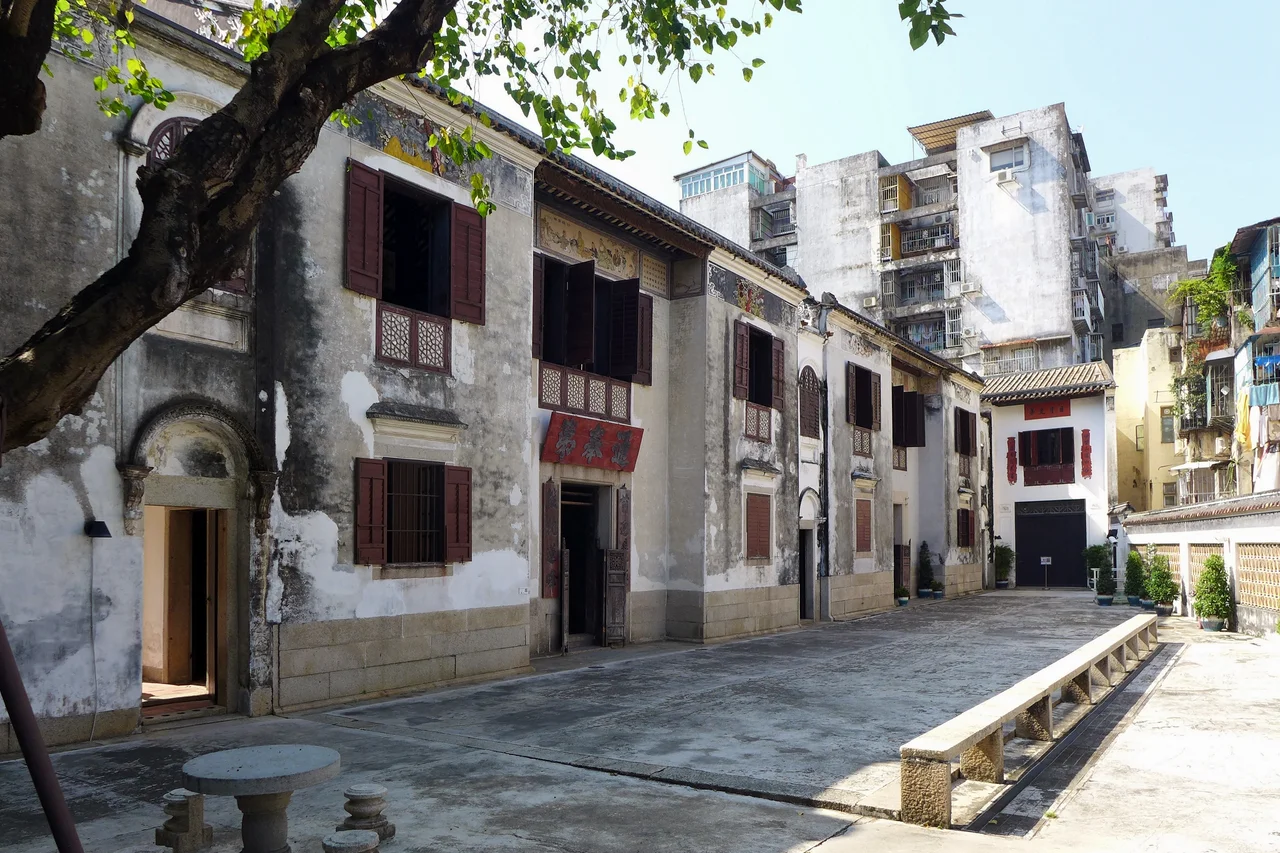
Zheng Wenrui built the house in 1869 — the eighth year of the reign of the Tongzhi Emperor — as a family compound in the São Lourenço district of the Macau Peninsula. His son Zheng Guanying, born in 1842, would go on to become one of the most influential thinkers of the late Qing period: a comprador, a merchant, a writer, and a man who believed that China could not survive contact with the modern world without fundamentally transforming itself. The compound he grew up in, which he and his brothers gradually expanded over the years, covers 4,000 square meters — substantial for a city as dense as Macau — and is considered among the largest private residences ever built on the peninsula. The architectural language is primarily Cantonese: covered walkways, interior courtyards arranged for shade and ventilation, carved timber screens. Western classical details — arched windows, decorative pilasters — appear at the edges, absorbed quietly into a design that remains Chinese in structure.
Words of Warning, Written at Home
Zheng Guanying's Shengshi Weiyan is not a household name outside China, but its influence on late 19th- and early 20th-century Chinese reform movements was profound. The book argued for constitutional government, modern education, industrial development, and the adoption of Western commercial practices — not as an act of cultural surrender, but as a strategy for national survival. That it was written here, in a house in Portuguese-administered Macau, is fitting. Zheng had spent his career moving between Chinese and Western business worlds, and the house around him embodied exactly the kind of selective, purposeful synthesis he was advocating. Sun Yat-sen is reported to have read Shengshi Weiyan as a young man; the book was among the texts that shaped a generation of Chinese reformers.
Decline, Crowding, and the Long Restoration
By the 1990s, the family had mostly moved out, and the house was subdivided among tenants. At its most crowded, more than 300 people were living inside the compound — numbers that put enormous strain on structures never designed for that density. A fire damaged the building significantly, and the restoration that followed took eight years to complete. The Macau government took formal possession of the property in 2001. Four years later, in 2005, the Mandarin's House was designated as part of the Historic Centre of Macau, a UNESCO World Heritage Site. The restored compound is now open to visitors, its courtyards quiet again, the carved screens and whitewashed walls returned to something close to what Zheng Guanying would have recognized.
Walking the Courtyards Today
Visiting the Mandarin's House means moving through a sequence of spaces designed to control light, air, and the flow of daily life. The main entrance leads through a moon gate into the first courtyard; subsequent rooms open inward, each more private than the last. The carved timber detailing on doors and screens is particularly fine — this was a household of considerable means, and the craftsmanship reflects it. The house sits in São Lourenço, one of the more atmospheric districts of the old city, a short walk from the Moorish Barracks and the A-Ma Temple. The surrounding streets, paved in Portuguese-style limestone mosaic, make the approach itself feel like a journey back through layers of Macau's history.
From the Air
The Mandarin's House sits at 22.1886°N, 113.5344°E in the São Lourenço district of the Macau Peninsula, roughly 600 meters east of the A-Ma Temple and the Inner Harbour waterfront. From the air at 2,000–3,000 feet, the old peninsula's dense, low-rise urban fabric is visible as a distinct contrast to the casino towers of Cotai to the south. The compound's interior courtyards are visible on close approach. Nearest airport: Macau International (VMMC) on Taipa island, approximately 3 kilometers southeast. Also nearby: Hong Kong International (VHHH), about 65 kilometers northeast across the Pearl River Delta.
Nearby Stories
- 2024 Shenzhen Stabbing 0.8 km away
- Lantau Peak 1.5 km away
- Kweilin Incident 2.4 km away
- Taishan City 7 km away
- Wanshan Archipelago Campaign 38 km away
- Hong Kong 12 68 km away
- Battle of Nanpeng Island 82 km away
- Erhai Lake 1335 km away