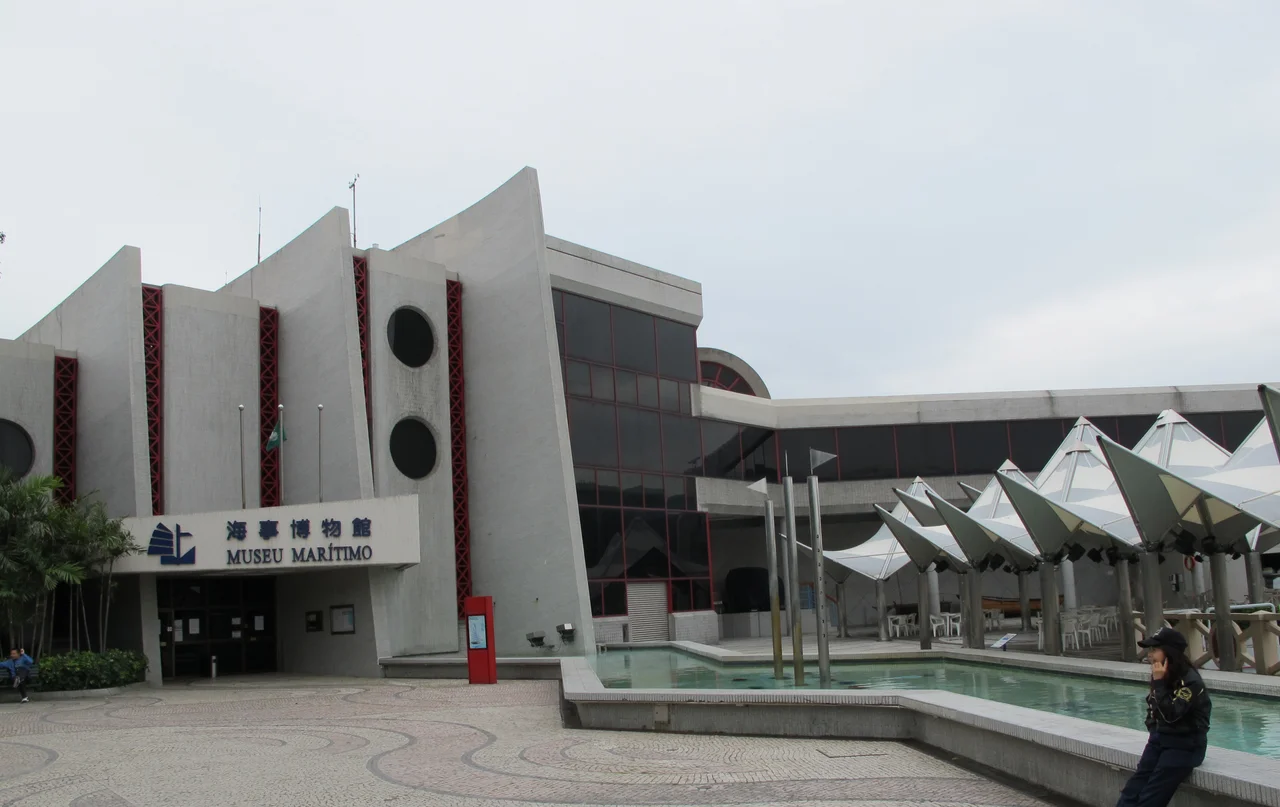

Maritime Museum (Macau)
The ground beneath the Maritime Museum is, in a precise and deliberate sense, the place where Macau began. Portuguese explorers landed here in 1553, and the encounter that followed — trading rights in exchange for clearing the coast of pirates — set in motion more than four centuries of Portuguese presence in East Asia. The museum built on this site does not hide that history behind abstraction. Its architects shaped the building to resemble a ship, the walls curving outward like a hull about to meet the sea.
A Landing Site Turned Museum
The idea for a maritime museum in Macau was proposed in 1986. The first museum opened the following year, in 1987, in a building that quickly proved too small for what the collection demanded. A new, larger building was constructed on the same site — the historic landing spot on the Inner Harbour waterfront — and opened on 24 June 1990. The original building was retained as the museum's administrative center. The new structure spans more than 800 square meters, and its ship-like profile is intentional: the institution is as much monument as museum, a formal acknowledgment that this particular stretch of waterfront changed the course of history for both Portugal and China. The A-Ma Temple, one of Macau's oldest structures and the landmark for which the city may have been named, stands just a short distance away.
Four Galleries, Four Ways of Reading the Sea
The Maritime Museum organizes its collection into four distinct exhibitions, each approaching the ocean from a different angle. The Maritime Ethnology Exhibition examines how fishing communities, traders, and seafarers across the South China Sea and beyond organized their lives around the water — the boats they built, the rituals they kept, the communities that formed in ports like this one. The Maritime History Exhibition traces the arc of seafaring from early navigation through the age of exploration that brought the Portuguese to these shores. The Maritime Technology Exhibition focuses on the mechanics: how ships were built, how navigation worked before GPS, how cargo moved across oceans before containerization. An Aquarium Gallery rounds out the permanent collection. Together the four galleries make the case that Macau's identity was always inseparable from the sea that surrounds it.
The Inner Harbour and Its Layered Meanings
The museum's location on the Inner Harbour — the Porto Interior — gives it a context that the building alone cannot provide. This was the working waterfront of old Macau, the place where junks and Portuguese carracks once shared anchorage, where goods from Goa, Malacca, Japan, and China converged in one of the busiest trading ports in Asia. The A-Ma Temple nearby was already ancient when the Portuguese arrived; local legend holds that the name 'Macau' derives from 'A-Ma Gau,' the bay of A-Ma. Standing on the waterfront outside the museum, with the temple behind you and the harbor in front, the geography of first contact becomes legible in a way that no exhibit can fully replicate. The surrounding streets still carry Portuguese names — Rua das Lorchas, named for the flat-bottomed trading vessels once common here — and the buildings mix colonial and Chinese vernacular architecture in proportions that feel unrehearsed.
Visiting Today
The Maritime Museum sits at the southwestern tip of the Macau Peninsula, in the Barra district just below São Lourenço. It is an easy walk from the Moorish Barracks and the Mandarin's House, and the concentration of historic sites in this corner of the peninsula makes it sensible to combine them in a single afternoon. The museum itself is compact enough to explore thoroughly in an hour or two. Outside, the waterfront walk along the Inner Harbour offers a different kind of history — the scent of the water, the silhouette of boats, the sense of a city that has always looked outward.
From the Air
The Maritime Museum sits at 22.1859°N, 113.5306°E at the southwestern tip of the Macau Peninsula, immediately adjacent to the A-Ma Temple and the Inner Harbour waterfront. From the air, the peninsula's southwestern point is easily identified: a wedge of low-rise dense urban fabric tapering to a point between the Inner Harbour (east-facing) and the Outer Harbour (west-facing). The ship-shaped museum building is visible on close approach from the south. Nearest airport: Macau International (VMMC) on Taipa, approximately 3.5 kilometers southeast. ICAO codes in the area: VMMC (Macau), VHHH (Hong Kong International).
Nearby Stories
- 2024 Shenzhen Stabbing 0.8 km away
- Lantau Peak 1.5 km away
- Kweilin Incident 2.4 km away
- Taishan City 7 km away
- Wanshan Archipelago Campaign 38 km away
- Hong Kong 12 68 km away
- Battle of Nanpeng Island 82 km away
- Erhai Lake 1335 km away