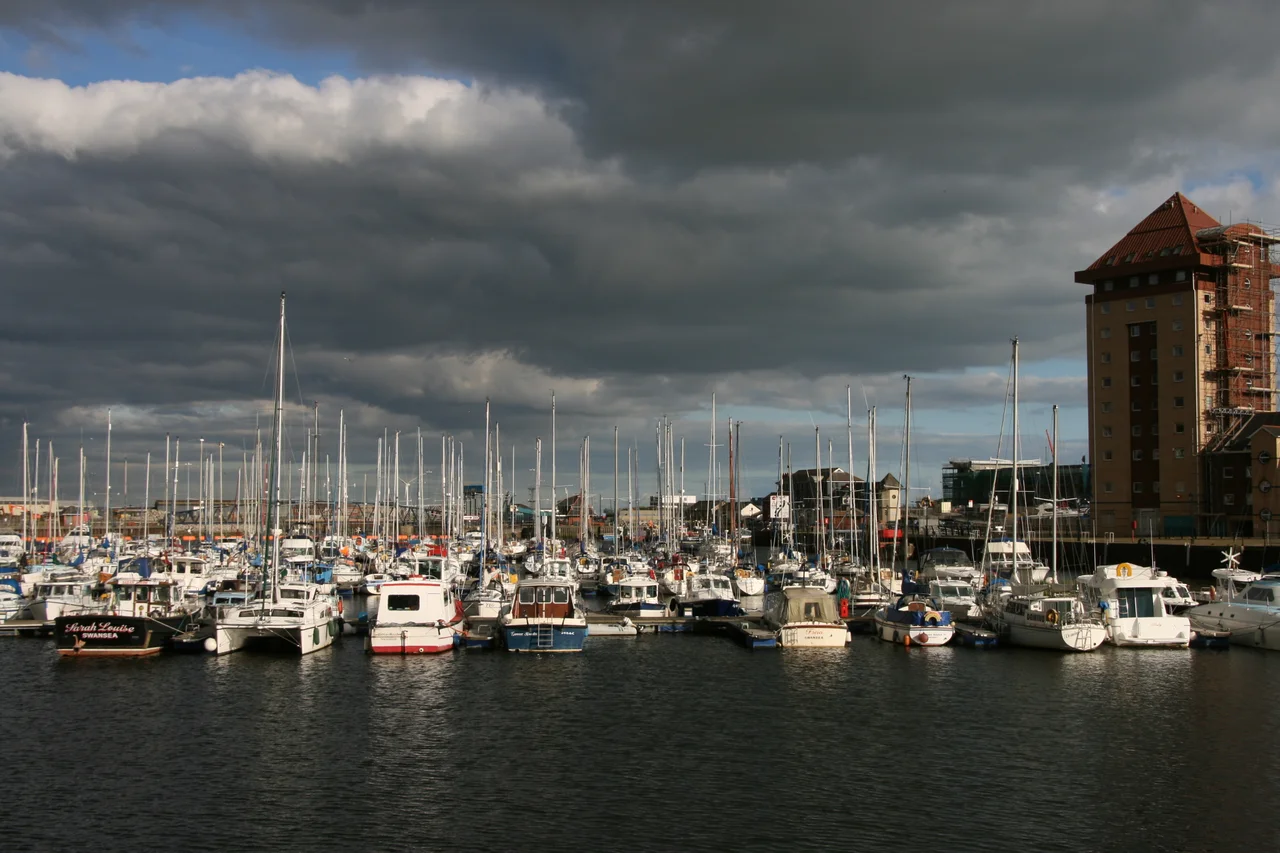

Maritime Quarter, Swansea
There is a story Swansea residents like to tell about how the Maritime Quarter came to exist. The city council filled in the old South Dock in the 1970s. The company that did the filling was run by the brother of a city councillor. A few years later, when planners decided the waterfront would make a better marina than a vacant lot, the same company was hired to dig the dock back out. The brother eventually went to Swansea Prison. The dock became a marina, the marina anchored a residential quarter, and Wales's tallest building now rises above it all. As civic origin stories go, it is at least an honest one.
Reinventing a Dockside
The South Dock was once the working face of industrial Swansea, a stone basin where coal and copper moved through the port. By the 1970s the trade had moved elsewhere and the basin was just a hole in the city. Brownfield redevelopment in the early 1980s rebuilt the area as low-rise apartments around the re-excavated dock. The architect Robin Campbell, then head of Environmental Design at Swansea Council, drew up the master plan. His brief was to make the Maritime Quarter feel like an extension of the city centre rather than a separate suburb, with walkways connecting through a development built piecemeal by several different builders. Quay Parade and Oystermouth Road, busy thoroughfares running between the marina and the shopping core, ended up cutting more of a line than anyone intended. The Maritime Quarter still feels slightly apart from the centre even now.
The Vanished Weaver Building
Where the Sainsbury's superstore stands today, a six-storey concrete tower once held grain. It was called the Weaver Building, built in 1897 by the French engineer François Hennebique, and it was the first reinforced-concrete building in Europe. Hennebique's patented system of steel-rebar-in-concrete went on to become the structural language of the twentieth century, from grain silos to apartment blocks to motorway flyovers. The Weaver was where it started on this side of the Channel. It is gone now, replaced by a supermarket, with no plaque to mark what was lost. Swansea's industrial heritage tends to disappear quietly like this, even the important pieces.
Meridian Quay and the Tallest in Wales
Rising 107 metres above the marina, The Tower at Meridian Quay holds the distinction of being the tallest building in Wales. It was finished in 2010, a slim residential block of glass and steel that altered the Swansea skyline more than any structure since the rebuilding after wartime bombing. From its upper floors you can see Mumbles Head to the west, the Bristol Channel to the south, and the Brecon Beacons to the north on a clear day. It is also a Welsh skyscraper in a country that does not really do skyscrapers, which is part of why it dominates the view in a way that nothing of its modest height would dominate Manchester or London.
Captain Cat and Dylan Thomas
Dylan Thomas was born in Swansea in 1914 and the city has spent the decades since trying to figure out what to do with that fact. The Dylan Thomas Centre, the Dylan Thomas Theatre, and a bronze statue of the poet himself all sit within the Maritime Quarter. A second statue, of Captain Cat, the blind retired sea captain from Thomas's radio play Under Milk Wood, stands nearby. Captain Cat is fictional, but in Swansea fiction and biography overlap so thoroughly that it hardly matters. Add the National Waterfront Museum, the Mission Gallery, Swansea Museum, and the Marina Towers Observatory, and the quarter functions as the city's cultural waterfront, a place to spend a wandering afternoon between art galleries and harbour cafes.
The Sail Bridge
Two pedestrian and cycle crossings link the Maritime Quarter to the main Swansea docks across the River Tawe. The Sail Bridge is the more theatrical of the two, a single white pylon leaning over the water with the deck slung from cables in a configuration that, from certain angles, really does resemble a sail filling with wind. The lock bridge is plainer, a steel structure spanning the Tawe Barrage, with a swing section that opens to let boats through. Together they tie the quarter into the rest of the waterfront and give walkers a reason to cross the river. The water in the marina itself has no railings around its edges, a design choice that has bothered residents for years; the dock has claimed a number of lives over the decades from people falling in by accident. It is the kind of small detail you notice once and never quite forget.
From the Air
The Maritime Quarter occupies the south-eastern corner of Swansea at 51.6154 N, 3.9386 W, immediately south of the city centre and east of the long curve of Swansea Bay. From the air the rectangular former South Dock basin stands out clearly, ringed by apartment blocks, with the slim tower of Meridian Quay rising at its southern end. The River Tawe runs along the eastern edge, its mouth blocked by the Tawe Barrage. Swansea Airport (EGFH) is 4 nautical miles west on Fairwood Common. Cardiff (EGFF) is 30 nautical miles east. The Bristol Channel coast lies south of the city; recommended viewing altitude is 1,500 to 3,000 feet to take in the marina, the city centre, and the sweep of Swansea Bay together.
Nearby Stories
- Dinefwr Castle 2.9 km away
- Cymmer Colliery Explosion 7.7 km away
- Brecon Beacons National Park 8.5 km away
- Caldey Abbey 9.4 km away
- Preseli Transmitting Station 12 km away
- Minehead Lifeboat Station 13 km away
- Ilfracombe Lifeboat Station 14 km away
- Lundy 19 km away