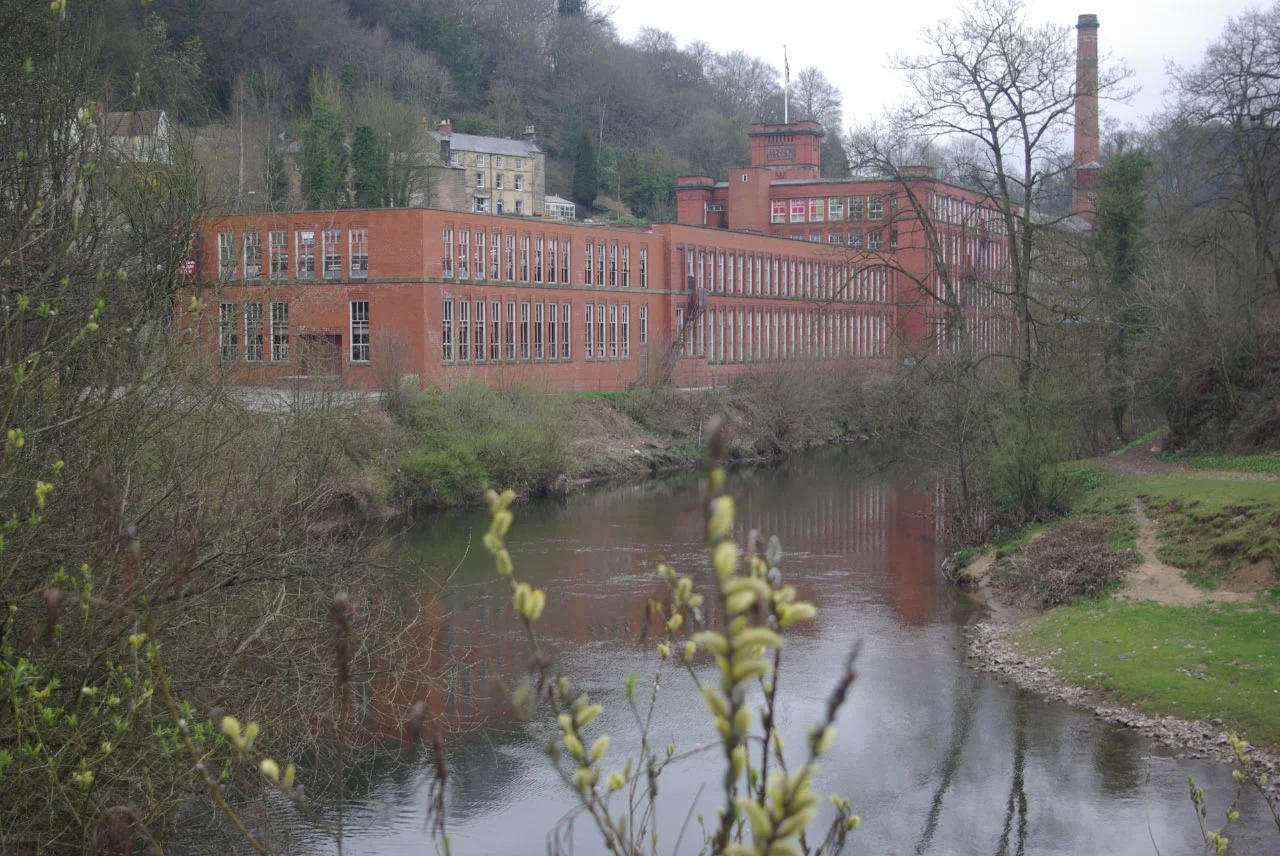

Masson Mill
By 1783, Richard Arkwright had something to prove. His first mill at Cromford had worked, his second mill had worked, and the cotton industry he had effectively invented was being copied from Lancashire to Saxony. So when he built his third spinning mill, on a stretch of the Derwent just two miles downstream from Cromford, he built it as a statement. Masson Mill was wider, taller, more architecturally confident than anything he had done before. The river was bigger here than at Cromford, the wheel could be bigger, the output could be greater. It was the moment Arkwright stopped experimenting and started showing off. Two and a half centuries later, the mill is still standing, still drawing power from the same river - now to generate electricity rather than to spin cotton - and visitors can shop inside it.
The Third Time
Arkwright's first mill at Cromford, opened in 1771, used the modest flow of the Bonsall Brook and the Cromford Sough. His second site followed soon after. Masson, completed in 1783, took advantage of the much greater volume of the River Derwent itself. The river meant a larger wheel, more horsepower, more spindles, more thread. A weir was built across the Derwent to raise a head for the new mill and for a pre-existing paper mill upstream. Unusually, the weir was built convex rather than concave, curving downstream like the back of a turtle. It still does. The shape distributes the load of the falling water differently than the usual concave design, and it has held for more than two centuries against a river that knows how to flood.
A Mill Built to Be Seen
The original 1783 building was twenty-one bays long, five storeys high, brick built on a base of local gritstone, with stone window dressings and quoins picking out the geometry. Inside, the staircase and ancillary services were tucked into a central projection so that the production floors stood clear from end to end, an arrangement that other mill architects soon copied. By around 1800 a second waterwheel had been added, then the roof was raised to create a usable sixth storey, then a tall chimney went up in 1900 and engine houses by the famous mill architects Stott and Sons. The visitor today is looking at layered iterations of nineteenth-century industrial style, but the bones are Arkwright's. James Adams, writing in his Gem of the Peak guidebook in 1840, said the night-time view of Masson was 'exceedingly imposing - the spacious mill with its hundred lights reflecting on the river and the thick foliage, mingling the din of wheels with the noise of the waterfall.'
Arkwright's House on the Hill
Across the river from Masson Mill stands Willersley Castle, the house Arkwright built for himself in the 1780s. The chimney smoke from the mill drifted past his drawing-room windows, and he could see his investment from his porch. He died in 1792 before the castle was fully finished, the wealthiest untitled person in Britain. His son Richard Arkwright junior completed it and lived there, managing the family's now vast industrial holdings. Willersley is now a hotel. From the river path between the two buildings you can stand on a footbridge and look upriver to the castle and downriver to the mill, and understand why this two-mile stretch of the Derwent is included in the UNESCO World Heritage Site for the Derwent Valley Mills. Almost nowhere else in the world can you see a single industrialist's vertical empire still standing - his house, his mill, his weir, his river - within a fifteen-minute walk.
Power, Then and Now
Waterwheels turned at Masson for one hundred and forty-five years. In 1928 they were finally replaced by turbines. In 1995, the turbines were upgraded with modern hydroelectric generators capable of producing 240 kilowatts, enough to power the building and feed surplus into the grid. The same falling water that drove the world's third water-powered cotton mill in 1783 now charges the lights, the tills, and the visitor exhibits. The cotton equipment is still there too, much of it preserved on the upper floors: Lancashire looms, a Yorkshire broadloom, Platt Brothers mules, a six-cylinder devil for tearing rags into useful fibre, condenser carding machines, Northrop looms. None of it runs in production, but visitors can walk between the machines and see what working a Derwent mill actually looked like.
What the Visitor Finds
Masson Mill today is two things at once. On the lower floors it is a shopping village - a sprawl of independent retailers using the old workspaces, with a café and the inevitable gift shop. On the upper floors it is the Working Textile Museum, with original Arkwright-era equipment in the rooms where it actually worked. The combination is awkward and useful at the same time. The shopping pays the bills that keep the museum open. The museum reminds the shoppers that they are inside a UNESCO World Heritage Site, on the river that powered the beginning of the modern factory age. The convex weir still curves below the windows. The Derwent still falls over it with the same noise Arkwright would have heard. Masson Mill is not a ruin and not a re-enactment. It is the original building, still doing more or less what it was built to do, two hundred and forty-three years later.
From the Air
Masson Mill stands at 53.1128°N, 1.5616°W in Matlock Bath, on the west bank of the River Derwent in Derbyshire. From the air, look for the distinctive cluster of brick and stone industrial buildings with a tall chimney, immediately downstream of a convex weir, with Willersley Castle on the wooded bluff across the river. Recommended viewing altitude is 2,500 to 3,500 feet AGL; the valley sides rise to over 1,000 feet AMSL. East Midlands Airport (EGNX) lies about 25 nautical miles southeast, Sheffield City Heliport (EGSY) about 20 nautical miles north-northeast. The Derwent Valley Mills World Heritage corridor runs south from here to Derby; on a clear day you can trace the river south through Cromford, Masson, and on toward Belper. Expect typical Peak District weather and possible cable car activity at the High Tor across the river.
Nearby Stories
- Nottinghamshire 3.7 km away
- RAF Finningley 5.5 km away
- Grantham Canal 7.2 km away
- Repton Abbey 7.9 km away
- Manchester 8.8 km away
- Macclesfield 9.7 km away
- Wentworth Castle 11 km away
- Broad Eye Windmill 12 km away