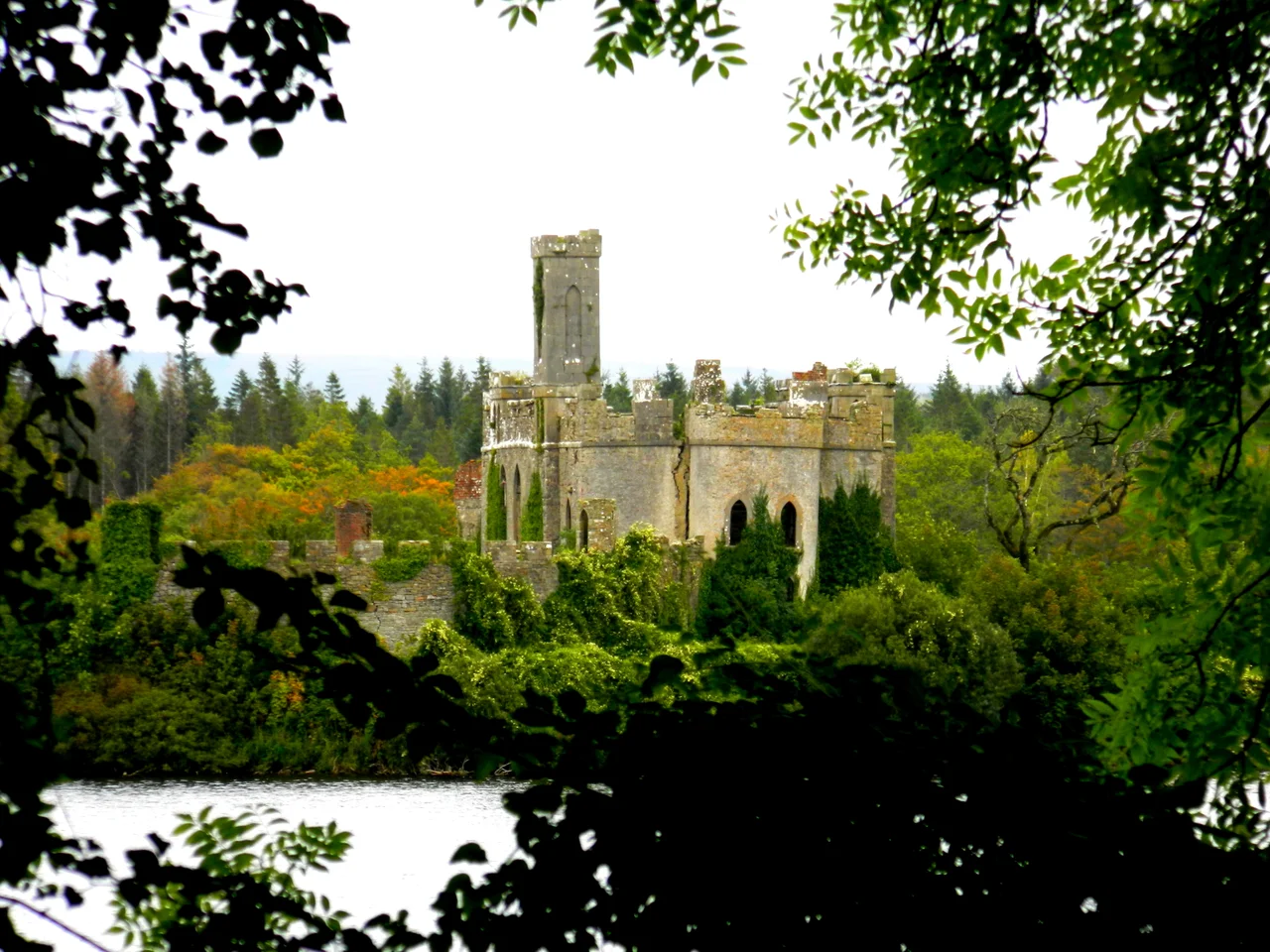

McDermott's Castle
There is an island in Lough Key, in the north of County Roscommon, that looks from the shore like something out of a children's story-book - a low green dome of trees ringed with old grey stone, a roofless tower house standing in the middle, no obvious way across the water. It is called Castle Island, and the castle on it is McDermott's. For eight hundred years it was the seat of the Mac Diarmada, the ruling dynasty of Magh Luirg, kings of a small Gaelic territory in northeast Connacht. They lost it in 1586. It has burnt at least twice in its history - once by lightning in 1184 and once again in the mid-twentieth century. And in between, in the 1820s, the great Regency architect John Nash - the man who designed Buckingham Palace's facade and laid out Regent Street in London - was commissioned to convert the ruin into a summer house.
The Annals of Loch Ce
The first written record of a castle on this island appears in the Annals of Loch Ce, which note that in 1184 a lightning bolt set the building on fire - one of the earliest dated lightning-strikes recorded in Irish history. Whatever was there was rebuilt. In 1235, during the final phase of the Norman conquest of Connacht, the rebuilt castle was besieged by Richard de Burgo, Baron of Connaught, who used some of the most extraordinary medieval siege technology ever recorded in Ireland: first a raft-mounted catapult that could move across the lake to attack any side of the island, and then fire-ships sent in to burn whatever the catapult had not battered. Cormac MacDermott, the King of Moylurg, was forced to surrender. The Mac Diarmada kept rebuilding. They kept losing it. They kept rebuilding again. A poem addressed to a fifteenth-century king of Moylurg, Tomaltach an Einigh, tells the story of the Hag of Lough Key - an old woman who used or abused the hospitality of an earlier king, Cormac MacDermott, by staying on the rock for a full year, and laid on the family the obligation of perpetual hospitality. To this day, the saying 'Tigh Mhic Diarmada' - the house of MacDermott - is shorthand in Irish for an open house.
The Lament
The Mac Diarmada finally lost the island in 1586 under the pressure of the Elizabethan reconquest. The bardic poet Eochaidh O hEoghusa, who died in 1617, wrote a poem lamenting the castle's emptiness - the kind of formal Gaelic elegy in which the bard mourns not just a man or a building but the entire collapsing world of patron, gift, music, and feast. The Mac Diarmada survived as a family but their kingship was over. The castle stood empty for two centuries. The lough kept its name. Then, in the early nineteenth century, the new wealthy English-aligned landlords of the area - the Stafford-King-Harmans of Rockingham, whose great Nash-designed mansion stood two miles up the river - commissioned a new piece of architectural play. John Nash, fresh from designing Buckingham Palace and Regent Street, was paid to convert the medieval ruin into a summer house. He kept the late-medieval tower house intact, added wings on either side and a kitchen on the eastern side, inserted larger windows into the old fortress walls, and notched the enclosure wall so the new windows could look out across the lake. The crenellations now visible on the tower are largely his - Victorian Gothic dressed onto Gaelic medieval.
Silver Pins and Butchered Cattle
The Nash summer house burnt in the mid-twentieth century, leaving the island again roofless. In 2014 the castle had its strangest moment of fame when it appeared in an episode of Chris O'Dowd's comedy Moone Boy as the residence of the mysterious 'Island Joe.' In 2018 it was put up for sale for the surprisingly modest sum of eighty thousand euro - a national monument, no less - but the sale was withdrawn and the island returned to private Irish ownership. The most important recent chapter is archaeological. In 2019 a team led by Tom Finan and Tracy Schryver excavated the island and found that what they had thought was a single medieval fortification was actually a layered multi-period site. Beneath the standing enclosure wall they uncovered an earlier wall two to three metres thick, buried under a metre and a half of soil. On the northern side they found medieval buildings dating to the thirteenth century - the period of the de Burgo siege. The artifacts told the story of high-status Gaelic life: silver pins, a gaming piece, and large dumps of butchered cattle, boar, and sheep bones - the leftovers of the feasts that the Hag of Lough Key had insisted on. The research made the cover of Archaeology Magazine.
What the Lake Holds
Today Lough Key Forest Park, the eight hundred acres of woodland and water that used to be the Rockingham estate, is the gateway from which most visitors first see Castle Island. A small ferry runs in summer. From the shore, in the right light, the place looks exactly the way a castle on an Irish island is supposed to look - small, dark, half-overgrown, the kind of view that makes Irish Tourism Board photographers nervous with happiness. From above, in a low-flying small aircraft, you can see what the lake hides: the rectangular enclosure inside the trees, the shape of the tower house, the lighter pale of the lake-bed where the medieval boat-landings probably were. Eight centuries on, the McDermotts of Coolavin in County Sligo still hold the Gaelic title of The MacDermot, Prince of Coolavin - the only Gaelic noble title still in continuous use that descends from a vanished medieval kingship. The castle is empty. The lake remembers. The view from the tower window - the one Nash widened - is still one of the best on the lough.
From the Air
Located at 53.989 degrees north, 8.232 degrees west, on Castle Island in the southwest portion of Lough Key, about 3 km east-northeast of Boyle town. The lake itself is the most useful landmark from cruising altitude - a roughly oval water body just east of the N4 road. The island and its small tower house are visible at lower altitudes against the wooded shoreline. Best viewed at 1,500-3,000 feet on calm clear days. Nearest airports: Ireland West Knock (EIKN) about 45 km west, Sligo (EISG) about 35 km north.
Nearby Stories
- Tulsk 1 km away
- Holywell ambush 5.8 km away
- Enniskillen Royal Grammar School 6.5 km away
- Aclare 7.6 km away
- Bawnboy 7.8 km away
- Clonfin Ambush 10 km away
- Benbulbin 14 km away
- RMS Empress of Britain (1930) 125 km away