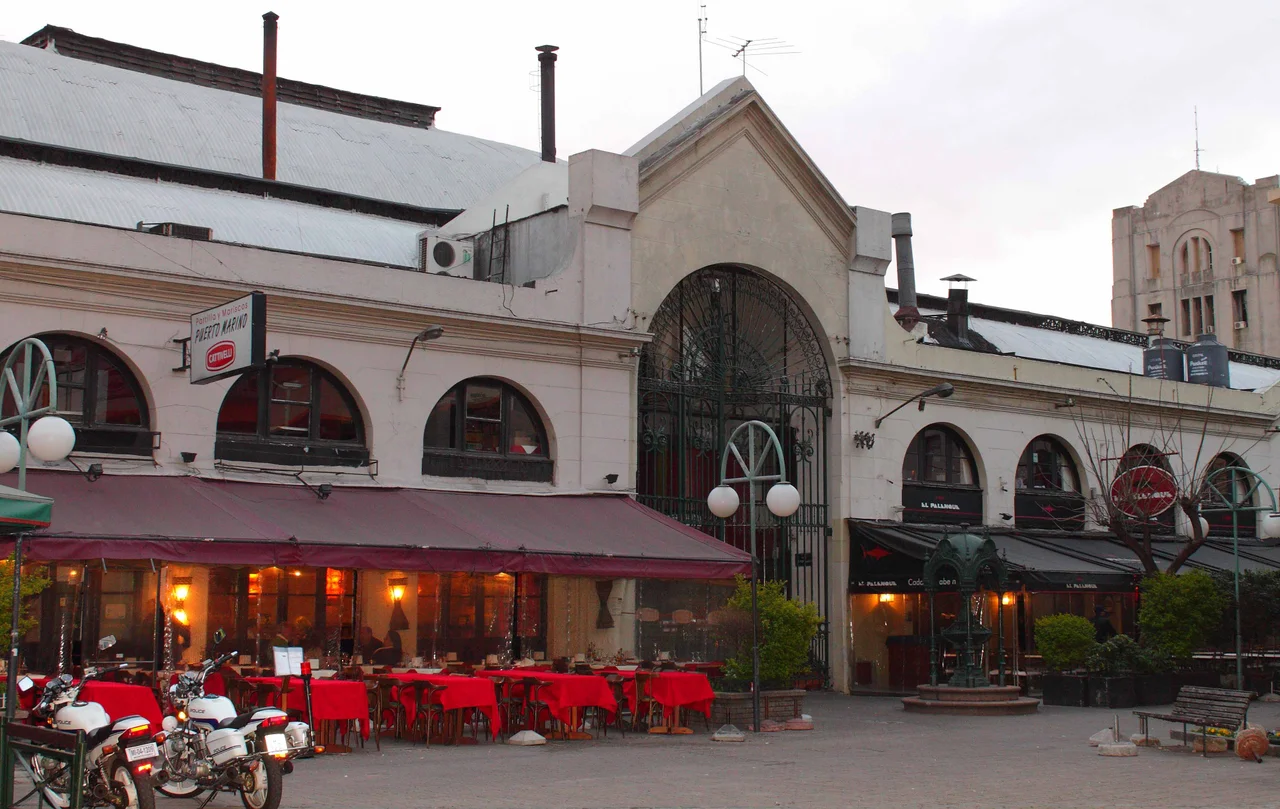

Mercado del Puerto
Step through the doors and the smoke hits first. It rises in blue ribbons from a long row of parrillas, the open-fire grills where chorizo, short ribs, and morcilla blister over wood coals. The roof overhead is a soaring lattice of black iron, the kind of thing you would expect to find sheltering a Victorian railway platform in northern England. That is no accident. The ironwork of the Mercado del Puerto was forged in Liverpool, shipped across the Atlantic in pieces, and bolted together steps from Montevideo's docks. The building no longer sells fruit and vegetables. It sells lunch, and the people of the Uruguayan capital have been coming here to eat it for generations.
Iron from Liverpool
The market was the ambition of a Spanish merchant named Pedro Sáenz de Zumarán, who assembled a private company to build one of the largest covered markets in South America. He turned to British engineers, and the great wrought-iron skeleton was fabricated in Liverpool by the Union Foundry, then loaded onto ships along with the blacksmiths who would assemble it on the far shore. It opened on 10 October 1868, with President Lorenzo Batlle y Grau and his ministers in attendance. The result was one of the first major wrought-iron superstructures on the continent, a piece of industrial Britain transplanted whole to the River Plate. A circular iron fountain once anchored the interior; in 1897 it gave way to a four-faced clock, also imported from Liverpool, which still marks the hours over the grills.
From Produce Stalls to Parrillas
For most of a century the hall did the unglamorous work it was built for, feeding the port and the city from stacks of crates and barrels of wholesale produce. Fortunes rose and fell with the trade, and by the middle of the twentieth century the old market had slipped into decline. Then, in the 1970s, it reinvented itself. The produce stalls emptied and grills moved in, and the smell of charcoal and seared beef replaced the smell of crated oranges. Uruguay takes its asado seriously; the cut of meat, the patience of the fire, the way the coals are banked all carry the weight of ritual. The Mercado became a place to taste that national obsession at its source, where the parrilleros tend their fires in full view and the meat comes to the counter still hissing. The building was declared a National Historic Monument in 1976. Today it stands at the heart of Ciudad Vieja, ringed by museums, artisan shops, and cultural institutions, a working monument that happens to serve lunch.
Medio y Medio
Order a drink here and you may be handed a piece of local history in a glass. The Mercado was the birthplace of medio y medio, a Uruguayan apéritif that blends sweet sparkling wine with dry white wine in equal measure. It was first mixed in the late nineteenth century at the market's Roldós bar, and it caught on as a festive pour for celebrations. More than a century later it is still made, still poured, and still tied in the local imagination to this particular building. To drink one beneath the iron roof is to taste something that was invented in the very room you are standing in.
The City at Its Loudest
The Mercado is at its most exuberant once a year, at midday on New Year's Eve. The hall and the streets around it fill for a riotous celebration built around a traditional water and cider fight, a soaking, sticky, joyous send-off to the old year that pulls in locals and travelers alike. Strangers drench strangers, bottles of cider spray into the crowd, and the whole quarter dissolves into laughter under the summer sun of the Southern Hemisphere. On any other day the rhythm is gentler. A guitarist works through a tango near the entrance. Plates of grilled meat pass across crowded counters. Tourists off the cruise ships wander in beside Montevideans who have been eating here for decades, and the murmur of a city at lunch fills the iron hall. The four-faced clock keeps time over all of it, a small piece of Liverpool keeping watch on the far side of the world, marking the hours in a market that long ago stopped selling anything but pleasure.
From the Air
The Mercado del Puerto sits in Ciudad Vieja at the western tip of Montevideo's peninsula, at 34.91°S, 56.21°W, immediately inland from the Port of Montevideo and its container cranes. From the air the working harbor and the grid of the old town are the clearest reference points; the market itself is a low rectangular hall near the waterfront. Carrasco/General Cesáreo L. Berisso International Airport (ICAO: SUMU) lies about 20 km east along the coast, and Ángel S. Adami Airport (ICAO: SUAA) serves general aviation to the northwest. Best appreciated at lower altitudes in clear River Plate light, with the broad brown estuary opening to the south.
Nearby Stories
- Piriápolis 24 km away
- Minas 40 km away
- Tronador (rocket) 67 km away
- Nueva Helvecia 69 km away
- La Plata Museum 122 km away
- Battle of Sarandí 126 km away
- Mundo Marino 145 km away
- South Georgia Island 2584 km away