_-_Meridian_Gate_-_Ng%E1%BB%8D_M%C3%B4n_(Ho%C3%A0ng_th%C3%A0nh_Hu%E1%BA%BF)_-_img_02.jpg)
Meridian Gate (Huế)
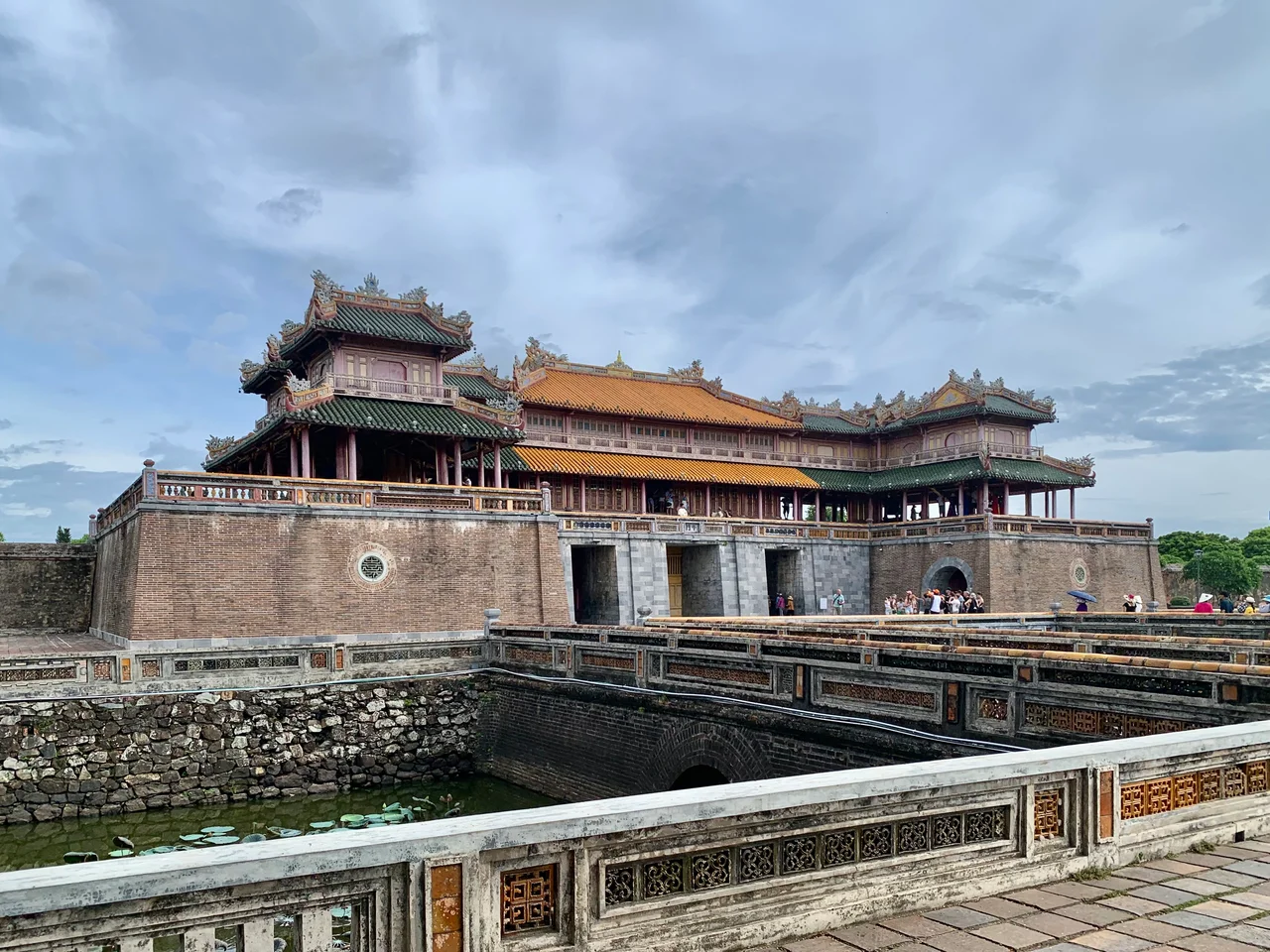
Five doors open through the Meridian Gate, and the distance between them measures the hierarchy of an entire imperial court. The center passage — wide, formal, paved with stone — was reserved exclusively for the emperor. The next two, slightly narrower, belonged to mandarins, soldiers, and horses. The outermost arches, modest in comparison, admitted everyone else. In the architecture of Nguyễn-dynasty power, every entrance was a statement of rank, and the gate itself was the statement that unified them all: the southern face of the Imperial City of Huế, built in 1833 to face the light that the Book of Changes assigned to emperors.
Built on Philosophy
The Meridian Gate — Ngọ Môn in Vietnamese, using the same characters as Beijing's famous gate — was constructed in 1833 under Emperor Minh Mạng, who undertook a wholesale reorganization of the Imperial City's architectural layout in his 14th year of rule. The site had previously held Nam Khuyết Đài, an earlier gate from the Gia Long period. Minh Mạng demolished it entirely to build something grander and more philosophically coherent.
The name and orientation were deliberate. According to the Book of Changes, south is the direction from which emperors should "listen to the world and rule wisely" — facing the light to govern by its clarity. The gate faces the Perfume River and, beyond it, the sacred Mount Ngự Bình. It was modeled after the Meridian Gate of Beijing's Forbidden City, with a main central section and two protruding wing structures representing que towers — traditional markers of palaces, temples, and tombs.
The Five-Phoenix Pavilion
Two levels compose the gate. The lower level is the fortress: heavy stone and brick, five arched passageways, built to endure. The upper level is something else entirely. Rising above the ramparts, the Five-Phoenix Pavilion — Lầu Ngũ Phụng — is an elaborate, palace-like structure whose roof blazes in imperial yellow glazed ceramic tile. Ceramic figures of animals and creatures crowd the ridgelines, their function partly decorative and partly protective, set there to ward off malevolent forces.
From the main hall of the pavilion, the emperor would watch troop parades and ceremonies in the courtyard below. His court occupied the flanking pavilions on either side. The view from that position — the courtyard spreading south, the moat beyond it, the mountains on the horizon — was designed to confirm everything imperial cosmology claimed about the emperor's place at the center of order. Standing here, with the city arranged before you and the mountains framing the distance, the design still works.
August 1945
The Meridian Gate's most significant moment came not during the dynasty's glory but at its end. On August 30, 1945, Emperor Bảo Đại appeared at the gate to deliver the imperial seal and sword to representatives of the Việt Minh provisional government — formally abdicating the Nguyễn throne and ending 143 years of dynastic rule. He had already seen the red flag with yellow star raised on the citadel's flag tower the week before.
The ceremony at Ngọ Môn was witnessed by a large crowd. Bảo Đại handed over the symbols of imperial authority and became, in his own words, a free citizen. It was the last imperial ceremony the gate hosted. The abdication effectively transferred sovereignty to Hồ Chí Minh's government, and the age the gate had been built to celebrate was over. What happened next — the French return, the partition, the war — was not written into the gate's original program.
Survived
The Vietnam War reduced 150 of the citadel's 160 original buildings to rubble or severe damage. The Meridian Gate survived. While house-to-house fighting consumed the city during the 1968 Tet Offensive, while artillery and airstrikes targeted anti-aircraft positions on the citadel's outer towers, Ngọ Môn stood. Its stone-and-brick lower level proved more durable than the wooden structures inside the walls. The yellow roof tiles of the Five-Phoenix Pavilion were still intact when the fighting stopped.
That survival matters for reasons beyond the merely structural. The gate remains the most photogenic face of Huế's imperial complex, the image most often reproduced in guides and prints. Its five arches still frame the approach to the inner palace. The yellow tile roof catches the afternoon light the same way it has since Minh Mạng ordered it built — still facing south, still watching the light.
From the Air
The Meridian Gate sits at 16.468°N, 107.576°E, forming the southern wall of the Imperial City within Huế's outer citadel. From altitude, look for the square outer citadel footprint on the north bank of the Perfume River — Ngọ Môn is the southern face, the gate most prominently visible from the river approach. The moat surrounding the Imperial City is visible at lower altitudes, and the Five-Phoenix Pavilion's yellow roof tiles are distinctive. Nearest airport: Phu Bai International (VVPB), approximately 14 kilometers to the southeast. For the best aerial view of the gate's architecture and its relationship to the inner courtyards, a pass at 2,000–3,000 feet from the south offers the same perspective the gate was designed to project: facing north, into the heart of the palace.
Nearby Stories
- The Rockpile 9.4 km away
- Operation Texas Star 19 km away
- Bà Nà Hills 21 km away
- Quảng Trị Citadel 24 km away
- Lăng Cô 26 km away
- Battle of Nam Dong 30 km away
- Saravan 65 km away
- Hainan Island Incident 378 km away