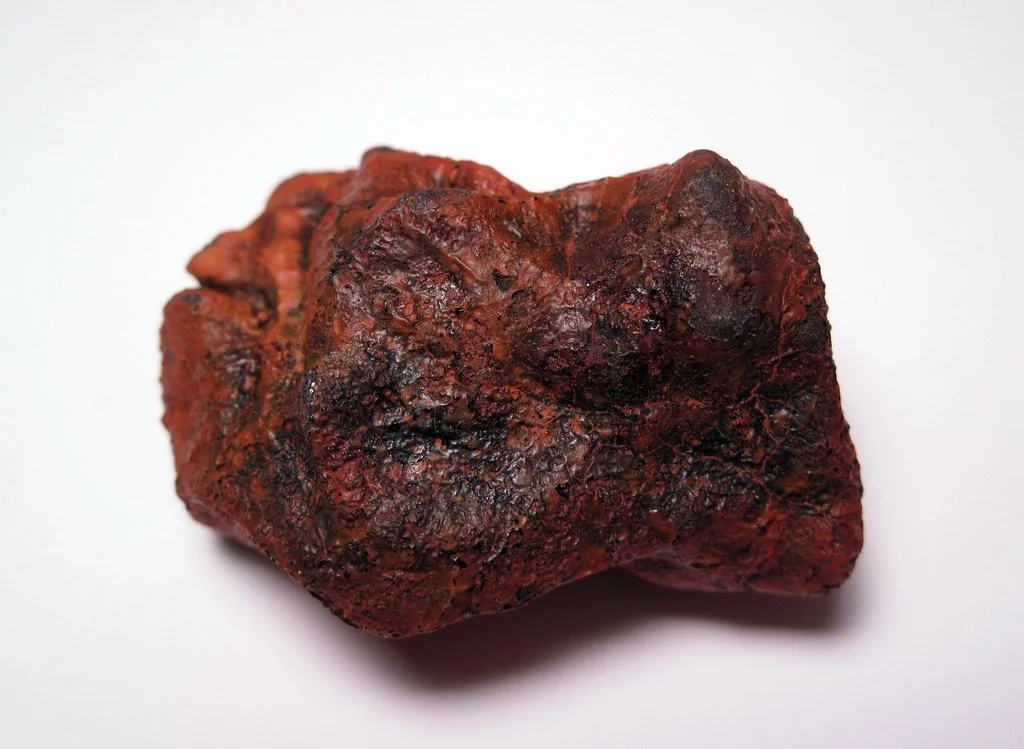

Millbillillie Meteorite
Two station hands were swinging open a gate in a boundary fence when the sky lit up. A fireball ran overhead "with sparks coming off it," they would later say, and it dropped somewhere on the plain to the north. That was October 1960, on a lonely stock track between Millbillillie and Jundee cattle stations near Wiluna. Nobody went looking. The men had stock to move and hundreds of square kilometres of saltbush to cover, and a falling star, however bright, was not a reason to stop work. For ten years, the stones it scattered lay where they landed.
A Visitor From Vesta
What fell that night was not ordinary rock. Millbillillie is a eucrite, a basaltic stone blasted off the surface of 4 Vesta, one of the largest bodies in the asteroid belt between Mars and Jupiter. Eucrites belong to a family of meteorites known by the acronym HED, and they carry the chemistry of ancient lava that once flowed across a small world half a Solar System away. To hold a piece of Millbillillie is to hold a fragment of a planet that never finished forming. The journey from Vesta to the Western Australian desert took millions of years and ended in a four-second streak of light over two men and a fence.
The Stones Wait, Then Are Found
The first pieces were not collected until 1970, a full decade after the fall. Over the years that followed, prospectors, station workers, and Aboriginal people walking the country picked up stone after stone, until more than 330 kilograms had been gathered from the plain. The largest single mass weighed around 20 kilograms. The Western Australian Museum holds that one along with a smaller 565-gram stone, but most of Millbillillie scattered into private hands and collections around the world. It remains the only meteorite of its kind ever recovered weighing more than 100 kilograms, which has made it one of the most studied and most traded eucrites on Earth.
Black Glass and Red Dust
Hold a fresh Millbillillie specimen and the first thing you notice is the crust. As the stone tore through the atmosphere, its outer skin melted into a glossy black glaze called fusion crust, sometimes rippled with flow lines where molten rock streamed backward against the wind of entry. Then the desert went to work. The iron-rich red dirt around Wiluna stained that black glass with rusty smears, so that many recovered stones wear both signatures at once: the deep space behind them and the outback that caught them. Collectors prize the contrast. Few meteorites so clearly show where they have been.
Sky-Stones in a Land of Stories
The country around Wiluna belongs to Aboriginal people whose connection to it stretches back tens of thousands of years, far longer than any pastoral lease or museum catalogue. They were among those who found the fallen stones, walking ground their ancestors had read for generations. Across Aboriginal Australia, falling fireballs and the rocks they leave behind appear in oral traditions that long predate Western science, accounts of fire from the sky woven into the law of place. Millbillillie sits at that meeting point. A piece of a vanished world, landing on some of the oldest continuously inhabited land on the planet, watched by people who already knew the sky could fall.
From the Air
The Millbillillie strewn field lies near 26.45 degrees south, 120.37 degrees east, on the plains between the former Millbillillie and Jundee stations, roughly 60 kilometres north of the town of Wiluna in Western Australia's arid interior. The nearest airfield is Wiluna Airport (ICAO: YWLU), with Leonora Airport (YLEO) well to the south. The terrain is flat red rangeland dotted with saltbush and seasonal claypans, easy to overfly but featureless to navigate by; the town of Wiluna and its airstrip are the main landmarks. Skies here are famously clear, with long visibility and dark nights ideal for spotting the very fireballs that delivered Millbillillie. Best viewed from low cruising altitude in the dry season, when the red earth shows true color against the scrub.
Nearby Stories
- Lake Way 11 km away
- Western Australia 22 km away
- Shoemaker Impact Structure 60 km away
- Wiluna Railway Line 60 km away
- Gascoyne River 97 km away
- Matuwa Kurrara Kurrara National Park 101 km away
- Yarrabubba 119 km away
- Banjawarn Station 128 km away