
Shoemaker Impact Structure
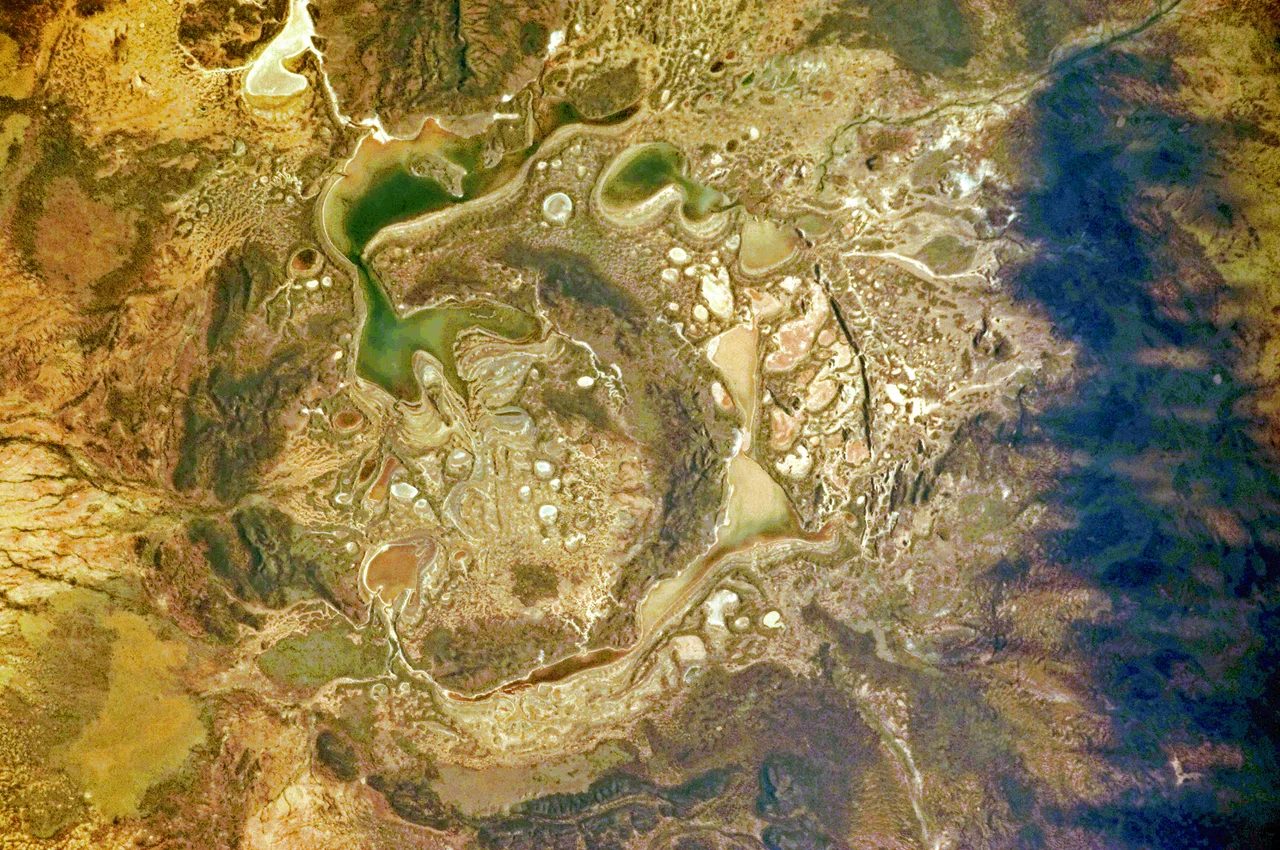
From the ground it is almost invisible, just low ridges and a scatter of salt pans in the flat red country north of Wiluna. From orbit it leaps out: a near-perfect bullseye more than 30 kilometres across, concentric rings of rock wrapped around a raised granite core, with seasonal salt lakes pooling in the grooves like silver in a fingerprint. This is the Shoemaker impact structure, the eroded stump of a crater gouged out of the Australian shield well over a billion years ago. It is the oldest impact scar known on the continent, and almost nothing about it makes sense until you see it from above.
Reading a Wound a Billion Years Old
An asteroid struck here in the deep Precambrian, with estimates ranging from roughly 1.6 to 1.7 billion years ago, when the only life on Earth was microbial and the land had no plants, no soil, no sound. The original crater was far larger and far deeper than what survives. More than a billion years of erosion have planed the landscape flat, slicing the crater open like a specimen on a bench and exposing its internal anatomy. At the center, a plug of ancient Teague Granite was shoved upward by the impact. Around it, layers of sedimentary rock buckled downward into a ring-shaped trough. What we walk on today is not the crater but its roots.
The Fingerprints of an Impact
For decades no one was sure what had made the ring. The first published suggestion that it might be an impact came in 1974, and proof followed when geologists found the unmistakable signatures of a hypervelocity strike. Shatter cones, distinctive rock fractures that radiate like the inside of a horse chestnut, can only form under the instantaneous pressure of an impact. Shocked quartz, with crystal lattices deformed by a shockwave, tells the same story. No volcano, no earthquake, no slow geological process leaves these marks. They are written only by something arriving from space at many kilometres per second, and the Shoemaker structure carries them clearly.
Where Two Ancient Worlds Meet
The crater sits on a geological seam, the boundary between the Archaean Yilgarn craton, a slab of crust among the oldest on Earth, and the younger Earaheedy Basin laid down on top of it. Lake Teague and a constellation of smaller salt lakes occupy the low ground of the rings, filling briefly after rare rains and then drying to glittering crust under the sun. The setting is austere and immense, a place where the planet's earliest chapters lie exposed at the surface. Few spots on Earth let you stand inside something this old and this violent, now utterly silent.
The Man on the Moon
The crater was renamed for Eugene "Gene" Shoemaker, the American geologist who all but invented the study of impacts and co-discovered the comet Shoemaker-Levy 9, which slammed into Jupiter in 1994. Shoemaker had dreamed of walking on the Moon as its first geologist, but Addison's disease grounded him. On 18 July 1997 he was killed in a car crash on the Tanami Track, not far across the outback from this very crater. Two years later, a capsule of his ashes rode the Lunar Prospector probe to the Moon and was deliberately crashed into its surface, making Shoemaker the only human ever buried off-world. His name on a billion-year-old Australian scar is a fitting echo. He spent his life on the trail of impacts, and one bears his name in the desert he died crossing.
From the Air
The Shoemaker impact structure is centered near 25.87 degrees south, 120.88 degrees east, about 100 kilometres north-northeast of Wiluna in Western Australia's arid interior. The defining feature from the air is the ringed pattern of low ridges and salt lakes, most striking from medium to high altitude where the full 30-kilometre bullseye and the bright crescents of Lake Teague resolve into a clear circular form; closer to the ground the structure dissolves into ordinary scrub and claypan. The nearest airfield is Wiluna Airport (ICAO: YWLU), with Leonora Airport (YLEO) farther south. Expect featureless red rangeland in all directions and excellent dry-season visibility. Fly higher than usual here: this is one of the rare landmarks best appreciated from altitude, where erosion's cross-section of an ancient crater becomes obvious.
Nearby Stories
- Matuwa Kurrara Kurrara National Park 40 km away
- Wiluna, Western Australia 45 km away
- Millbillillie Meteorite 49 km away
- Gascoyne River 68 km away
- Little Sandy Desert 73 km away
- Wiluna Railway Line 120 km away
- Mulga Queen Community 169 km away
- Collier Range National Park 189 km away