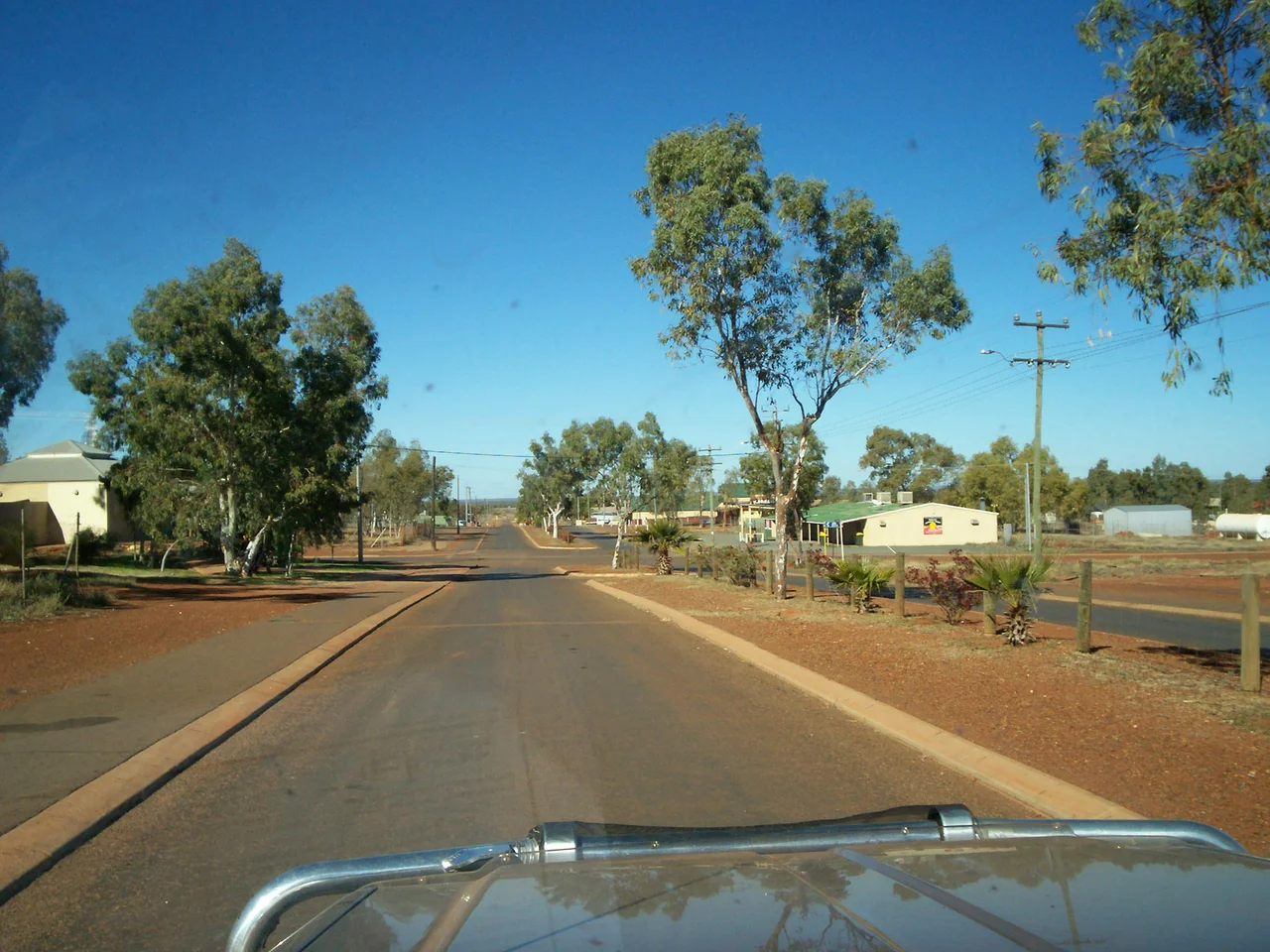

Wiluna, Western Australia
Two people walked out of the Gibson Desert in 1977, emaciated and near death, and the whole nation paid attention. Warri and Yatungka were among the last of the Mandildjara to live the old way, alone in their country long after everyone else had drifted to the settlements. Decades earlier they had fallen in love against tribal law and fled together rather than be parted. Now a drought was killing them, and a search party - organised by local Aboriginal elders and led by explorer Stan Gratte with tribal elder Mudjon - found the couple and brought them in to Wiluna. There, the people they had defied as the young lovers forgave them. Within four weeks of each other, in 1979, they died. Wiluna is the town at the end of that walk.
The Edge of the Desert
Wiluna sits where the settled world runs out. This is the gateway to the Western Desert, the southern trailhead of the Canning Stock Route and the western start of the Gunbarrel Highway - the place where the maps stop showing towns and start showing emptiness. The climate is uncompromising: 258 millimetres of rain in an average year, summer days that climb to 38 degrees. When the rare wet season does come, shallow lakes spread across the country and draw in life from everywhere - kangaroos, goannas the locals call bungarras, bustards, dingoes, and the feral camels and donkeys that now roam the inland. Then the water sinks away, and the red desert returns to its enormous quiet.
Martu Country
Long before any of this had a name on a map, this was Martu country - an outlying part of a homeland that stretched east into the Little Sandy and Gibson Deserts, crossed for generations along the routes that water and ceremony dictated. The dispossession came in layers, each one taking more: pastoral leases fenced the land, gold drew a flood of newcomers, and in the 1950s a church mission was established with government backing. Around the time of the British atomic tests near Maralinga, Aboriginal people from several different language groups were pushed together onto the mission site - peoples who had never been meant to live in one another's pockets. The frictions that forced crowding created have not fully healed. And yet the knowledge survived. The hunters, the bush mechanics, the craftspeople, the keepers of law - they carried their skills through all of it, and they carry them still.
Boom, Bust, and Back
Gold made the modern town and nearly unmade it. Lawrence Wells explored the area in 1892; gold was struck in 1896, and within months more than 300 prospectors had descended. By the 1930s, Wiluna roared with a population north of 9,000 - one of the great inland goldfields. Then World War II gutted the mining industry, the workforce scattered, and the decline was vertiginous: by 1963 fewer than 100 people remained. The town that had nearly become a ghost held on, and in 1981 the gold came back. Today the Wiluna Gold Mine works just south of town, lately squeezing metal from the tailings the old days left behind, while a fly-in fly-out workforce services a scatter of mines across the region.
Fire from the Sky
In October 1960, two station workers opening a gate on the track between Millbillillie and Jundee saw a fireball cross the sky with sparks streaming off it and fall into the spinifex to the north. The stones that came down became the Millbillillie meteorite - more than 330 kilograms of rare eucrite, fragments of the asteroid Vesta blasted off in some ancient collision in the belt between Mars and Jupiter. Curiously, no specimens were officially collected until 1970, though members of the local Aboriginal community had already gathered pieces of the sky-stone. It is a fitting Wiluna story: something extraordinary falling on country so remote that the rest of the world took a decade to notice.
What Endures
Modern Wiluna is small and stubborn. The Club Hotel, once a relic tangled up with the harm that alcohol brought the community, was reborn in 2019 as the shire's offices. There is a store, a pool, a school, a clinic, a caravan park. The Goldfields Highway link to Meekatharra is slowly being sealed, the roadwork done in partnership with a Martu training centre so the benefit stays local. Around the town, the desert holds the things that matter most - the sites, the routes, the stories. Major General Michael Jeffery, a future Governor-General of Australia, was born here in 1937; but the truest sons and daughters of this place are the people whose country it has always been.
From the Air
Wiluna lies at 26.59 degrees south, 120.22 degrees east, on the edge of the Western Desert in the Goldfields-Esperance region. It is served by Wiluna Airport (ICAO YWLU) right at the town; the nearest larger centre is Meekatharra (YMEK) to the west, with Leinster (YLST) to the southeast. From the air, the town is a compact grid in immense red country, with the gold mine and its tailings just to the south, the salt expanse of Lake Way beyond, and the unsealed and sealed strands of the Goldfields Highway and the Canning Stock Route radiating into desert. This is genuinely remote flying - minimal traffic, few diversion fields, and fuel and services to plan around carefully. Visibility is typically excellent, but watch for summer dust storms and the heavy, flood-bringing rain of the cyclone season. A viewing altitude of 4,000 to 7,000 feet AGL conveys just how isolated Wiluna is at the desert's edge.
Nearby Stories
- Wiluna Railway Line 23 km away
- Yeelirrie uranium project 42 km away
- Western Australia 58 km away
- Yarrabubba 79 km away
- Murchison River 87 km away
- Shoemaker Impact Structure 90 km away
- Leinster Nickel Mine 103 km away
- Gascoyne River 121 km away