
Modern History of Knossos
The man who first put a spade into Knossos was not Arthur Evans. His name was Minos Kalokairinos, and he was a Cretan merchant with a Greek name that turned out to be eerily appropriate. In 1878, with Crete still under Ottoman rule, Kalokairinos dug into a low hill called Kefala just south of Heraklion and pulled out enormous storage jars and tablets covered in an unreadable script. The Ottoman authorities ordered him to stop, jailed him briefly, and forbade further digging. Twenty-two years later, with Crete autonomous and Ottoman power finally lifted from the island, the wealthy English archaeologist Arthur Evans bought the hill outright. He had read about Kalokairinos's tablets in a German journal. He was looking for the source of an early script he had seen on seal stones in an Athens market. He found a labyrinth.
Waiting for the march of history
Evans began digging in March 1900 and within weeks knew he had something extraordinary. The walls came up faster than the workmen could clear them, frescoes still bright on plaster that had been buried for three thousand five hundred years, storerooms with their pithoi still in place, a throne carved from gypsum that he immediately attributed to a king. He named the civilization Minoan after the legendary King Minos, the figure Greek myth placed at Knossos as the keeper of the labyrinth and the Minotaur. The choice was deliberate. Evans believed myth preserved historical memory; he believed the palace he was uncovering had been the model for the labyrinth. The walls he was lifting back into the air had stood when the pyramids were already old.
Crete changes hands
The political ground beneath the dig kept shifting. Crete had been Ottoman since 1669, autonomous under a Christian high commissioner from 1898, and fully part of Greece from 1913. Each transition left bureaucratic residue Evans had to navigate. He poured his own fortune into the site, eventually rebuilding sections in painted concrete to stabilize what he had uncovered, a decision that scandalized later archaeologists. The reconstructions made Knossos walkable for tourists, gave the world its mental image of Minoan Crete, and froze in plaster a number of guesses that subsequent excavation has shown to be wrong. Even so, without those reconstructions much of what stood would have collapsed. Evans built Villa Ariadne on the hillside above the dig and ran Knossos as a private fiefdom, employing local Cretans, training young British archaeologists, and presiding over the site like the Priest-King he believed had once lived there.
Knossos in two world wars
When the First World War came, Evans was in his sixties and the site went quiet, with only caretakers and small probes by the British School at Athens. The Second World War was harder. After the Battle of Crete in May 1941, German forces occupied the island and Villa Ariadne briefly became a Wehrmacht headquarters. Then, after the Germans left in 1944, the villa became the headquarters of the British Area Command and a base for the United Nations Relief and Rehabilitation Administration. UNRRA workers who arrived to feed starving Cretans included Mercy Seiradaki, an archaeologist who had previously dug here with Evans's team. The German surrender on Crete was signed at Villa Ariadne in 1945, in a room that fifty years earlier had been Evans's library.
After Evans
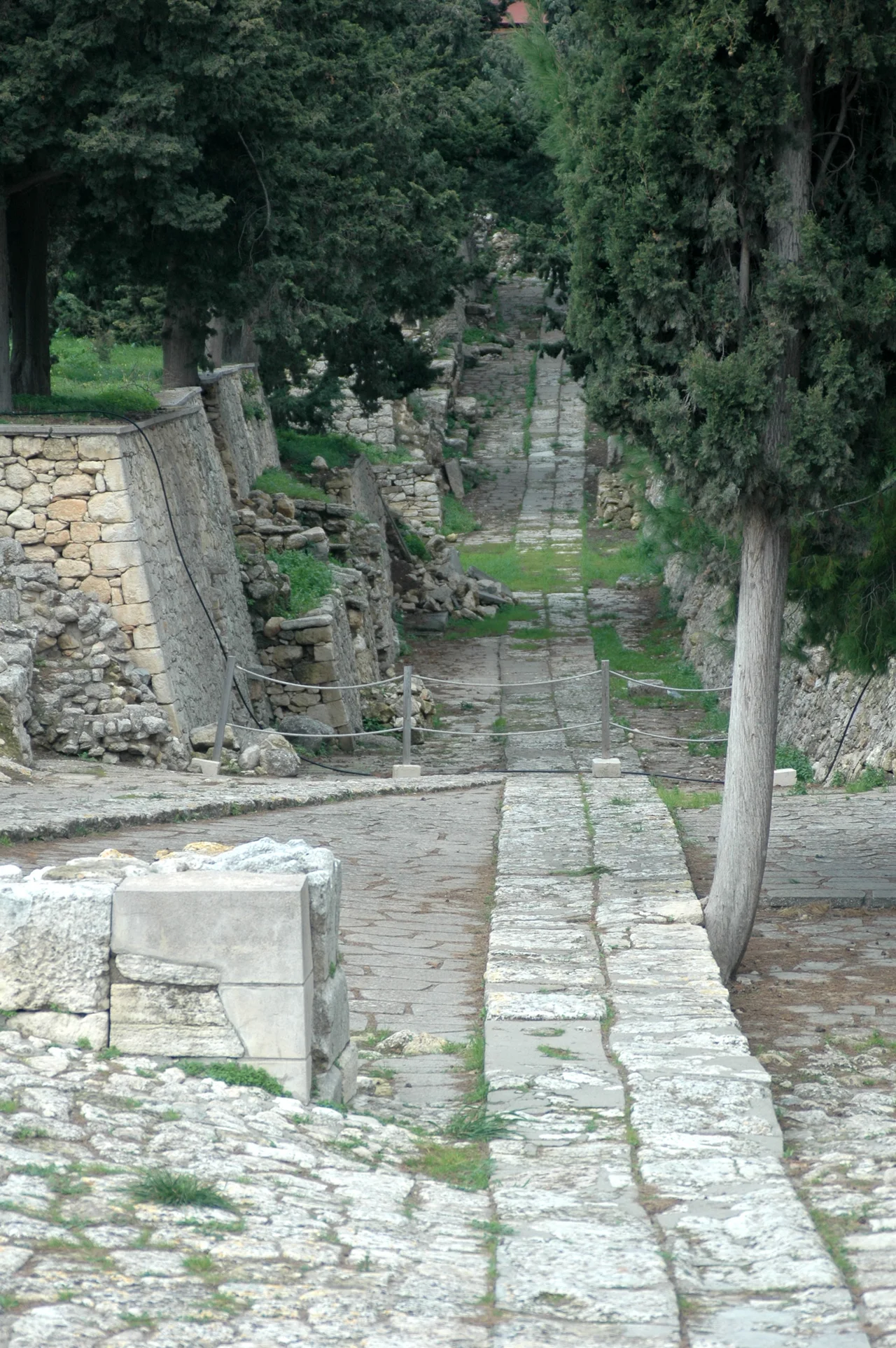
Evans died in 1941, before the war ended. Curatorship of Knossos passed first to John Pendlebury, who was killed by German paratroopers in the Battle of Crete; then to R.W. Hutchinson; then in 1947 to Piet de Jong, the Dutch artist who had drawn so many of the great frescoes; and finally in 1951 to the Greek Archaeological Service, which has run the site ever since. Heraklion grew, and modern apartments now press against the boundary fences of the dig. In 1966, Sinclair Hood built a new Stratigraphical Museum to hold the millions of potsherds that Evans's century of excavation had produced. Tourists arrive by the busload. Most photograph the painted concrete porticoes Evans rebuilt and assume they are touching Bronze Age stone. They are touching something more complicated: a 20th-century English imagination of a civilization that nobody fully understands, raised over the actual fragments of one of the oldest cities in Europe.
From the Air
35.298 N, 25.163 E. Knossos sits about 5 km south of Heraklion on the north-central coast of Crete, in a valley running south from the sea toward Mount Juktas. Heraklion International (LGIR) is 8 km north and offers easy approach. Best aerial view at 2,000-4,000 ft AGL, where the rectangular palace footprint and the modern reconstructions are clearly visible. Mount Juktas rises 8 km to the south-southwest and was sacred to the Minoans; from the air the palace's central court aligns toward it. Mediterranean conditions; meltemi winds in summer.
Nearby Stories
- Archaeological Museum of Agios Nikolaos 7.3 km away
- Battle of Rethymno 16 km away
- Archaeological Museum of Chania 52 km away
- Siege of Chania (1645) 101 km away
- 1956 Amorgos Earthquake 132 km away
- Battle of Derna (1805) 306 km away
- Siege of Derna 338 km away
- Battle of Sidi Barrani 376 km away