.JPG)
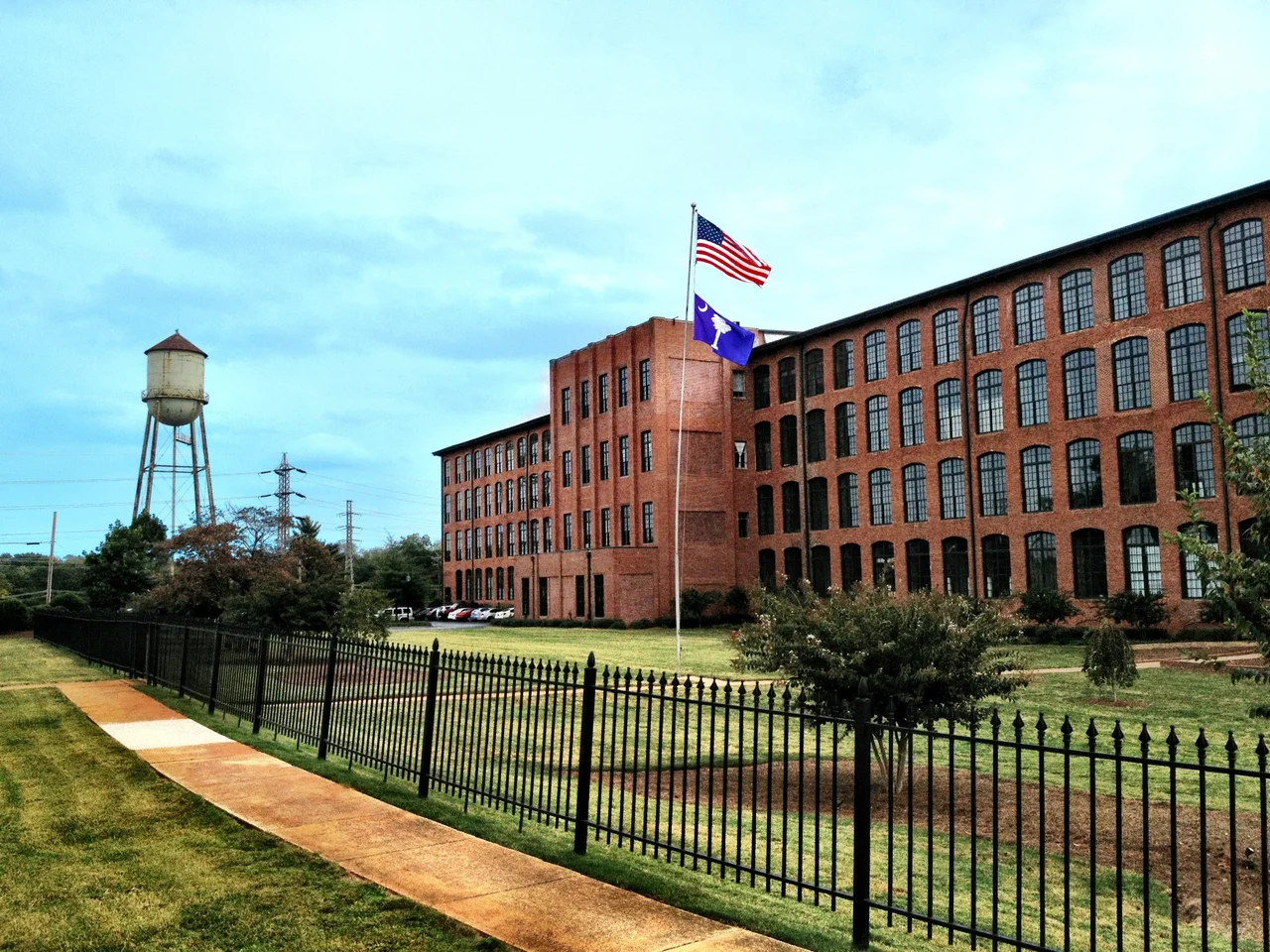
Monaghan Mill
When union organizers from the United Textile Workers of America arrived at the Monaghan Mill during the national strike of 1934, they found the gates locked. A troop of National Guardsmen was stationed at the entrance. The workers inside kept working. This was not, by the standards of the southern textile belt, an unusual response to organized labor. What was unusual at Monaghan was the paternalistic apparatus that had built the loyalty in the first place: a YMCA the company paid for, a hospital with one of the best doctors in the upstate, an elementary school, a Baptist-Methodist mill church, two kindergartens, an entire high school district carved out of the regular Greenville system because mill executives thought Greenville High was overcrowded and unwelcoming.
Two Cousins from Up the Road
Monaghan Mill was founded in February 1900 by Lewis Wardlaw Parker and his cousin Thomas Fleming Parker. Lewis was a lawyer from Abbeville who had graduated from the College of South Carolina and become president of the Bank of Greer. Thomas was a Charleston native whose family already held shares in upstate cotton mills. They named the new mill for County Monaghan in Ireland, the birthplace of their grandfather Thomas Fleming. Lockwood, Greene and Company of Rhode Island, the same New England engineering firm that designed mills across the textile belt, built it on 325 acres on the west side of Greenville near the Reedy River. The mill opened in 1902 with 35,000 spindles and $450,000 in capital. By 1907 it had 60,000 spindles and $700,000 in capital, and was producing print cloths, fancy dress goods, shirtings, and shade cloth for markets across the country.
The Belgians and the Boarding Houses
The surge in southern textile manufacturing at the turn of the twentieth century drew workers from unexpected places. Most came down from Appalachia, but Monaghan also employed about fifty Belgian immigrants, who lived together at one of the mill's boarding houses. They were skilled workers, brought over because the mill needed expertise in certain kinds of cloth that Belgian factories were known for. The mill village around Monaghan eventually housed several hundred families. Thomas Parker, as mill president, deliberately built the village as a model of industrial paternalism. He hired one of the area's best doctors to run a free medical clinic and added a nurse. He funded a playground, an elementary school, and a YMCA that cost $18,000 in 1904 dollars, the first YMCA located in any southern mill town. As director of the YMCA he hired a young man named Lawrence Peter 'Pete' Hollis, who would later become a nationally recognized educator and the first superintendent of the Parker School District.
Baseball, Church, and the Stretch-Out
By 1904 Monaghan had its own baseball team. In 1907 it joined the Greenville Cotton Mill Baseball League, where mill owners competed for the best players because winning teams built worker loyalty and gave operatives, the term mill owners used for their workforce, something disciplined to do with their free time. The mill village was largely self-sufficient: its own well, its own electricity, its own waste disposal, a company store, and a single church that Baptists and Methodists shared until each denomination could afford its own building. During the 1920s the mill expanded again under president Thomas Marchant, who continued the paternalistic management style. Then the Depression hit. Demand for textiles collapsed. By the early 1930s workers were getting only three days of work every two weeks. Mill management instituted what workers called the stretch-out, longer hours and more machines per worker for no additional pay. When the Roosevelt administration proposed a 40-hour week, Marchant traveled to Washington multiple times to argue against it, saying Monaghan would 'go plum broke on forty hours a week.' In 1934, when the national textile strike hit, the gates stayed locked and the National Guard kept the organizers out.
Lofts and the Swamp Rabbit
By the second half of the twentieth century, the global cotton industry had moved on. Cheaper foreign labor undercut American mills. The Monaghan mill village deteriorated as workers left. In 1983 the Greenville County Redevelopment Authority began renovations, eventually repairing 134 homes and repaving streets. The mill itself kept running until 2001, when textile production finally stopped. In October 2005 the building was added to the National Register of Historic Places as an industrial site, with a classification of Early Twentieth Century Revival architecture. The 17-acre property included the original smokestack, water tower, and pond. In October 2006 the mill reopened as the Lofts of Greenville, with 190 apartment units. The conversion preserved the open floor plans, exposed brick, pine beams, stained concrete floors, and arched factory windows. Hiking trails on the property connect to the Swamp Rabbit Trail, the 22-mile rails-to-trails greenway that runs from Travelers Rest down through Greenville to Conestee Park. Residents now bike or walk the same paths that mill workers once trudged home along, past the same pond, under the same smokestack, in a city that has decided its old factories are worth more standing than torn down.
From the Air
Located at 34.87 degrees North, 82.42 degrees West, on the west side of Greenville, South Carolina, near the Reedy River. The Monaghan Mill complex, now the Lofts of Greenville, is a long brick industrial building visible from the air with the original smokestack and water tower still standing. Nearest airports: Greenville Downtown (KGMU) about 3 nm east, Donaldson Center (KGYH) about 4 nm south, Greenville-Spartanburg International (KGSP) about 11 nm east-northeast. Best viewed at 1,500 to 3,000 feet AGL; the Swamp Rabbit Trail corridor running through the property is visible as a green linear feature from low altitude.
Nearby Stories
- Battle of Musgrove Mill 6.9 km away
- Carl Sandburg Home National Historic Site 13 km away
- Stumphouse Mountain Tunnel 17 km away
- Forest City, North Carolina 20 km away
- Chiquola Mill Massacre 20 km away
- Battle of Blackstock's Farm 26 km away
- Great Smoky Mountains National Park 65 km away
- Tree That Owns Itself 84 km away