
Monkey Mia
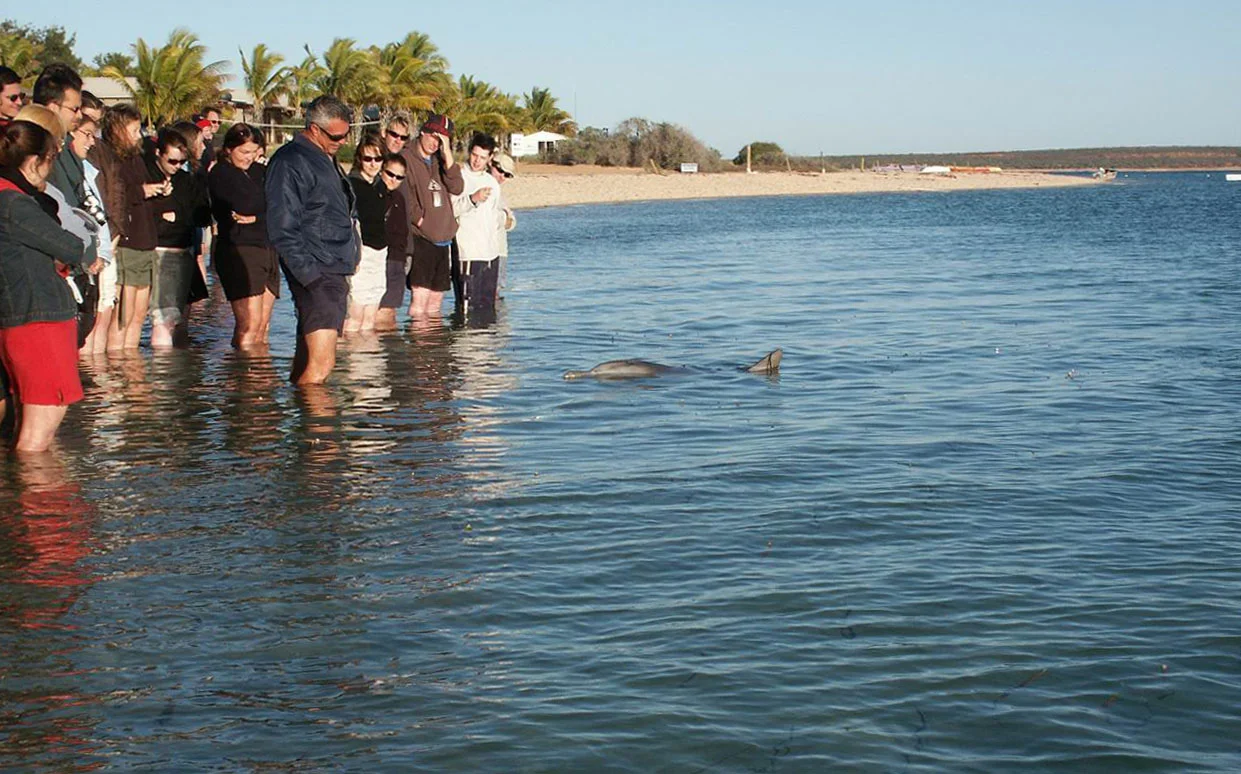
The water here is so shallow and so clear that the dolphins arrive as shadows first, dark shapes sliding through turquoise toward a line of human ankles. Then the dorsal fins break the surface, and the crowd on the Monkey Mia beach goes quiet. This is one of the few places on Earth where wild dolphins, owing nothing to anyone, choose to come ashore and look you in the eye. They have been doing it for more than half a century, on a beach 900 kilometres north of Perth where the red dirt of the Western Australian outback runs straight into the Indian Ocean.
A Name Nobody Can Quite Explain
The name is half-solved at best. "Mia" is straightforward enough: in the local Aboriginal language it means home, or shelter, which feels right for a place dolphins return to. "Monkey" is the puzzle. Western Australia's Geographic Names Committee has logged a tangle of competing stories. Perhaps a pearling boat called Monkey once anchored in the bay in the late nineteenth century. Perhaps a schooner of that name arrived as early as 1834. Perhaps it honours the pet monkeys kept by Malay pearl divers who camped along this shore. Or perhaps, less romantically, the word appeared on an 1899 list of local names supplied by the Geraldton police, where its meaning was given simply as "salt or bad water." The beach keeps its secret, and the dolphins are no help.
How the Dolphins Came to Stay
The area was gazetted in 1890 as a working base for the pearling and fishing trades, and dolphins drifted close to the boats here as early as the 1940s, drawn by the chance of a thrown fish. The story tightened in the 1960s, when a local fisherman and his wife began handing scraps to bottlenose dolphins as they came in with the day's catch. Word travelled. People started arriving to see the animals that swam to shore. An information centre went up in 1985, a state grant built roads and car parks in 1988, and in November 1990 the surrounding waters were declared a marine park. What began as a habit between one couple and a few wild animals had become a global pilgrimage.
Five Dolphins, Carefully Counted
Up to 100,000 visitors a year now come for those few minutes in the shallows, and managing that adoration is a science of its own. Rangers from the Department of Biodiversity, Conservation and Attractions feed a small number of adult female dolphins — up to five under the programme's rules, though in practice only two currently come regularly — and never more than a tenth of the food those animals need in a day. The restraint is deliberate. The dolphins must stay wild enough to hunt, to raise their calves, to live as dolphins rather than as pets queuing for handouts. The rules are strict precisely because the relationship is fragile. A free animal that comes to you on its own terms can also, at any moment, simply choose to leave.
A Laboratory in Knee-Deep Water
These are Indo-Pacific bottlenose dolphins, and Shark Bay is where the world learned how clever they truly are. In 1982, researchers Richard Connor and Rachel Smolker arrived to study the famous beach animals, and the project soon spread to hundreds of dolphins across the bay. Since 1984 an international team has tracked them, and what they found rewrote the science. Roughly one in twenty Shark Bay dolphins forages by wearing a sea sponge over its beak like a glove, protecting it while probing the seafloor for hidden fish. Mothers teach the trick to their daughters and almost no one else. It is one of the first documented cases of a tool-using culture in any animal besides ourselves, passed down generation to generation in the warm shallows off this single beach.
From the Air
Monkey Mia sits at 25.79 degrees south, 113.72 degrees east, on the Peron Peninsula inside the Shark Bay World Heritage Area. From the air the bay reads as a vast palette of blues and greens, with pale seagrass meadows and the white ribbon of the Monkey Mia beach marking the dolphins' arrival point. Shark Bay (Monkey Mia) Airport, ICAO YSHK, lies just south near Denham with a single runway. Carnarvon Airport (YCAR) is the nearest larger field, roughly 130 km north. The region is arid and skies are typically clear; a sun-and-shade approach mid-morning shows off the seagrass banks and the dark deep-water channels that thread between them. Recommended viewing altitude 2,000 to 5,000 feet for the coastline and bay colours.
Nearby Stories
- L'Haridon Bight 9.2 km away
- Edel Land National Park 16 km away
- Dirk Hartog Island 16 km away
- Hartog Plate 23 km away
- Woodleigh Impact Structure 41 km away
- Carnarvon Tracking Station 65 km away
- Pimbee National Park 67 km away
- Gascoyne Junction 107 km away