.jpg)
Monte Verde
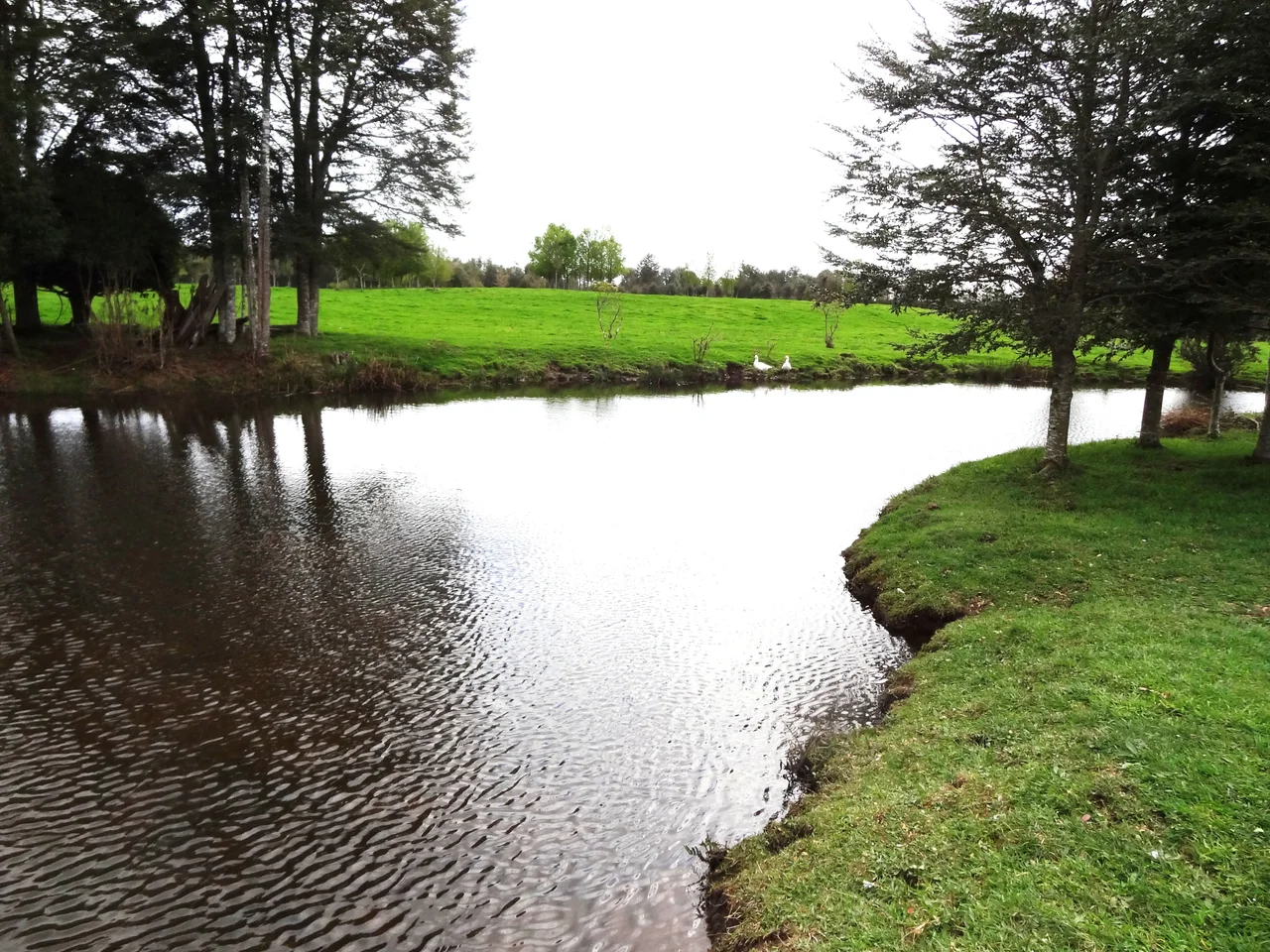
It began with a bone that didn't make sense. In late 1975, near a creek in southern Chile where logging had torn open the soil, farmers turned up a strange object they took for an old cow bone. It wasn't. It belonged to a mastodon, and it had been lying in the peat of Chinchihuapi Creek for some fourteen thousand years. When anthropologist Tom Dillehay began excavating the spot a couple of years later, he uncovered something that would unravel a theory textbooks had treated as settled fact: the campsite of people who lived at the bottom of the world more than a thousand years before anyone thought humans had arrived in the Americas at all.
What the Bog Kept
Monte Verde survived because it drowned. Soon after the site was abandoned, the creek rose and a peat bog sealed it in an airless, waterlogged tomb where bacteria could not do their slow work of erasure. So the things that almost never last, lasted. Wooden posts from roughly a dozen hut frames. Scraps of hide that may have covered them. Knotted cordage. Stone tools, edible plants, and chewed wads of seaweed. There is even a footprint pressed into the clay, small enough that archaeologists believe a child left it. From the hearths and dwellings, researchers estimate that twenty to thirty people lived here together—a community, with shelter and fire and the ordinary debris of daily life.
A Thousand Years Too Early
The dates were the bombshell. Radiocarbon analysis placed Monte Verde II at roughly 14,500 calibrated years ago—well over a millennium older than Clovis, New Mexico, long held up as the earliest human presence in the New World. For most of the twentieth century, the consensus held that the first Americans walked down through an ice-free corridor in central Canada only after the glaciers retreated, around 13,000 years ago. But Monte Verde sits eight thousand miles south of the Bering Strait. People could not have reached it on foot through that corridor in time, because before the ice melted, the corridor was a lifeless waste that could feed no traveler. The math simply did not work.
The People of the Coast
What Monte Verde pointed to instead was the sea. Among the finds were nine species of seaweed and marine algae, hauled from coastlines and bays up to ninety kilometers away and directly dated to between roughly 14,200 and 14,000 years ago. Some were food; others are still used as medicine in Chilean folk practice today, which hints that these people knew the ocean intimately. The picture that emerged was not of big-game hunters chasing herds across tundra, but of maritime people—gatherers and fishers who knew the shore, who could travel by boat or along the beach and live off what the water gave. The first Americans, it seemed, may have come down the coast.
Convincing the Doubters
Science does not change its mind easily, nor should it. Many archaeologists resisted, and the early dates were not widely accepted until 1997, when a panel of respected specialists traveled to the site, examined the evidence, and concluded that Monte Verde was genuine and predated Clovis. The discovery did not disprove that people crossed from Asia; it reshaped the route and the timeline, lending weight to the coastal-migration hypothesis now favored by most researchers. A still-deeper, far more contested layer hints at an even earlier presence, but Dillehay himself has urged caution there. What is no longer in serious doubt is the central claim: people made a home beside this creek roughly fourteen and a half millennia ago, and in doing so they pushed the human story of an entire hemisphere back into deeper time.
From the Air
Monte Verde lies in the Llanquihue Province of southern Chile, at approximately 41.50°S, 73.20°W, on the banks of Chinchihuapi Creek—a tributary of the Maullín River about 36 miles inland from the Pacific—near the city of Puerto Montt. The site itself is a quiet, low-lying creek-side bog rather than a dramatic landmark; from the air, look for the green, water-laced lowlands northwest of Puerto Montt, framed by the Andes to the east. The nearest major airport is Aeropuerto El Tepual (SCTE) at Puerto Montt, only about 10–15 nm away. Skies here are often cloudy and rain-soaked; clear viewing is best in the southern summer. Recommended viewing altitude is 2,000–4,000 feet over the lowland creek valleys.
Nearby Stories
- Ancud 3.6 km away
- Frutillar 29 km away
- Battle of Agüi 29 km away
- Vicente Pérez Rosales National Park 31 km away
- Sinking of Janequeo and Leucotón 46 km away
- Cochamó Valley 56 km away
- Battle of Mocopulli 65 km away
- Pumalín Douglas Tompkins National Park 86 km away